

Government-judiciary rift deepens as senior lawmaker asks National Assembly to summon top judge

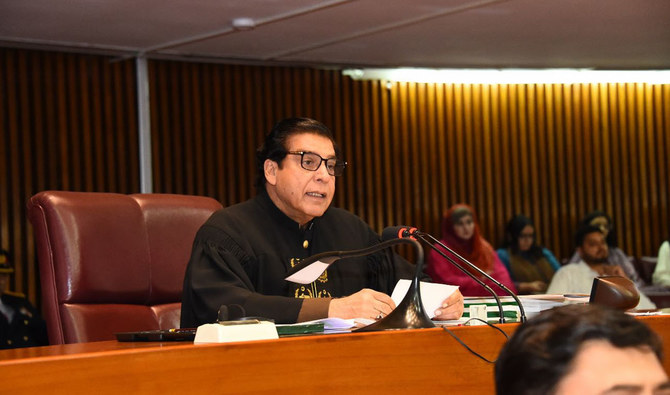
The file photo taken on April 27, 2023, shows the National Assembly Speaker Raja Pervez Ashraf gesturing during a session of the Parliament in Islamabad, Pakistan. (Photo courtesy: @NAofPakistan/Twitter)
Short Url
Updated 04 May 2023
Follow

Government-judiciary rift deepens as senior lawmaker asks National Assembly to summon top judge

  • Former PM Abbasi says the Supreme Court chief justice should be asked why he demanded record of parliamentary proceedings
  • NA Speaker Raja Pervez Ashraf calls the development ‘serious issue,’ promises not to compromise on parliamentary supremacy

ISLAMABAD: National Assembly Speaker Raja Pervez Ashraf ruled out the possibility of compromising on parliamentary supremacy on Wednesday after a senior lawmaker urged him to summon the country’s chief justice and ask him why he wanted record of the house proceedings related to a new law limiting his powers.

The uproar in the National Assembly began on Tuesday after an eight-member apex court bench instructed the attorney general to share the parliamentary proceedings while hearing petitions challenging the Supreme Court (Practice & Procedure) Bill, 2023.

The law limits the power of the chief justice of Pakistan, depriving him of the authority to solely initiate public interest litigation on his own through suo moto proceedings. It also dilutes his administrative power to constitute benches and determine their composition and involves more judges in the process.

Speaking on the floor of the house, former prime minister Shahid Khaqan Abbasi, who belongs to the ruling Pakistan Muslim League-Nawaz (PML-N) party, asked the National Assembly speaker to form a committee to debate the matter.

“This is not a small matter since it relates to the supremacy and sovereignty of the house,” he said while issuing a brief statement.

“The chief justice should be asked to come here and tell why he has asked for the record,” he added.

The speaker said he was aware of the sentiments of members of parliament while asking them to bring a resolution for the consideration of the house.

“It is a very serious issue,” he agreed. “There can be no compromise on the supremacy and sovereignty of this house. I can assure you of that as the custodian of the house.”

Tensions have been mounting between the government and the top court since the superior judiciary took up a case of election delay in Punjab and Khyber Pakhtunkhwa following the dissolution of the provincial legislatures by former prime minister Imran Khan and his allies in January.

The top court instructed the country’s election commission to hold the Punjab polls on May 14 and ordered the central bank to release the required funds for the purpose.

However, the government maintained the Supreme Court had gone beyond its constitutional mandate by issuing the rulings which challenged the principles of parliamentary supremacy and separation of powers.

Pakistan’s defense minister Khawaja Asif also spoke during the National Assembly debate on Wednesday, saying it was unfortunate that two constitutional institutions had come face to face with each other.

“We are not against the court but we are against this territorial trespassing,” he said.

Asif maintained whenever the constitution had been violated by military rulers, their actions were endorsed by the courts.

He added it was time Pakistan’s parliament held judges, “who aided and abetted constitutional violations,” accountable.


ADB, Pakistan sign over $300 million agreements to undertake climate resilience initiatives

Updated 11 sec ago
Follow

ADB, Pakistan sign over $300 million agreements to undertake climate resilience initiatives

  • Pakistan ranks among nations most vulnerable to climate change and has seen erratic changes in weather patterns
  • The projects in Sindh and Punjab will restore nature-based coastal defenses and enhance agricultural productivity

ISLAMABAD: The Pakistani government and the Asian Development Bank (ADB) have signed more than $300 million agreements to undertake two major climate resilience initiatives, Pakistan’s Press Information Department (PID) said on Tuesday.

The projects include the Sindh Coastal Resilience Sector Project (SCRP), valued at Rs50.5 billion ($180.5 million), and the Punjab Climate-Resilient and Low-Carbon Agriculture Mechanization Project (PCRLCAMP), totaling Rs34.7 billion ($124 million).

Pakistan ranks among nations most vulnerable to climate change and has seen erratic changes in its weather patterns. In 2022, monsoon floods killed over 1,700 people, displaced another 33 million and caused over $30 billion losses, while another 1,037 people were killed in floods this year.

The South Asian country is ramping up climate resilience efforts, with support from the ADB and World Bank, and investing in climate-resilient infrastructure, particularly in vulnerable areas.

“Both sides expressed their commitment to effectively utilize the financing for successful and timely completion of the two initiatives,” the PID said in a statement.

The Sindh Coastal Resilience Project (SCRP) will promote integrated water resources and flood risk management, restore nature-based coastal defenses, and strengthen institutional and community capacity for strategic action planning, directly benefiting over 3.8 million people in Thatta, Sujawal, and Badin districts, according to ADB.

The Punjab project will enhance agricultural productivity and climate resilience across 30 districts, improving small farmers’ access to climate-smart machinery, introducing circular agriculture practices to reduce residue burning, establishing testing and training facilities, and empowering 15,000 women through skills development and livelihood diversification.

Earlier this month, the ADB also approved $381 million in financing for Pakistan’s Punjab province to modernize agriculture and strengthen education and health services, including concessional loans and grants for farm mechanization, Science, Technology, Engineering and Mathematics (STEM) education, and nursing sector reforms.