

Pakistan moves up seven places in World Press Freedom Index

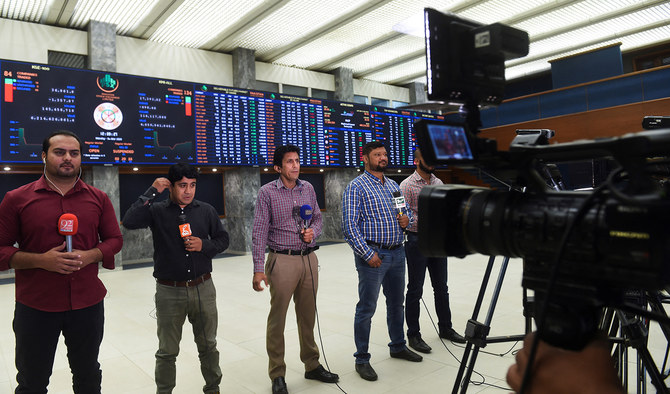
Journalists report from the trading floor at the Pakistan Stock Exchange (PSX) in Karachi on March 9, 2020. (AFP/File)
Short Url
Updated 03 May 2023
Follow

Pakistan moves up seven places in World Press Freedom Index

  • Pakistan now ranks 150 out of 180 countries, with a score of 39.95 as compared to 37.99 last year
  • Freedom Network said last week violations rose by 60% in Pakistan from May 2022 to March 2023

ISLAMABAD/KARACHI: Pakistan has improved its ranking by seven places in the latest World Press Freedom Index after “changes of government loosened constraints on the media,” international media watchdog Reporters Without Borders (RSF) said in its annual report, released on Wednesday to coincide with World Press Freedom Day.

Pakistan is counted among the world’s most dangerous countries for journalists. Last year, the RSF said 93 journalists had been killed over the past 20 years in the South Asian nation where incidents of arrests, media censorship, online abuse, and physical attacks against journalists are common.

The latest RSF index, however, said Pakistan now ranks 150 out of 180 countries, with a score of 39.95 as compared to 37.99 last year.

The report evaluates each country or territory’s score using five contextual indicators, political context, legal framework, economic context, sociocultural context, and safety.

“Changes of government loosened constraints on the media in Pakistan (150th) and the Philippines (132nd), even if these two countries continue to be among the world’s most dangerous countries for journalists,” the RSF said in its 2023 analysis. 

“Despite changes in political power, a recurring theme is apparent: political parties in opposition support press freedom but are first to restrict it when in power," RSF added, saying Pakistan’s media regulators were directly controlled by the government and put the defence of the executive government before the public’s right to information. 

"As the military has tightened its grip on civilian institutions, coverage of military and intelligence agency interference in politics has become off limits for journalists,” RSF said.

The Pakistan military denies it suppresses the press. 

Media watchdog Freedom Network said in its annual ‘Pakistan Press Freedom Report’ released last week that violations rose by over 60% in Pakistan from May 2022 to March 2023.


Pakistan to sell excess gas in international markets from Jan.1— petroleum minister

Updated 24 min 6 sec ago
Follow

Pakistan to sell excess gas in international markets from Jan.1— petroleum minister

  • Pakistan was reportedly exploring ways to reduce $378 million in annual losses from supply glut caused by excess fuel imports 
  • Move to sell excess LNG in international markets will limit $3.56 billion losses caused since 2018-19, says petroleum minister

ISLAMABAD: Pakistan will sell its excess liquefied natural gas (LNG) in international markets from Jan. 1, Petroleum Minister Ali Pervaiz Malik said, revealing the move would limit losses caused from a years-long supply glut. 

Local and international media outlets had reported in July that Pakistan was exploring ways to sell excess LNG cargoes amid a gas supply glut that government officials said was costing domestic producers $378 million in annual losses. News reports had said Pakistan had at least three LNG cargoes in excess that it imported from Qatar and has no immediate use for.

Speaking to reporters during a press conference on Sunday, Malik said there was an excess of imported gas in Pakistan as the use of this fuel for power generation had reduced in the country during the past few months. He said Islamabad had been forced to sell the gas to local consumers, due to which the circular debt in the gas sector from 2018 till now had ballooned to around Rs1,000 billion [$3.56 billion]. 

“From Jan. 1 we will sell this excess fuel in international markets to reduce our burden and limit our losses of this Rs1,000 billion [$3.56 billion],” Malik said. 

He said this move would also allow Pakistan’s state-owned enterprises in the sector to operate on their full capacity and generate profits and employment. 

Malik also spoke of foreign oil companies that were ready to invest millions in the country in the near future. 

The minister cited the recent visit of Turkish energy minister to Pakistan which had resulted in the state-owned Turkish Petroleum signing deals to carry out onshore and offshore drilling activities in Pakistan. 

“Turkish Petroleum will also open its office in Islamabad, where 10 to 15 Turkish nationals will be working,” Malik said. 

He also said that a delegation of the State Oil Company of Azerbaijan Republic (SOCAR) visit Pakistan this week, adding that it was also expected to collaborate with local companies for oil and gas exploration.

The minister said SOCAR was also opening its office in Pakistan. 

“It will also invest millions of dollars in the construction of an oil pipeline from Machike to Thalian in collaboration with the PSO (Pakistan State Oil) and FWO (Frontier Works Organization),” Malik said.