

Zelensky denies attacking Moscow, vows to start counteroffensive

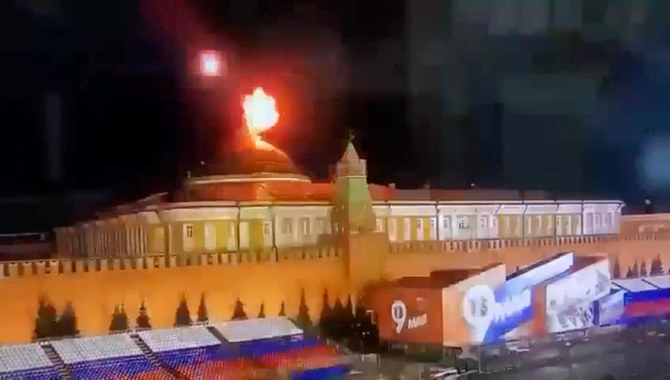
A still image taken from video shows a flying object exploding in an intense burst of light near the dome of the Kremlin Senate building during the alleged Ukrainian drone attack in Moscow in this image taken from video obtained by Reuters on May 3, 2023. (Reuters)
Short Url
Updated 04 May 2023
Follow

Zelensky denies attacking Moscow, vows to start counteroffensive

  • Russia accused Ukraine on Wednesday of attacking the Kremlin with drones overnight
  • Ukraine’s president on surprise visit to Finland

HELSINKI/KYIV Ukrainian President Volodymyr Zelensky rejected on Wednesday Moscow’s claim that Kyiv had attempted to attack the Kremlin and said his country would soon start a counteroffensive on its own soil against Russian forces.

Russia earlier on Wednesday accused Ukraine of a failed attempt to assassinate President Vladimir Putin in a drone attack on the Kremlin citadel in central Moscow, and threatened to retaliate.
Speaking at a press conference in Finland, NATO’s newest member, Zelensky said his concern was to defend Ukraine’s own cities and villages against the Russian invasion launched almost 15 months ago.
“We don’t attack Putin, or Moscow, we fight on our territory,” Zelensky said.
Asked why it was in Russia’s interests to accuse Ukraine of trying to assassinate Putin, Zelensky said: “It’s very simple. Russia has no victories. He (Putin) can no longer motivate his society, and he can’t just send his troops to their death anymore... now he needs to somehow motivate his people to go forward.”
The Ukrainian president also said he was sure the West would supply Kyiv with modern war planes if his country was successful on the battlefield, citing prior examples that had led to Ukraine being granted new types of military aid.
“This is why I am sure we will soon have aircraft. Because we will soon conduct an offensive, and after it I am sure we will be given planes. I would rather it was the other way round, as it would be easier for us, but it is like it is, and we are grateful for everything,” Zelensky said.
“We need them. Really need them,” he said.
Finnish President Sauli Niinisto said Finland could not donate its US-made Hornets fighters because they were old and few other countries in Europe had similar models, so it would not make sense to build up a service chain.


Danish PM Mette Frederiksen, Ukrainian President Volodymyr Zelenskiy and Finnish President Sauli Niinisto meet the press during the Nordic-Ukrainian Summit in Helsinki, Finland, on May 3, 2023. (Mads Claus Rasmussen via REUTERS)

Case for NATO membership
The Ukrainian president’s visit to Finland, one of only a few journeys he has made abroad since the Russian invasion, was announced only after his arrival amid tight security in the Finnish capital.
He reiterated his case for Ukraine to join NATO, the Western military alliance of which Finland last month became the 31st member in direct response to Russia’s invasion.
“We need security guarantees today, while we are not in NATO,” Zelensky said.
“But in any case, our goal is to have full membership in the alliance. This is one of the reasons why I am here today. The second reason, or to be honest the priority, is strengthening our army.”
Zelensky held bilateral talks with Niinisto as well as a regional summit that included the prime ministers of Sweden, Norway, Denmark and Iceland, all of which said they supported Ukraine’s ultimate goal of becoming a member of the EU and NATO.
Hundreds of people gathered in central Helsinki to see Zelensky arrive, cheering as he appeared in front of the presidential palace.

Zelensky said Russia did not appear to be interested in extending the Black Sea grain deal that has allowed vital food exports, but that Kyiv was focused on looking for partners to continue the deal due to expire on May 18.
Asked about the grain deal and whether the alleged attack on the Kremlin would affect negotiations, he said: “I don’t see interest from Russia to continue the grain initiative, but this happens every time. But we are not looking for interest from Russia. We are looking for the fulfilment of the agreements with our partners.”


Bangladesh votes in world’s first Gen Z-inspired election

Updated 51 min 24 sec ago
Follow

Bangladesh votes in world’s first Gen Z-inspired election

  • Ousted PM Hasina’s Awami League party banned
  • BNP, Jamaat in close race with big economic, geopolitical stakes

DHAKA: For years under former Prime Minister Sheikh Hasina, Bangladesh’s opposition had little presence on the streets during elections, either boycotting polls or being sidelined by mass arrests of senior leaders. ​Now, ahead of Thursday’s vote, the roles have reversed.
Hasina’s Awami League is banned, but many young people who helped oust her government in a 2024 uprising say the upcoming vote will be the Muslim-majority nation’s first competitive election since 2009, when she began a 15-year-rule.
The Bangladesh Nationalist Party (BNP) is widely expected to win, although a coalition led by the Islamist Jamaat-e-Islami is putting up a strong challenge. A new party driven by Gen-Z activists under the age of 30 has aligned with Jamaat after failing to translate its anti-Hasina street mobilization into an electoral base.
BNP chief Tarique Rahman told Reuters his party, which is contesting 292 of the 300 parliamentary seats at stake, was confident of winning “enough to form a government.”

Bangladesh Nationalist Party (BNP) chairman Tarique Rahman speaks during an election campaign rally, ahead of the national election at Pallabi, in Dhaka, Bangladesh, on February 8, 2026. (Reuters)

Analysts say a decisive result in the February 12 vote, instead of a fractured outcome, is vital for restoring ‌stability in the nation of ‌175 million after Hasina’s ouster triggered months of unrest and disrupted major industries, including ‌the garments ⁠sector ​in the ‌world’s second-largest exporter.
The verdict will also affect the roles of rival regional heavyweights China and India in the South Asian nation.
“Opinion polls suggest the BNP has an edge, but we must remember that a significant portion of voters are still undecided,” said Parvez Karim Abbasi, executive director at Dhaka’s Center for Governance Studies.
“Several factors will shape the outcome, including how Generation Z — which makes up about a quarter of the electorate — votes, as their choices will carry considerable weight.”
Across Bangladesh, black-and-white posters and banners bearing the BNP’s “sheaf of paddy” symbol and Jamaat’s “scales” hang from poles and trees and are pasted on roadside walls, alongside those of several independent candidates. Party shacks on street corners, draped in their emblems, blare campaign songs.
It marks a sharp ⁠contrast with past elections, when the Awami League’s “boat” symbol dominated the landscape.
Opinion polls expect the once-banned Jamaat, which had opposed Bangladesh’s India-backed 1971 independence from Pakistan, to have its best electoral ‌performance even if it does not win.

China’s influence increases as India’s wanes
The election verdict ‍will also influence the roles of China and India in Bangladesh ‍in coming years, analysts have said. Beijing has increased its standing in Bangladesh since Hasina was seen as pro-India and fled to ‍New Delhi after her ouster, where she remains.
While New Delhi’s influence is on the wane, the BNP is seen by some analysts as being relatively more in tune with India than the Jamaat.
A Jamaat-led government might tilt closer to Pakistan, a fellow Muslim-majority nation and a long-standing rival of Hindu-majority India, analysts say. Also, Jamaat’s Gen-Z ally has said “New Delhi’s hegemony” in Bangladesh is one of its main concerns and its leaders met Chinese diplomats recently.
Jamaat, which calls ​for a society governed by Islamic principles, has said the party is not inclined toward any country.
BNP’s Rahman has said if his party formed the government it would have friendly relations with any nation that “offers what is suitable for ⁠my people and my country.”
Bangladesh, one of the world’s most densely populated countries with high rates of extreme poverty, has been hit by high inflation, weakening reserves and slowing investment, which has pushed it to seek large-scale external financing since 2022, including billions of dollars from the International Monetary Fund and the World Bank.

Bangladesh Nationalist Party (BNP) chairman Tarique Rahman attends an election campaign rally, ahead of the national election at Pallabi, in Dhaka 

Corruption is the biggest concern among the 128 million voters, followed by inflation, according to a survey by Dhaka-based think tanks Communication & Research Foundation and Bangladesh Election and Public Opinion Studies.
Analysts say Jamaat’s clean image is a factor in its favor, much more than its Islamic leanings.
“Voters report high intention to participate, prioritize corruption and economic concerns over religious or symbolic issues, and express clear expectations for leaders who demonstrate care, competence and accountability,” said the survey.
Nevertheless, BNP’s Rahman, son of former Prime Minister Khaleda Zia, is seen as the frontrunner to lead the next government. But if the Jamaat-led coalition emerges ahead, its chair, Shafiqur Rahman, could be in line for the top job.
Mohammad Rakib, 21, who is set to vote for the first time, said he hoped the next government would allow people to express their views and exercise their franchise freely.
“Everyone ‌was tired of (Hasina’s) Awami League. People couldn’t even vote during national elections. People had no voice,” he said. “I hope the next government, whoever comes into power, will ensure this freedom of expression.”