More Jeddah arrivals from Sudan after evacuation by sea

1 / 3
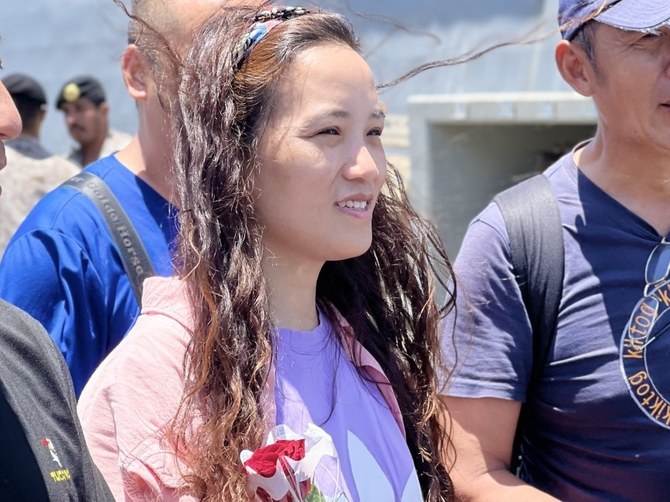
The 22 evacuated came from several different countries. (AN Photo/Nawaf Al-Mutairi)
2 / 3
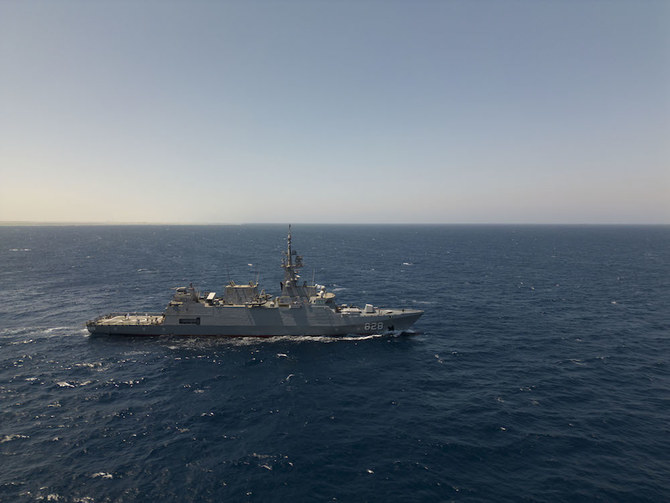
Drone shots of Saudi Arabia’s HMS Al-Jubail en route to the King Faisal Naval Base in Jeddah from Port Sudan. (AN Photo/Nawaf Al-Mutairi)
3 / 3
Drone shots of Saudi Arabia’s HMS Al-Jubail en route to the King Faisal Naval Base in Jeddah from Port Sudan. (AN Photo/Nawaf Al-Mutairi)
Short Url
Updated 04 May 2023
Follow

More Jeddah arrivals from Sudan after evacuation by sea

  • 22 people of differing nationalities arrived safely in the Kingdom

JEDDAH: Saudi Arabia’s HMS Al-Jubail arrived at the King Faisal Naval Base in Jeddah from Port Sudan on Wednesday with the latest contingent of people seeking refuge from the Sudanese unrest.

A group of 22 people of different nationalities arrived safely in the Kingdom, according to the Ministry of Defense.


Those onboard included members of the media, including Arab News.

Brig. Gen. Turki Al-Maliki, spokesman for the ministry, said that those seeking refuge included seven Saudi citizens, eight Chinese, six Sudanese and a Kuwaiti.

He said: “There are no distinctions between nationalities. We serve everyone who meets the requirements.”

Al-Maliki added that there were more priority cases to be evacuated, including women, children and the elderly.

Opinion

This section contains relevant reference points, placed in (Opinion field)

“This is a humanitarian case, and the evacuation requests come from other embassies in Sudan to the Saudi embassy in Khartoum. These embassies receive the names, information and documents. Then they forward them to our embassy in the Sudanese capital.”

The vessel set sail at about 1:00 p.m. with some 33 Saudi and international media representatives on board, along with the crew of the ship under the pennant number 828, captained by Brig. Gen. Abdullah Al-Zahrani.

The ship arrived at Port Sudan and docked a few miles away from the port. The passengers traveled on a Sudanese tug to the wharf where the 22 people were waiting for the ship to take them to safety.

Following media representatives’ request, and after coordinating with the Sudanese side, the correspondents were allowed to go ashore to interview the evacuees, who were lining up to get their documents checked by the Saudi authorities on the dockside.


After arrival in Jeddah, Luan Jianhua, a Chinese evacuee who works in an air-conditioning factory, told Arab News that people felt they were in danger in Sudan, but not when their evacuation request was approved by Saudi officials in Sudan.

“In Sudan, we felt the situation was a bit dangerous, but after the embassy transported us to Port Sudan we are happy now that we are safe and secure. We really appreciate all the efforts and services that Saudi Arabia provided us with,” Jianhua said.

At Port Sudan, Osama Siddiq, a fourth-year medical student, told Arab News that the evacuees had struggled with the sounds of rockets and gunfire on a daily basis.

“We were unable to sleep. We even did not know whether we would live for another day, but when we heard about the Saudi evacuation operations, we decided to go to Port Sudan to get evacuated. It took us nearly 12 hours by bus from Khartoum to reach Port Sudan,” he said.

He registered his name at the Saudi embassy and his evacuation request was promptly approved.

“I am full of hope to soon see my family members, who are living in Saudi Arabia, and I would like to thank the Saudi government and Prince Mohammed bin Salman,” he said.

Bayan Khairi, a sophomore nursing student at National University, had, for two weeks, failed to get out of Khartoum to join her family who are living in Saudi Arabia.


“The war started on April 15, and we could not leave Khartoum because of the war and the things that were happening. I stayed in the capital city 14 days before my brother arranged my evacuation with the Saudi embassy, who were very helpful and they responded very quickly,” she said.

Describing her parents’ feelings while she was in danger, Khairi said that her mother cried every day, and her father called her daily.

“I am so happy now that Saudi Arabia helped us so much, and I am grateful for their efforts in evacuating me. I truly can’t believe I came out of Khartoum safely,” she said.

Accompanying the media team to Sudan, Faiz Al-Maliki, a Saudi social influencer, told Arab News that he was at the evacuation of large numbers of Arabs and foreigners from Sudan to Saudi Arabia.


“I would like to extend my thanks and appreciation to King Salman and Crown Prince Mohammed bin Salman for their follow-up and keenness on these people’s comfort and high-quality services, entirely provided by Saudi hands,” he said.

“May Allah bless King Salman and his crown prince. Thank you also to those who participated with us today, to our Royal Saudi Naval Forces, and to all our security people, in general.”

The HMS Al-Jubail was built by the Spanish state-owned shipbuilding company, Navantia. The Avante 2200 war vessel joined the Saudi naval forces in August 2022.

According to the Ministry of Defense, the vessel is the first ship of the Al-Sarawat Project, which includes the manufacturing and building of five corvette Avante 2200 — the latest of their kind in the world. The 85.8-meter-long ship is capable of confronting all threats, whether from the air, surface or subsurface levels.


Healthcare must be ‘proactive’ says Hevolution exec

Updated 4 sec ago
Follow

Healthcare must be ‘proactive’ says Hevolution exec

  • Princess Dr. Haya bint Khaled bin Bandar Al-Saud spoke to Arab News at a presentation of its second Global Healthspan Report

RIYADH: Healthcare needs to shift to a global model that targets preventing disease rather than treating it, a senior executive from the Saudi-funded Hevolution Foundation told Arab News.

The senior vice president of research of Hevolution, Princess Dr. Haya bint Khaled bin Bandar Al-Saud, spoke to Arab News at a presentation of its second Global Healthspan Report at the nonprofit’s headquarters in Riyadh’s KAFD on Wednesday.

“People have to be aware, healthcare has to change its way of thinking, because it’s a must,” she said. “We cannot be reactive anymore, we have to be proactive.

“And this has to start earlier in the education of health professionals, and third, someone needs to take this to the global agenda. The general public needs to know that this is a reality.” 

Launching its report, Hevolution called for urgent global action to treat healthy aging as an economic imperative, where prevention, not disease, drives prosperity.

The organization focuses on healthspan research, or extending the healthy human lifespan.

The findings of the report centered around five main areas; rising awareness and public demand, breakthrough science and new therapies, AI and data revolution, investment momentum and gaps and economic and policy imperatives.

The report detailed the momentum of a new healthspan era where science, technology and public awareness are converging, but momentum alone is not enough.

Al-Saud explained that achieving equitable and evidence-based progress would require coordinated leadership from scientists, policymakers and investors alike.

“Today, science and societal cause has to be integrated, meaning the public needs to know that everything that we are investing in is for the general population, not just on a local level but on a global level,” she said.

The report surveyed 23 countries on the awareness of healthspan, which found that two-thirds of healthcare professionals now receive patient inquiries about healthspan interventions at least once a month, with one-third reporting them weekly.

Al-Saud highlighted that the report also found that 80 per cent of citizens believed governments should fund preventive care programs, while 39 per cent expressed concern about inequality in access.

“Awareness is the most important thing. This subject touches every single one of us, every single one of us has a story that this relates to, whether a grandparent, sick parent, or us,” she said.

Under artificial intelligence the report found that 74 per cent of experts believe AI will transform healthspan R&D and healthcare delivery, yet 26–30 per cent remain opposed to AI in diagnostics, reflecting an ongoing trust and ethics gap.

The report detailed that 59 per cent of investors cite lack of awareness as the top barrier while 46 per cent point to limited experts, unclear evidence and weak regulatory frameworks.

“Between 2022 and 2024 the investments in healthspan has doubled, it’s estimated to be $7 billion invested in finding interventions in healthspan globally,” Al-Saud said.

Investment in healthspan reached $7.33 billion in 2024, up from $3.48 billion the previous year. The average deal size has grown 77 per cent since 2020, signaling maturing confidence in the sector.

“Hevolution Foundation remains the world’s largest philanthropic backer of aging biology and healthspan science, with $400 million allocated in over 230 grants, 25 partnerships, and four biotech ventures,” Al-Saud said.

According to a report from Hevolution, expanding could deliver up to $220 billion annually in productivity gains, and every $1 invested in prevention could yield $16 in returns.

“We always want to support scientists but the end-consumer is the general public,” Al-Saud said.

Hevolution has remained true to its mission since its foundation; to extend healthy human lifespan for all, mobilizing the science, innovation and investment needed to make healthier longer lives a shared global reality.

Established by royal decree in 2018 and launched in 2021, Hevolution Foundation is a non-profit organization that focuses on accelerating independent research and entrepreneurship in the emerging field of healthspan science.

Headquartered in Riyadh, Saudi Arabia, with a North American hub in Boston, the foundation says it has plans for further international expansion, and has set key goals and targets to advance its vision and mission.