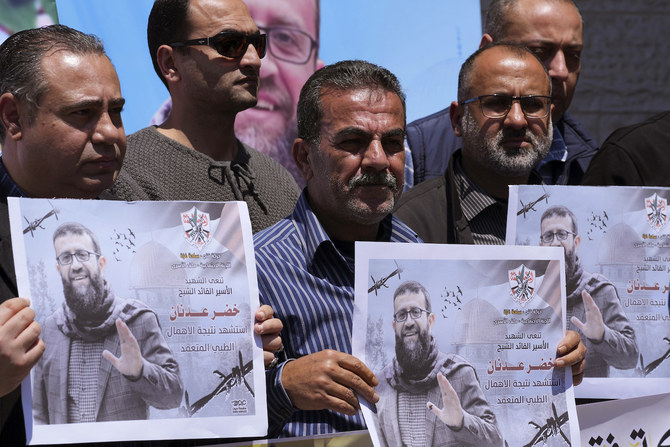

GAZA CITY, Palestinian Territories: Khader Adnan, a high-profile Palestinian prisoner, died in Israeli custody on Tuesday, after staging a hunger strike for 86 days.
Adnan, a leader in the militant Islamic Jihad group, began staging protracted hunger strikes more than a decade ago, introducing a new form of protest against Israel’s mass detention of Palestinians without charge or trial.
On Tuesday, the 45-year-old became the first long-term hunger striker to die in Israeli custody.
As Israeli-Palestinian violence has spiked, the number of administrative detainees has risen to more than 1,000 over the past year, the highest number in two decades.
For administrative detainees, hunger strikes are often the last recourse. Several have staged hunger strikes lasting several months, often becoming dangerously ill. Previous Israeli governments have at times conceded to some of their demands to avoid deaths in custody.
This time, warnings about Adnan’s deteriorating health were ignored, said the advocacy group Physicians for Human Rights Israel.
The group and Adnan’s lawyer said they had asked Israeli authorities to move him from his cell to a hospital where his condition could best be monitored. The rights group said a doctor who visited Adnan several days ago warned that his life was in danger.
In retaliation, Palestinian factions fired at least three rockets toward Israeli towns on Tuesday morning from the Gaza Strip, without a specific group claiming responsibility.
The Israel Defense Forces announced that it had detected three shells fired from the Gaza Strip, all of which fell in an open area and were not intercepted by the Iron Dome defense system.
Ziyad Al-Nakhala, secretary-general of Islamic Jihad, said: “Sheikh Khader will remain a great symbol of our people, symbol of freedom fighters in the world, and a high flag in our march toward Jerusalem.”
“(We express) our loyalty today to all the martyrs and to Sheikh Khader Adnan, and to those who will join the ranks of the blessed martyrs,” he added.
“We will not leave the path of jihad and resistance until our land is liberated from the Zionist murderers and criminals,” Al-Nakhala said.
Local Palestinian media quoted sources saying that the leaders of the Islamic Jihad in the Gaza Strip canceled travel plans to attend a meeting of their political bureau.
The sources added that efforts were being made by various local and international parties to prevent an escalation and a return to a new confrontation in the besieged enclave.
The Palestinian Al-Quds newspaper reported, quoting informed sources: “Islamic Jihad is still conducting internal discussions about its response amid Arab and international contacts and pressures on the movement to refrain from responding.”
Adnan was from Arraba, Jenin in the northern West Bank. He was arrested 12 times under administrative detention, and had been on five hunger strike since 2012.
Ismail Haniyeh, head of the Hamas political bureau residing in Qatar, contacted Al-Nakhala, residing in Lebanon, following Adnan’s death.
Haniyeh said later: “This is an open battle against the occupation, and our people are rising up against it around the clock.”
The Gaza Strip has witnessed dozens of rounds of fighting with Israel since Hamas took control in mid-2007, the most prominent of which was in May 2021.
Hussam Badran, a member of the political bureau of Hamas, said: “This heinous crime shows the true face of the abhorrent occupation, which abandoned all meanings of humanity by assassinating Adnan in its prison, by neglecting him medically, in addition to his administrative detention without charge or trial more than once.”
Muhammad Al-Hindi, a member of the political bureau of Islamic Jihad and official in charge of its political department, said: “The enemy will pay for this crime and the price for all its crimes against our prisoners and our people, God willing.”
Islamic Jihad had two rounds of escalation in the Gaza Strip, without the participation of Hamas: first following the assassination by Israel of one of its military leaders, Baha Abu Al-Atta, in 2019, and, second, after the assassination of its military leaders in 2022.
Palestinians gathered in front of the headquarters of the International Committee of the Red Cross in Gaza City to condemn Adnan’s death.
They carried placards that read “Khader Adnan, a revolutionary, a striker, and a martyr.”