

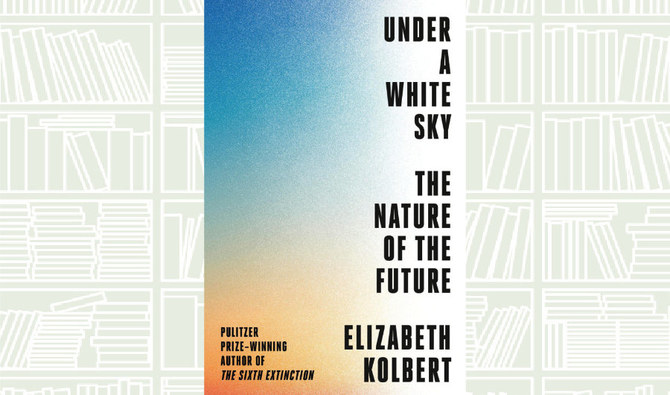
What We Are Reading Today: Under a White Sky by Elizabeth Kolbert

Short Url
Updated 01 May 2023
Follow

What We Are Reading Today: Under a White Sky by Elizabeth Kolbert

In “Under a White Sky,” Elizabeth Kolbert takes a hard look at the new world we are creating. Along the way, she meets biologists who are trying to preserve the world’s rarest fish, which lives in a single tiny pool in the middle of the Mojave; engineers who are turning carbon emissions to stone in Iceland; Australian researchers who are trying to develop a super coral that can survive on a hotter globe; and physicists who are contemplating shooting tiny diamonds into the stratosphere to cool the earth.

One way to look at human civilization, says Kolbert, is as a ten-thousand-year exercise in defying nature. In “The Sixth Extinction,” she explored the ways in which our capacity for destruction has reshaped the natural world. Now she examines how the very sorts of interventions that have imperilled our planet are increasingly seen as the only hope for its salvation, according to a review on goodreads.com.


What We Are Reading Today: ‘How the Universe Got Its Spots’

Photo/Supplied
Updated 02 January 2026
Follow

What We Are Reading Today: ‘How the Universe Got Its Spots’

  • Nimbly explaining geometry, topology, chaos, and string theory, Levin shows how the pattern of hot and cold spots left over from the big bang may one day reveal the size of the cosmos

Author: JANNA LEVIN 

Is the universe infinite or just really big? With this question, cosmologist Janna Levin announces the central theme of this book, which established her as one of the most direct, unorthodox, and creative voices in contemporary science.

As Levin sets out to determine how big “really big” may be, she offers a rare intimate look at the daily life of an innovative physicist, complete with jet lag and the tensions between personal relationships and the extreme demands of scientific exploration.

Nimbly explaining geometry, topology, chaos, and string theory, Levin shows how the pattern of hot and cold spots left over from the big bang may one day reveal the size of the cosmos.