

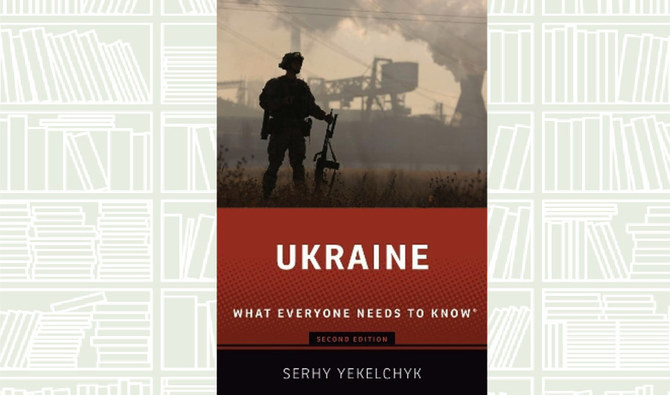
What We Are Reading Today: Ukraine: What Everyone Needs to Know

Short Url
Updated 30 April 2023
Follow

What We Are Reading Today: Ukraine: What Everyone Needs to Know

Author: Serhy Yekelchyk

Ukraine’s political crises can be traced to the linguistic differences and divided political loyalties that have long fractured the country. However, this theory obscures the true significance of Ukraine’s civic revolution and the conflict’s crucial international dimension. The 2013-14 Ukrainian revolution presented Russia with both a democratic and a geopolitical challenge. In reality, political conflict in Ukraine is reflective of global discord, stemming from differing views on state power.
The book is an updated edition of Serhy Yekelchyk’s 2015 publication, “The Conflict in Ukraine.” It addresses Ukraine’s relations with the West, particularly the US, from the perspective of Ukrainians. The book explains how independent Ukraine fell victim to crony capitalism, how its people rebelled twice in the last two decades in the name of democracy and against corruption, and why Russia reacted so aggressively to the strivings of Ukrainians.
This volume is essential reading for anyone who wants to understand contemporary politics in Europe, according to a review on goodreads.com.


What We Are Reading Today: Worldly Afterlives by Julia Stephens

Updated 24 December 2025
Follow

What We Are Reading Today: Worldly Afterlives by Julia Stephens

Indian migrants provided the labor that enabled the British Empire to gain control over a quarter of the world’s population and territory. In the mid-1800s, the British government began building an elaborate bureaucracy to govern its mobile subjects, issuing photo IDs, lists of kin, and wills. It amassed records of workers’ belongings such as handwritten IOUs, crumpled newspaper clippings, and copper bangles. 

“Worldly Afterlives” uses this trove of artifacts to recover the stories of the hidden subjects of empire. Navigating the remains of imperial bureaucracy — in archives scattered across Asia, Africa, the Middle East, and the Americas — Julia Stephens follows migrant families as they traverse the Indian Ocean and the British Empire. She draws on in-depth interviews to show how the histories of empire reverberate in the present.