UN holds Afghanistan crisis talks in Qatar, without Taliban

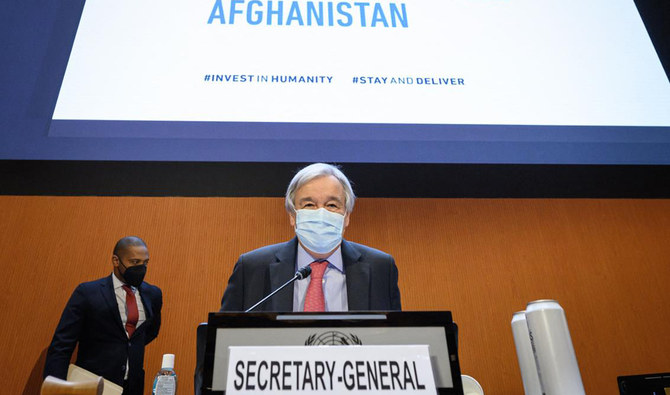
UN Secretary-General Antonio Guterres says the Doha meeting ‘is intended to achieve a common understanding within the international community on how to engage with the Taliban’ on a variety of issues. (AFP)
Short Url
Updated 01 May 2023
Follow

UN holds Afghanistan crisis talks in Qatar, without Taliban

  • The UN and US have insisted that recognition is not on the agenda
  • No country has established formal ties with the Taliban administration

DOHA: The Taliban will be absent from UN-led talks that open Monday in Qatar on how to handle Afghanistan’s rulers and press them to ease a ban on women working and girls going to school.
Envoys from the United States, China and Russia as well as major European aid donors and key neighbors such as Pakistan are among representatives from about 25 countries and groups called to the two days of talks by UN Secretary-General Antonio Guterres.
The Taliban government has not been invited, however, and ahead of the meeting the question of recognition of the administration has loomed large.
A small group of Afghan women staged a weekend protest march in Kabul to oppose any moves to recognize the rulers who returned to power in August 2021.
In an open letter to the Doha meeting released Sunday, a coalition of Afghan women’s groups said they were “outraged” that any country would consider formal ties because of the record of the government that says its handling of women’s rights is “an internal social issue.”
The United Nations and United States have insisted that recognition is not on the agenda.
Rights’ groups fears have been fueled by UN deputy secretary-general Amina Mohammed, who said last month that the Doha meeting could find “baby steps” that lead to a “principled recognition” of the Taliban government.
The UN said the comments were misinterpreted. No country has established formal ties with the Taliban administration and UN membership can only be decided by the UN General Assembly.
Ahead of his arrival in Doha, Guterres’ office said the meeting “is intended to achieve a common understanding within the international community on how to engage with the Taliban” on women’s and girls’ rights, inclusive governance, countering terrorism and drug trafficking.
“Any kind of recognition of the Taliban is completely off the table,” US State Department spokesman Vedant Patel said last week.
Since ousting a foreign-backed government in 2021, the Taliban authorities have imposed an austere version of sharia law that the United Nations has labelled “gender-based apartheid.”
Women have been barred from most secondary education and universities, and prevented from working in most government jobs as well as UN agencies and NGOs.
Though divided on many disputes, the UN Security Council powers united on Thursday to condemn the curbs on Afghan women and girls and urge all countries to seek “an urgent reversal” of the policies.
Diplomats and observers say, however, that the Doha meeting highlights the quandary faced by the international community in handling Afghanistan, which the UN considers its biggest humanitarian crisis with millions depending on food aid.
Amina Mohammed said it was “clear” that the Taliban authorities want recognition. Formal UN ties would help the government reclaim billions of dollars of desperately needed funds seized abroad after it took power.
But diplomats from several countries involved in the Doha talks said this would not be possible until there is a change on women’s rights. The Afghan foreign ministry said after last week’s UN vote that “diversity should be respected and not politicized.”
The UN chief is to give the Doha meeting an update on a review of the world body’s critical relief operation in Afghanistan, ordered in April after authorities had stopped Afghan women from working with UN agencies, diplomats said.
The UN has said it faces an “appalling choice” over whether to maintain its huge operation in the country of 38 million. The review is scheduled to be completed on Friday.


Another construction crane collapse in Thailand kills 2 people a day after deadly train derailment

Updated 58 min 45 sec ago
Follow

Another construction crane collapse in Thailand kills 2 people a day after deadly train derailment

  • A construction crane has collapsed onto an elevated road near Bangkok, a day after another construction accident in northeastern Thailand killed 32 people

NAKHON RATCHASIMA, Thailand: A construction crane collapsed onto an elevated road near Bangkok, killing two people on Thursday, a day after another crane fell on a moving passenger train in northeastern Thailand and killed 32 people.
The work on an extension of the Rama 2 Road expressway — a major artery leading from Bangkok — has become notorious for construction accidents, some of them fatal.
The crane collapsed at part of the road project in Samut Sakhon province, trapping two vehicles in the wreckage, according to the government’s Public Relations Department.
Transport Minister Phiphat Ratchakitprakarn said on Thai TV Channel 7 that two people had died. It was unclear if anyone else had been trapped in the wreckage.
There was uncertainty about the number of victims because the site is still considered too dangerous for search teams to enter, said Suchart Tongteng, a rescue worker with the Ruamkatanyu Foundation.
“At this moment, we still can’t say whether another collapse could happen,” he said, citing dangling steel plates. “That’s why there are no rescue personnel inside the scene, only teams conducting on-site safety assessments.”
At the site of Wednesday’s train derailment, the search for survivors ended, Nakhon Ratchasima Gov. Anuphong Suksomnit said. Three passengers listed as missing were presumed to have gotten off the train earlier, but that was still being investigated.
Officials believed 171 people had been aboard the train’s three carriages, which were being removed from the scene Thursday.
The crane that fell, crushing part of the train, was a launching gantry crane, a mobile piece of equipment often used in building elevated roadways.
Police were still collecting evidence and interviewing witnesses and have not pressed charges, provincial Police Chief Narongsak Promta told reporters.
South Korea’s Foreign Ministry reported a South Korean man in his late 30s, was among the dead.
The high-speed rail project where the accident occurred is associated with the plan to connect China with Southeast Asia under Beijing’s Belt and Road Initiative.
In August 2024, a railway tunnel on the planned route, also in Nakhon Ratchasima, collapsed, killing three workers.
Anan Phonimdaeng, acting governor of the State Railway of Thailand, said the project’s contractor is Italian-Thai Development, with a Chinese company responsible for design and construction supervision.
A statement posted on the website of the company, also known as Italthai, expressed condolences to the victims and said the company would pay compensation to the families of the dead and hospitalization expenses for the injured.
Transport Minister Phiphat said Italthai was also the lead contractor on the highway project where Thursday’s accident took place, though several other companies are also involved.
The rail accident had already sparked outrage because Italthai was also the co-lead contractor for the State Audit Building in Bangkok that collapsed during construction last March during a major earthquake centered in Myanmar. The building’s collapse was the worst quake damage in Thailand and about 100 people were killed.
Twenty-three individuals and companies have been indicted, including Italthai’s president and the local director for the company China Railway No. 10, the project’s joint venture partner. The charges in the case include professional negligence and document forgery, and Thailand’s Department of Special Investigation has recommended more indictments.
The involvement of Chinese companies in both projects has also drawn attention, as has Italthai and Chinese companies’ involvement in the construction of several expressway extensions in and around Bangkok where several accidents, some fatal, have occurred.
In Beijing, Chinese Foreign Ministry spokesperson Mao Ning said Wednesday the government was aware of the rail accident and had expressed condolences.