

World Health Organization begins to assist Pakistan after first monkeypox case

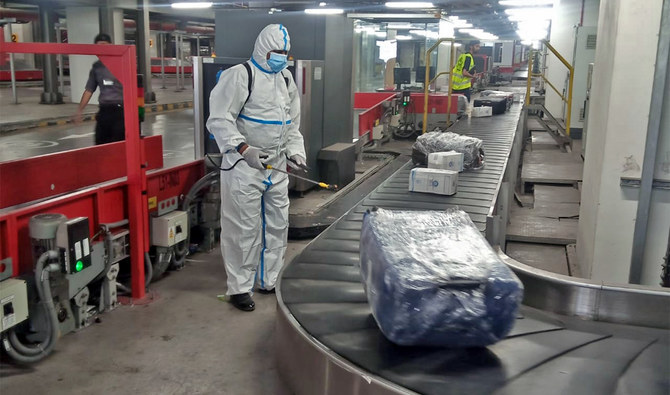
A worker wearing personal protective equipment (PPE) disinfects luggage on a conveyor belt at Jinnah International Airport in Karachi on April 25, 2023, after Pakistan reports the first case of monkeypox virus. (Photo courtesy: Pakistan Civil Aviation Authority)
Short Url
Updated 29 April 2023
Follow

World Health Organization begins to assist Pakistan after first monkeypox case

  • Pakistani health authorities have been taking precautionary steps since last year and deny local transmission of disease
  • The international health agency says it will assist Pakistan with lab testing while pointing out ‘the situation is still evolving’

ISLAMABAD: The World Health Organization (WHO) announced on Saturday it was working with Pakistan to prevent the outbreak of monkeypox (Mpox) after the country reported its first case of the disease earlier this month.

Pakistan said it had isolated a resident of the federal capital suffering from the viral disease who recently returned from a visit abroad.

The health authorities said there was no evidence of local transmission of the disease, though they had been taking precautionary measures since last year in May and had examined over 20 suspected cases since then.

“The World Health Organization is working and investigating with the Government of Pakistan on Money Pox, as the situation is still evolving,” the global health agency announced in a brief statement. “Also, WHO will assist the Government of Pakistan as per their requirement especially in lab testing, Points of Entry and provision of testing kits.”

Mpox is a viral zoonotic disease caused by a pox virus (MPXV). It can be transmitted from infected animals to humans or from infected humans to others humans via close contacts and droplets.

WHO declared Mpox a public health emergency of international concern in July 2022. So far, there have been about 87,000 confirmed cases of the disease internationally with 119 related deaths.

Pakistan also put airports on high alert to ensure medical screening of inbound passengers.

The country’s health ministry said it was trying to ensure enhanced surveillance through laboratory diagnostics, contact tracing, and rapid identification of suspected cases to provide optimal clinical care and prevent the spread of the disease.
Mpox can lead to high fever, headache, exhaustion, muscle and backaches, and swollen lymph nodes.



Pakistan Navy tests missile, loitering munitions and unmanned vessel at Arabian Sea

Updated 5 sec ago
Follow

Pakistan Navy tests missile, loitering munitions and unmanned vessel at Arabian Sea

  • The exercise reflects growing focus on air defense and autonomous systems in modern warfare

ISLAMABAD: Pakistan’s navy conducted live firing of a surface-to-air missile, tested loitering munitions and carried out open-sea trials of an unmanned surface vessel during a major exercise in the North Arabian Sea on Saturday, highlighting a growing focus on air defense and unmanned warfare amid evolving regional security dynamics.

The exercise, which demonstrated both conventional and autonomous capabilities, comes at a time when Pakistan is increasingly emphasizing advanced technology and multi-domain operations following last year’s four-day conflict with nuclear-armed India, which reinforced the importance of air defense, surveillance and precision strike systems.

“Pakistan Navy demonstrated its operational readiness and combat preparedness through a comprehensive exercise in the North Arabian Sea, showcasing both conventional and unmanned capabilities, as per dictates of evolving naval warfare,” the Navy’s Directorate General Public Relations said in a statement.

“The exercise included the successful live firing of LY-80(N) Surface to Air Missile (SAM) from Vertical Launching System at extended range, validating the long-range capabilities of Pakistan Navy’s modern air defense systems,” it added. “LY-80(N) SAM successfully engaged and neutralized an aerial target, demonstrating Pakistan Navy’s robust air defense capabilities.”

The statement said the exercise also featured the successful engagement of surface targets using a loitering munition, which it said demonstrated the navy’s precision strike capability.

“Successful open-sea trials of Unmanned Surface Vessel (USV) were also conducted, marking a significant leap in autonomous naval technology,” it continued. “The trials validated the platform’s ability to combine high-speed performance with mission-critical durability.”

Pakistan’s armed forces routinely hold large-scale exercises to enhance operational readiness, but recent drills have placed greater emphasis on emerging technologies, reflecting lessons drawn from modern conflicts.

Key capabilities demonstrated during the exercise included extreme maneuverability, precision navigation and weather resilience.

Chief of the Naval Staff Admiral Naveed Ashraf commended officers and men of the Pakistan Navy for their professionalism and operational competence, reiterating the navy’s resolve to ensure the seaward defense of the country and safeguard its maritime interests.