


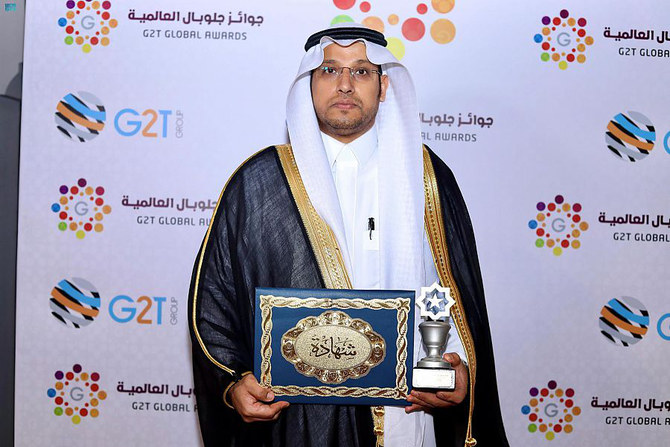

RIYADH: The Charity Society for Orphan Care in the Eastern Region has received the G2T Global Award for best Arab institution in 2022 in the humanitarian work category.
Benaa’s Director-General Abdullah bin Rashid Al-Khalidi also received the award for best Arab executive in the same category.
Al-Khalidi received the award on behalf of Prince Turki bin Mohammed bin Fahad, minister of state and chairman of Benaa’s board of directors, at the award ceremony in the Moroccan city of Marrakesh on April 27.
Prince Turki said in his message: “This honor comes as a culmination of the wise leadership’s unlimited support to empower the non-profit sector in general, and the great interest in the category of orphans in Saudi Arabia, and to provide all means that help them to continue their ambition in serving their country, and to motivate community institutions and individuals to contribute time, effort and money to sponsor them.”
Al-Khalidi said that Benaa’s triumph was the result of its efforts since the association was first established in 2010, as well as its achievements and successes at local, regional, and global levels.
He extended his appreciation to Prince Turki for his great support of the society, which effectively contributed to Benaa gaining its local and international status.
Al-Khalidi said the awards adopted a set of quantitative and applied criteria in selecting the winners based on a set of factors, including the size of the institution, the total assets, and the scope of administrative supervision.
He noted that the criteria also include academic and scientific qualifications and cumulative professional experience, as well as the nature of the leadership capacity and the nature of the institution and its strategic and operational intricacies, not to mention business results on an annual and cumulative basis and the institution’s impact on the local and Arab economy.
The awards were launched in 2016, and have crowned major Arab companies and institutions in various vital fields.
They also aim to strengthen Arab partnerships by ensuring communication among business executives.


