

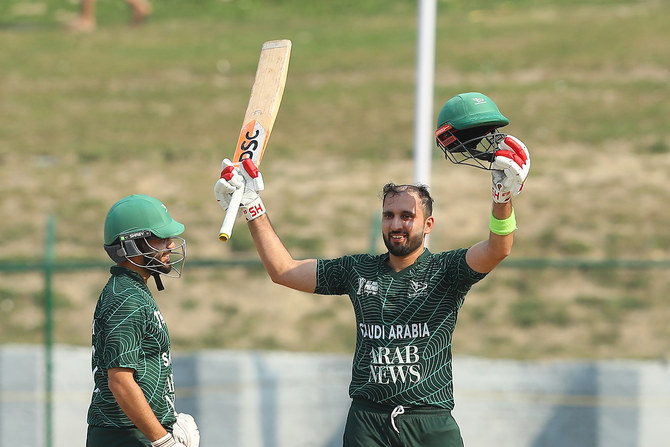

On April 22, Abdul Waheed scored 124 runs for Saudi Arabia’s men’s cricket team in its victory against Qatar in Kathmandu. This was an impressive achievement.
The Saudi team has not played many one-day internationals. It has played more T20 internationals, where Waheed’s record has been modest. Scoring 100 runs, or a century, in a single innings, is the aspiration of most cricketers, a moment to be savored by the individual and applauded by onlookers.
The context and importance of a century varies. In Waheed’s case, it meant that a victory was achieved for the Saudi team in the Asia Premier Cup. Its importance acquired even greater significance because the team’s match against Nepal on April 24 was abandoned without a ball being bowled.
The point gained meant that the winner of the final group stage match between Saudi Arabia and Oman would progress to the semifinals. Oman totaled a massive 366 in 50 overs. Waheed fell agonizingly short, on 95, of another international century, as his team responded bravely, but forlornly, with 294.
This week has also witnessed the 50th birthday of one of cricket’s greatest-ever players, Sachin Tendulkar. He is the only person to have scored 100 centuries in international matches, 51 of them being in Test matches, the most by any individual in the history of the game.
Nicknamed the “Little Master,” Tendulkar made his Test debut aged 16 and scored his first Test 100 aged 17. Many argue that he is the best batsman of all time, one blessed with superb anticipation, balance and timing, who scored runs in all conditions and parts of the world.
Even Sir Donald Bradman, with a Test batting average of 99.94, for which many judge him as the greatest, was impressed. Watching Tendulkar bat, Bradman asked his wife if she could see any similarity between them. Her reply was that yes, in terms of compactness, technique and stroke production.
As from his 50th birthday, Tendulkar will share another similarity with Bradman. Cricket Australia has named the gates through which visiting players will enter the field at the Sydney Cricket Ground the Lara-Tendulkar gates. Australian players enter the field via the Don Bradman Gates.
One achievement that eluded Tendulkar was scoring 100 centuries in first-class cricket. This is defined as matches of three or more days scheduled duration that allow for teams of 11 players to play two innings each. Test matches fit into this category, as do the longer formats of domestic competitions organized in each of the 12 Test-playing countries. Tendulkar is recorded as having scored 89 first-class centuries.
Twenty-five male players have achieved the “hundred hundreds” pinnacle. The first to do so was W. G. Grace, who reached this landmark in 1895, ultimately scoring 124 centuries. Grace is widely regarded as one of a small number of people who revolutionized the game at various stages of its development.
Until Grace, the number of centuries that had been scored was small, the first one ever recorded around 1775. This makes Grace’s innings of 224 not out for All-England against Surrey in 1866, when he had only just turned 18, a remarkable achievement. As his long career unfolded, 44 seasons of first-class cricket, he became synonymous with gamesmanship, technical innovation, mischief, all round cricket and sporting skills, boisterousness on the field and an ability to make money out of the game as an amateur.
On a bitterly cold April 24, 1905, as Grace was drawing to the end of his career, he captained the Gentlemen of England against Surrey, for whom Jack Hobbs was making his debut. When asked for his opinion of the debutant, Grace opined: “He’s goin’ to be a good ’un.” By 1925, Hobbs had surpassed Grace’s record number of 100s, going on to notch 199 before retiring in 1934.
Another Surrey player, Andrew Sandham, a contemporary of Hobbs, also scored 100 centuries. Additionally, he was famous for scoring the first triple century in Test cricket, 325 against the West Indies in 1929. The fact that 21 of the 25 “hundred centurions” are or were English reflects the amount of first-class cricket played in the country. It is becoming more difficult to achieve, as the shorter formats start to erode the amount of time the top players commit to the longer formats.
The most recent player to reach this mark was Mark Ramprakash in 2008. His career spanned 1987 to 2012, involving two English counties, Middlesex and Surrey, and England, for whom he scored a mere two centuries in an intermittent career of 52 matches.
Only one player, Bradman, achieved the milestone without playing English county cricket, another mark of his greatness. The other three non-English players each had lengthy stints in the English domestic game. Sir Vivian Richards scored exactly half of his 114 centuries in England, Zaheer Abbas slightly under half, and the New Zealander Glenn Turner almost 70 percent. It is highly improbable that anyone will score a 100 centuries in first-class cricket again.
Regular record breaking has shifted more toward the shorter format. Batting strike rates — runs scored x 100 divided by deliveries faced — have assumed greater significance than an individual’s score, especially in T20 cricket. It is clear that the feat of hitting six sixes in an over is being targeted in this format. In the history of the game at the highest level, this has been achieved on only nine occasions.
Yet, it must surely remain the case for most cricketers, at all levels, that the scoring of a century provides a profound sense of achievement.
As a corollary to this, I must declare an indulgence. The focus of this week’s column on 100 runs reflects the fact that this is my 100th weekly column for the Arab News.
In two years, international cricket has changed and Saudi cricket has progressed, developments which the column has placed within the context of the times.


