

Lebanese army deploys in response to calls for Syrian refugees to protest

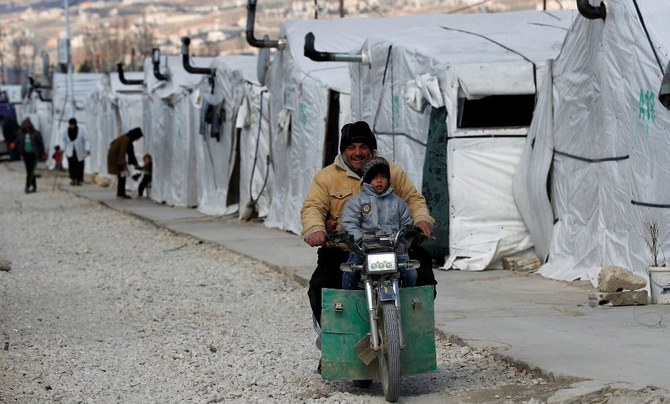
A displaced Syrian man and his son ride a motorcycle, as they drive between the tents at a refugee camp, in Bar Elias, in eastern Lebanon’s Bekaa Valley, March 5, 2021. (AP Photo)
Short Url
Updated 26 April 2023
Follow

Lebanese army deploys in response to calls for Syrian refugees to protest

  • PM Mikati: There are gangs smuggling Syrians into Lebanon illegally in exchange for large sums of money
  • Announcement of the deportation of around 50 Syrians from Lebanon to Syria two weeks ago sparked international protests

BEIRUT: Caretaker Lebanese Prime Minister Najib Mikati said on Wednesday that there were gangs smuggling Syrians into Lebanon illegally across the border through the Bekaa or Akkar in exchange for large sums of money, “while the country can no longer bear the burden of refugees.”

Mikati expressed surprise at the criticism directed toward Lebanon for deporting Syrians who entered the country illegally.

The announcement of the deportation of around 50 Syrians from Lebanon to Syria two weeks ago sparked international protests.

Lisa Abou Khaled, spokesperson for the UN High Commissioner for Refugees, told Arab News: “The UNHCR has noticed an increase in the number of raids on Syrian (refugee camps) in both Mount Lebanon and the north, and as of April, the UNHCR has confirmed at least 13 raids and has received reports of Syrians being detained for future deportation, including those who are known and registered with the UNHCR.”

A number of municipalities in Lebanese regions have started surveys and inspections to register refugees and restrict their movements in the towns where they reside.

Calls circulated on social media on Tuesday for Syrian refugees to protest in front of the UNHCR building in Jnah, south of Beirut, on Wednesday, while counter-calls were issued by the Lebanese to prevent them from protesting.

On Tuesday night, a police officer in the municipality of Al-Qlayaa in southern Lebanon was assaulted by a Syrian refugee who violated the night curfew. The officer was taken to the hospital, while the police arrested the refugee and are investigating the incident.

Syrian opposition figure Kamal Labwani threatened the Lebanese army in a video posted on social media and called on refugees to carry weapons to defend themselves.

On Wednesday, the Lebanese army and its intelligence, internal security forces, and riot control units deployed around the UNHCR headquarters in anticipation of the protest and to prevent any clashes.

On Tuesday evening, Interior Minister Bassam Mawlawi sent a letter to the internal security forces asking them “to prevent protests by Syrian refugees and counter Lebanese protests.”

On Wednesday, Mikati chaired a ministerial meeting attended by leaders of security agencies to discuss the Syrian refugee file. The meeting confirmed Lebanon’s right to enact “measures previously taken by the Higher Defense Council in 2019 against violators who enter Lebanon illegally and without official and legal documents.”

The attendees requested the UNHCR, “within a deadline of one week from the date of the meeting, to provide the Ministry of Interior with data on Syrian refugees in all their forms” and asked “that the status of refugee be dropped for anyone who leaves Lebanese territory.”

The attendees emphasized the necessity of “registering the births of Syrians on Lebanese territory in coordination with UNHCR.”

They also reiterated their call for foreign countries “to share the burden of Syrian refugees, particularly given the increasing numbers of refugees and the worsening economic crisis.”

The attendees requested “the Ministry of Labor, in coordination with the General Directorate of General Security, to tighten monitoring of Syrian labor within the permitted sectors.”

They also called on the minister of justice to investigate the possibility of immediately handing over detainees and convicts to the Syrian state.

The Lebanese government estimates the number of Syrian refugees in Lebanon to be over 1.5 million, distributed in camps and communities on Lebanese territory, mostly concentrated in the Bekaa and northern regions.

Abou Khaled, UNHCR spokesperson, said: “The number of Syrian refugees registered by the UNHCR reached 805,326 as of last March, but the UNHCR knows that the number of non-registered refugees in Lebanon is higher and believes that the total amounts to 1.5 million.”

As for the illegal movement of Syrian refugees between Lebanon and Syria, Abou Khaled said: “The conversations and interactions between the UNHCR and the refugees indicate that back-and-forth trips to Syria are rare. The costs and risks of these illegal trips cross border — often with the participation of smugglers — are high, preventing the majority of Syrians from resorting to these practices.”

Abou Khaled affirmed that “in the cases where the UNHCR identifies the return of a Syrian refugee to Syria, we double-check the information and we cancel their file. However, sometimes, there might be urgent reasons prompting refugees to go back to Syria, and they do that for a certain reason and for a limited period of time.”

As for the ministerial committee’s request to share the UNHCR’s data, Abou Khaled said: “The UNHCR encourages the Lebanese government to cooperate more in this matter by sharing with us the data it has on the refugees’ movement, so we can review them and compare them with ours. The UNHCR reiterates its keenness to work with the relevant authorities in a systematic manner that encourages data sharing and movement monitoring.”

The UNHCR fears that those being deported are at risk, even if they are not registered as refugees.

Following a meeting with the ministerial committee, Mustafa Bayram, minister of labor, said: “Around 37,000 Syrians entered Syria during the Eid Al-Fitr period and came back to Lebanon after spending the holiday vacation there, which deprives them of their refugee status.”

Bassam Mawlawi, the interior minister, emphasized that “Syrians in Lebanon are subject to the Lebanese law and order. They should be registered with the competent official authorities. Their situation must be regulated because this chaos is detrimental to Lebanon, their interests, and the security situation, which we are responsible for.”

Aya Majzoub, Amnesty International’s deputy director for the Middle East and North Africa, urged Lebanese authorities to “halt unlawful deportation of Syrian refugees for fear that they are at risk of torture or persecution at the hands of the Syrian government upon return to war-ravaged Syria.”


Palestinians wait at border between Gaza and Egypt as uncertainty clouds reopening of Rafah crossing

Updated 6 sec ago
Follow

Palestinians wait at border between Gaza and Egypt as uncertainty clouds reopening of Rafah crossing

  • At that pace, long waits are facing most of the roughly 20,000 sick and wounded people who Gaza’s Health Ministry has said need treatment abroad
  • Reopening the crossing is considered key as the ceasefire agreement moves into a complicated second phase
  • The bus with about 40 Palestinians that entered Gaza via Rafah on Tuesday arrived at Nasser hospital in Khan Younis early Wednesday morning, where their families welcomed them after spending the entire day waiting

KHAN YOUNIS, Gaza Strip: Palestinians gathered on both sides of Gaza’s border with Egypt on Tuesday hoping to pass through the Rafah crossing, after its reopening the previous day was marred by delays, interrogations and uncertainty over who would be allowed to cross.
On the Egyptian side were Palestinians who fled Gaza earlier in the Israel-Hamas war to seek medical treatment, according to Egypt’s state-run Al-Qahera News television. On the Gaza side, Palestinians in need of medical care that is unavailable in Gaza gathered at a hospital before ambulances moved toward Rafah, hoping for word that they would be allowed to cross the other way.
The office of the North Sinai governor confirmed Tuesday that an unknown number of patients and their companions had crossed from Gaza into Egypt.
The bus with about 40 Palestinians that entered Gaza via Rafah on Tuesday arrived at Nasser hospital in Khan Younis early Wednesday morning, where their families welcomed them after spending the entire day waiting.
Though hailed as a step forward for the fragile ceasefire struck in October, it took more than 10 hours for only about a dozen returnees and a small group of medical evacuees to cross in each direction on the first day Rafah reopened.
Three women who crossed into Gaza on Monday told The Associated Press on Tuesday that Israeli troops blindfolded and handcuffed them, then interrogated and threatened them, holding them for several hours before they were released.
The numbers permitted to cross on Monday fell well short of the 50 people that officials had said would be allowed each way and barely began to address the needs of tens of thousands of Palestinians who are hoping to be evacuated for treatment or to return home.
The import of humanitarian aid or goods through Rafah remains prohibited.
’Not a solution to the crisis’
Evacuation efforts on Tuesday morning converged around a Red Crescent hospital in Khan Younis, where a World Health Organization team arrived and a vehicle carrying patients and their relatives rolled in from another hospital. Then the group of WHO vehicles and Palestinian ambulances headed toward Rafah to await crossing.
As the sick, wounded and displaced waited to cross in both directions, health officials said the small number allowed to exit so far paled beside Gaza’s tremendous needs. Two years of fighting destroyed much of its medical infrastructure and left hospitals struggling to treat trauma injuries, amputations and chronic conditions like cancer.
In Gaza City, Shifa Hospital director Mohamed Abu Selmiya called the pace “crisis management, not a solution to the crisis,” imploring Israel to permit the importing of medical supplies and equipment. He wrote on Facebook: “Denying the evacuation of patients and preventing the entry of medicines is a death sentence for them.”
UN and WHO officials said the trickle of patients allowed out and restrictions on bringing in desperately needed supplies are prolonging a disastrous situation in Gaza.
“Rafah must function as a real humanitarian corridor so we can have a surge in aid deliveries,” said Tom Fletcher, the UN’s top relief official.
Palestinian Red Crescent spokesperson Raed Al-Nims told AP that only 16 patients with chronic conditions or war wounds, accompanied by 40 relatives, were brought from Khan Younis to the Gaza side of Rafah on Tuesday — less than the 45 patients and wounded the Red Crescent was told would be allowed.
After days of anticipation over the reopening, hope lingered that it might mark a meaningful first step. In Khan Younis, Iman Rashwan waited for hours until her mother and sister returned from Egypt, hoping others would soon see their loved ones again.
Waiting on both sides
Officials say the number of crossings could gradually increase if the system works, with Israel and Egypt vetting those allowed in and out. But security concerns and bureaucratic snags quickly tempered expectations raised by officials who for weeks had cast reopening as a major step in the ceasefire deal.
There were delays on Monday over disagreements about luggage allowances. Returnees were carrying more than anticipated with them, requiring additional negotiations, a person familiar with the situation told the AP, speaking on condition of anonymity to discuss the diplomatic matter.
“They didn’t let us cross with anything,” Rotana Al-Regeb said as she returned around midnight Monday to Khan Younis. “They emptied everything before letting us through. We were only allowed to take the clothes on our backs and one bag per person.”
The initial number of Palestinians allowed to cross is mostly symbolic. Israeli and Egyptian officials have said that 50 medical evacuees would depart — along with two caregiver escorts — and 50 Palestinians who left during the war would return.
At that pace, long waits are facing most of the roughly 20,000 sick and wounded people who Gaza’s Health Ministry has said need treatment abroad. About 150 hospitals across Egypt are ready to receive patients, authorities said.
Who and what would be allowed through Rafah was a central concern for both Israel and Egypt.
Israeli Prime Minister Benjamin Netanyahu has said that anyone who wants to leave will eventually be permitted to do so, but Egypt has repeatedly said the Rafah crossing must open in both directions, fearing Israel could use it to push Palestinians out of Gaza.
Reopening the crossing is considered key as the ceasefire agreement moves into a complicated second phase. That calls for installing a new Palestinian committee to govern Gaza, deploying an international security force, disarming Hamas and taking steps to begin rebuilding.
In a meeting Tuesday with US special envoy Steve Witkoff in Jerusalem, Netayanhu repeated Israel’s “uncompromising demand” that Hamas be disarmed before any reconstruction begins, the prime minister’s office said.
A 19-year-old killed in southern Gaza
Nasser Hospital in Khan Younis said Ahmed Abdel-Al, 19, was shot and killed by Israeli troops on Tuesday morning in a part of the southern Gaza City, some distance away from the area under the Israeli military’s control.
Israel’s military said it was not immediately aware of any shootings in the area.
Abdel-Al was the latest of the 529 Palestinians killed by Israeli fire since the Oct. 10 start of the ceasefire, according to Gaza’s Health Ministry. They are among more than 71,800 Palestinians killed since the start of the war, according to the ministry, which does not distinguish between fighters and civilians.
The ministry, part of Gaza’s Hamas-led government, keeps detailed casualty records that are seen as generally reliable by UN agencies and independent experts.