

First batch of Pakistani evacuees from Sudan arrives in Jeddah

A Saudi Navy sailor carries a child as a Saudi ship transporting evacuees of different nationalities from Sudan arrive at the King Faisal Naval Base in Jeddah on April 24, 2023. (SPA)
Short Url
Updated 26 April 2023
Follow

First batch of Pakistani evacuees from Sudan arrives in Jeddah

  • There are about 1,300 Pakistanis in Sudan, out of which 900 have so far been moved to safety in Port Sudan
  • Pakistan’s Foreign Office expresses gratitude to Saudi Arabia for its support and hospitality to Pakistani nationals

ISLAMABAD: The first batch of 37 Pakistani nationals from the battle-scarred Sudan arrived in Jeddah on a ship early Wednesday morning, the Foreign Office in Islamabad confirmed, expressing its gratitude to the Saudi authorities for helping with the evacuation process of its citizens.

Pakistan’s diplomatic mission in Sudan has managed to evacuate over 900 of its nationals from the capital city of Khartoum, which has remained embroiled in conflict for the last several days, and brought them to the safety of Port Sudan, which is situated on the eastern coast.

Of these, 200 Pakistani nationals were brought to Port Sudan on Wednesday of which 37 arrived in Jeddah, while the remaining 863 persons are waiting for their transportation arrangements to the kingdom. 

There are more than 1,300 Pakistanis in Sudan, which is witnessing fierce fighting between its army and powerful paramilitary forces. The evacuation process became possible after the initiation of a 72-hour cease-fire between the two warring camps, which was brokered by the United States after 10 days of urban warfare resulting in hundreds of deaths.
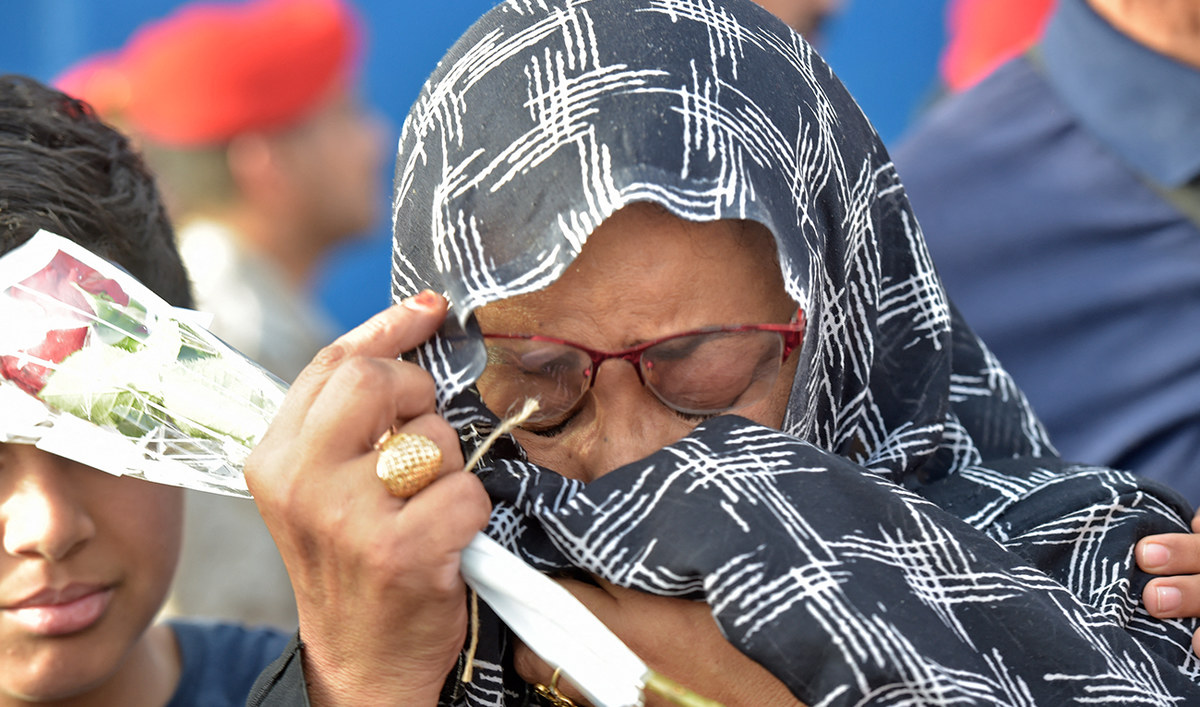


A woman cries as she arrives at King Faisal navy base in Jeddah on April 26, 2023 following a rescue operation from Sudan amid a US-brokered ceasefire between the country's warring generals. (AFP)

The conflict also injured a large number of people before triggering an exodus of foreigners.

“The ship carrying 37 Pakistani nationals from Port Sudan arrives in Jeddah,” the Foreign Office said in a Twitter post, adding the evacuation plan to rescue Pakistani nationals was continuing in Sudan. “They were received by [Consul General] in Jeddah, Khalid Majid, on arrival at Jeddah Port,” it said. “We are grateful to the Government of the Kingdom of Saudi Arabia for its support and hospitality.”

“Another convoy of 200 Pakistanis has arrived safely in Port Sudan and the Embassy of Pakistan in Sudan will continue to facilitate their stay in Port Sudan and arrange their eventual repatriation from Sudan,” it added.

Hamzah Gilani, a spokesperson for the Pakistani consulate in Jeddah, said the Saudi government was taking care of the accommodation and other needs of the evacuees.

“I would like to express my sincere gratitude to the Saudi government for facilitating the evacuation of Pakistani citizens who were stranded in Sudan, and special thanks go to the leadership of King Salman and Crown Prince Mohammed bin Salman for providing logistical support and accommodation,” he told Arab News over the phone from Jeddah.

“This humanitarian effort is a testament to the deep friendship between Pakistan and Saudi Arabia,” he added.

According to a statement issued by the Saudi foreign ministry earlier in the day, the kingdom brought 13 of its citizens along with 1,674 people belonging to other nationalities to its seashore.

So far, Saudi Arabia has evacuated about 2,148 individuals belonging to 62 nationalities since the beginning of the conflict in Sudan.


Pakistan Air Force conducts ‘Exercise Golden Eagle’ to test combat readiness, agility

Updated 10 February 2026
Follow

Pakistan Air Force conducts ‘Exercise Golden Eagle’ to test combat readiness, agility

  • The exercise follows an intense, four-day Pakistan-India military conflict in May 2025
  • It focused on AI-enabled operations integrating disruptive technologies, military says

ISLAMABAD: The Pakistan Air Force (PAF) has conducted “Exercise Golden Eagle” that successfully validated its combat readiness and operational agility through synchronized employment of the PAF’s complete combat potential, the Pakistani military said on Tuesday.

It comes months after Pakistan’s four-day military conflict with India in May, with Islamabad claiming victory in the standoff after the PAF claimed to have shot down at least six Indian fighter aircraft, including the French-made Rafale. New Delhi acknowledged some losses but did not specify a number.

The exercise was conducted on a Two-Force construct, focusing on AI-enabled, net-centric operations while integrating indigenous niche, disruptive and smart technologies in line with evolving regional security dynamics, according to the Inter-Services Public Relations (ISPR), the Pakistani military’s media wing.

Operating within a robust Integrated Air Defense System, friendly forces shaped the battlespace through seamless fusion of kinetic operations with cyber, space and electro-magnetic spectrum operations.

“The kinetic phase featured First-Shoot, First-Kill swing-role combat aircraft equipped with long-range BVR air-to-air missiles, extended-range stand-off weapons and precision strike capabilities, supported by Airborne Early Warning & Control platforms and Air-to-Air Refuelers,” the ISPR said in a statement.

“A key highlight of the exercise was Manned–Unmanned Teaming, with deep-reach killer drones and loitering munitions operating in a highly contested, congested and degraded environment, validating PAF’s capability to conduct high-tempo operations in modern warfare.”

In recent months, many countries have stepped up defense engagement with Pakistan, while delegations from multiple nations have proposed learning from the PAF’s multi-domain air warfare capabilities that officials say were successfully employed during the May conflict.

“The successful conduct of Exercise Golden Eagle reaffirms Pakistan Air Force’s unwavering commitment to maintaining a high state of operational preparedness, leveraging indigenous innovation and effectively countering emerging and future security challenges,” the ISPR added.