

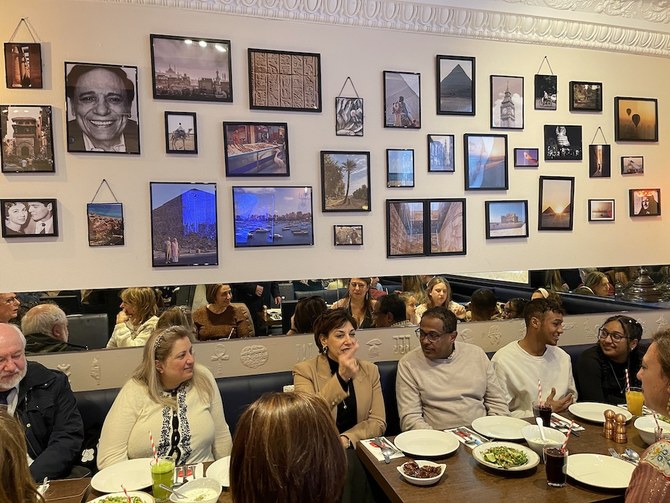

LONDON: An Egyptian ambience gave those attending the British Egyptian Society’s cultural event in London a real taste of home during the Muslim month of Ramadan.
The event, which was held at Al-Basha Restaurant in Knightsbridge toward the end of the holy month, was attended by more than 50 people of various nationalities, including attendees from the UK, Saudi Arabia, Sudan, Canada, Jordan, and Egypt, organizers said.
Mohamed Abul Khair, Egyptian consul general to the UK, told Arab News: “It’s my first Ramadan here in London and it’s quite a great feeling to feel at home — but I’m not at home, I’m in the heart of London, but you have so many celebrations going around.”
He said the atmosphere evoked the memory of being back in Egypt with his family and friends.

“The whole spirit of Egyptian life is here, and it’s not only tonight but I have attended several iftars here in London and they’re all very similar,” he added.
Khair said the Egyptian community in the UK, which consists of more than 200,000 people, is progressing in all fields, “which is very good,” and “each one is progressing in their own field, whether a doctor, or an engineer, or IT developer, quite impressive, [and] they are great ambassadors even.”
Noel Rands, secretary of the British Egyptian Society, said the cultural association had existed since around 1990 and organizes conferences and trips regularly, as well as an annual Ramadan iftar, where it mixes with other UK-based societies, including the Saudi British Society and the Anglo Jordanian Society, which were also present.
He added: “Egypt is a country which is unbelievably warm. When you go to Egypt, it’s welcoming, you are so welcome, and that is why we have a lot of English members because they have so many fond memories.”
Rands, who has been secretary for 20 years, said he is always looking for new fun ideas for members and to organize more trips, both in the UK and overseas, including to museums and exhibitions. He has arranged a number of trips to Paris, Berlin, Turin and Florence.

He said: “Our next trip is a visit to Highclere, where they have a Tutankhamun exhibition, and of course the castle itself, which was used during the filming of Downton Abbey.
“We’re always happy [to grow and expand], but the main problem with societies like ours is sponsorship.
“When we put on the conference in 2006 we had so many sponsors, we had fewer in 2012, and then we had fewer in 2019, so to put on events or to grow, you need money.”
Phil Chambers, a Canadian lawyer living in London and a member of the society, said: “One of the things I miss about living in the region is the ability to participate in regular iftars.
“[That means] not only the challenge of getting through the day without eating, but equally the cultural bringing together that wonderful meal entails.”
Chambers, who spent several years living in the Middle East, including in Egypt and Yemen, praised the society for its efforts in hosting an annual iftar.
He said: “I went to one last year, and I met an interesting range of people, demographic and ages, and this year it will be the same. It’s been a lot of fun, new restaurant, new cuisine, but also a lot of familiar and very welcoming faces.”
British-Egyptian Nora Khattab, a recent graduate of University College London, said it was a great opportunity to socialize and meet new people.
She added: “If we were in our home countries we would have been going out for iftar every day, so just the fact that we are able to do that here is really lovely, and just meeting lots of people over food as well.
“Obviously it’s nice getting to know lots of different age groups, but I think if you wanted to have more youth engagement, it would be nice to have more youth events and link the grassroots communities from there, who would then get involved in the wider Egyptian societies.”


