

Pakistan eye series victory against New Zealand in final T20I today

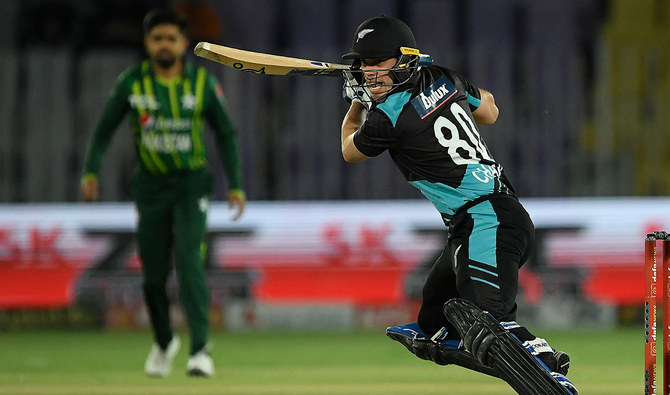
New Zealand's Mark Chapman plays a shot during the fourth Twenty20 international cricket match between Pakistan and New Zealand at the Rawalpindi Cricket Stadium in Rawalpindi, on April 20, 2023. (AFP/File)
Short Url
Updated 24 April 2023
Follow

Pakistan eye series victory against New Zealand in final T20I today

  • Pakistan, who beat New Zealand easily in first two T20Is, are 2-1 up in series
  • Gate money from fifth T20I will be donated for Turkiye, Syria earthquake victims 

ISLAMABAD: The Pakistan cricket team will be gunning for a victory against New Zealand tonight, Monday, as the two teams clash at the Rawalpindi Cricket Stadium for the fifth and final T20I of the five-match bilateral series. 

Pakistan, who cruised to victories over the Black Caps in the first and second T20Is by 88 runs and 38 runs, respectively, ended up losing the third match of the series by a narrow four runs. New Zealand were 164/5 during the fourth match of the series when the heavens parted and rain interrupted play. With only one match to go, Pakistan are 2-1 up, which means the home side can either win or draw the series but not lose from here. 

New Zealand would be on the lookout for fiery pacer Haris Rauf, who has consistently clocked in over 145kph for the green shirts and from four matches in the series so far, taken an impressive 11 wickets. While skipper Babar Azam has been the pick of the batters courtesy of a stellar century, batter Iftikhar Ahmed was exceptionally dangerous in the third T20I between the two sides. He almost won the match for Pakistan when all looked lost, scoring a whirlwind 60 from 24 balls in the third match which the Black Caps won by the slimmest of margins. 

The Pakistan Cricket Board (PCB) had earlier announced that the gate money from the fifth and final T20 between Pakistan and New Zealand will be donated to the earthquake victims in Türkiye and Syria. The PCB said it would play its part in raising donations for millions of people affected on either side of the Türkiye and Syria border by joining hands with the Punjab Government. The Pakistan side, on the other hand, will wear commemorative caps to convey Pakistan’s everlasting solidarity to the two nations. 


Pakistan squad:

Babar Azam (c), Shadab Khan (vc), Faheem Ashraf, Fakhar Zaman, Haris Rauf, Iftikhar Ahmed, Ihsanullah, Imad Wasim, Mohammad Haris, Mohammad Nawaz, Mohammad Rizwan †, Naseem Shah, Saim Ayub, Shaheen Shah Afridi, Shan Masood, Zaman Khan

New Zealand squad: 

Tom Latham † (c), Chad Bowes, Mark Chapman, Dane Cleaver †, Matt Henry, Ben Lister, Cole McConchie, Adam Milne, Daryl Mitchell, James Neesham, Rachin Ravindra, Henry Shipley, Ish Sodhi, Blair Tickner, Will Young


Pakistani student launches ‘Urdu ChatGPT’ AI model

Updated 18 January 2026
Follow

Pakistani student launches ‘Urdu ChatGPT’ AI model

  • Developer says “Qalb” is largest large language model built exclusively for Urdu
  • Project highlights push to localize artificial intelligence for non-English users

ISLAMABAD: A Pakistani student studying in the United States has launched an artificial intelligence model designed exclusively for the Urdu language, a development its creator says could help bridge longstanding gaps in access to advanced digital tools for millions of speakers worldwide.

The project, called Qalb, is positioned as an Urdu-first large language model at a time when most generative AI systems are primarily trained on English and other widely used global languages. Supporters of language-specific models argue they can improve accuracy, cultural relevance and accessibility for users in education, business and public services.

Urdu is spoken by more than 230 million people globally, including in Pakistan, India and diaspora communities, but remains under-represented in advanced AI systems. Efforts to localize artificial intelligence have increasingly been seen as critical for widening participation in digital economies, particularly in developing countries.

“Qalb is now recognized as the world’s largest Large Language Model created exclusively for the Urdu language,” Taimoor Hassan, the project’s developer, was quoted this month in a report in state-run news agency APP. 

“Trained on a massive dataset of 1.97 billion tokens and benchmarked across seven-plus international evaluation frameworks, Qalb outperforms existing Urdu-focused AI models on key real-world performance indicators, setting a new standard for natural language processing in Pakistan,” Hassan said.

“This is a development model and in the next phase we would soon launch App for mobile and web so that people could use and benefit from Qalb ChatGPT.”

Hassan completed his undergraduate degree in computer science at FAAST University’s Peshawar campus and is currently studying for a master’s degree in computer science and software engineering at Auburn University in the United States. According to APP, he is a serial entrepreneur who has previously launched and exited multiple startups and has represented Pakistan at international technology forums.

“I had the opportunity to contribute in a small way to a much bigger mission for the country,” Hassan said.

“Together with my undergraduate roommates and teammates, Jawad Ahmed and Muhammad Awais, we are committed to continuously fine-tuning localized models for niche industries, which we believe can become a major breakthrough for Pakistan.”

Both collaborators are also graduates of FAAST University Peshawar Campus and are currently studying in Germany, APP reported.

The team behind Qalb said the model is intended to support local businesses, startups, educational platforms and voice-based digital services, arguing that meaningful innovation is no longer limited to large technology firms.

“Technology is no longer locked behind big budgets or big teams. With the right mindset, even a small group can build products that educate, automate, and serve millions,” Hassan told APP.