

Death toll in Kenyan starvation cult rises to 58 – police

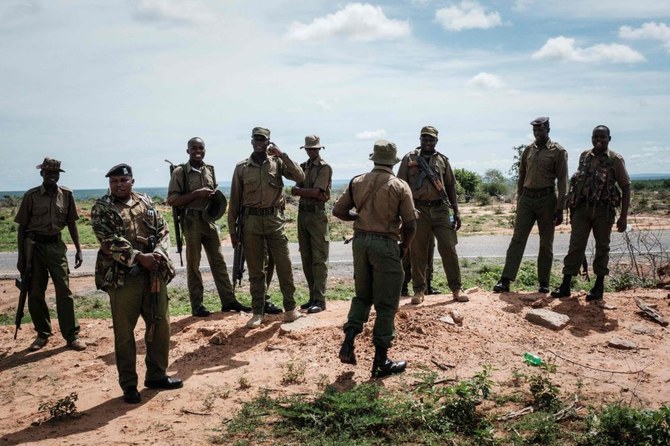
A senior Kenyan official has described the so-called Shakahola Forest Massacre as ‘the clearest abuse of the constitutionally enshrined human right to freedom of worship.’ (AFP)
Short Url
Updated 24 April 2023
Follow

Death toll in Kenyan starvation cult rises to 58 – police

  • A full-scale investigation has been launched into the Good News International
  • A rights group tipped off police about the movement and its extreme practices

NAIROBI: Kenyan police have recovered 58 bodies, mostly from mass graves in a forest in eastern Kenya, thought to be followers of a Christian cult who believed they would go to heaven if they starved themselves, the country’s police chief said on Monday.

The death toll, which has repeatedly risen as exhumations have been carried out, could rise further. The Kenyan Red Cross said 112 people have been reported missing to a tracing and counselling desk it has set up at a local hospital.

Followers of the self-proclaimed Good News International Church had been living in several secluded settlements in an 800-acre area within the Shakahola forest.

Kenya’s Inspector General of Police Japhet Koome, visiting the scene, said the death toll included 50 people found in mass graves as well as eight who were found alive and emaciated, but later died.

He added that 29 survivors had been rescued and police were still searching for potential others.

“Forensic investigators, homicide detectives, other police officers as well as some government pathologists are here with us conducting investigations and carrying out exhumations,” said Koome in remarks broadcast on Kenyan television.

The cult’s leader, Paul Mackenzie, was arrested on April 14 following a tip-off that suggested the existence of shallow graves containing the bodies of at least 31 of his followers. Koome said 14 other cult members were in police custody.

Mackenzie was arraigned on April 15 at Malindi Law Courts, where the judge gave police 14 days to conduct investigations while he was kept in detention. Kenyan media have reported that he is refusing food and water.

Reuters was not able to reach any lawyer or representative for Mackenzie.

President William Ruto said Mackenzie’s teachings were contrary to any authentic religion.

“Mr Mackenzie ... pretends and postures as a pastor when in fact he is a terrible criminal,” said Ruto, who was delivering a speech at an unrelated public event just outside Nairobi.

He said he had instructed relevant agencies to get to the root cause of what had happened and to tackle “people who want to use religion to advance weird, unacceptable ideology in the Republic of Kenya that is causing unnecessary loss of life.”


EU parliament approves 90-bn-euro loan for Ukraine amid US cuts

Updated 5 sec ago
Follow

EU parliament approves 90-bn-euro loan for Ukraine amid US cuts

  • awmakers voted by 458 to 140 in favor of the loan, intended to cover two-thirds of Ukraine’s financial needs for 2026 and 2027

The EU parliament on Wednesday approved a 90-billion-euro loan for Ukraine, providing a financial lifeline to cash-strapped Kyiv four years into Russia’s invasion.
Lawmakers voted by 458 to 140 in favor of the loan, intended to cover two-thirds of Ukraine’s financial needs for 2026 and 2027 and backed by the EU’s common budget — after plans to tap frozen Russian central bank assets fell by the wayside.

Military aid to Ukraine hit its lowest level in 2025 as the US pulled funding, leaving Europe almost alone in footing the bill and averting a complete collapse, the Kiel Institute said Wednesday.
Kyiv's allies allocated 36 billion euros ($42.9 billion) in military aid in 2025, down 14 percent from 41.1 billion euros the previous year, according to Kiel, which tracks military, financial and humanitarian assistance pledged and delivered to Ukraine since Russia's full-scale invasion.
Military aid in 2025 was even lower than in 2022, despite the invasion not taking place until February 24 that year.
US aid came to a complete halt with President Donald Trump's return to the White House in early 2025.
Washington provided roughly half of all military assistance between 2022 and 2024.
European countries have thus made a significant effort to plug the gap, increasing their collective allocation by 67 percent in 2025 compared with the 2022-2024 average.
Without that effort, the US cuts could have been even more damaging, the institute argued.
However, the think tank points to "growing disparities" among European contributors, with Northern and Western European countries accounting for around 95 percent of military aid.
The institute calculated that Northern European countries (Denmark, Estonia, Finland, Iceland, Latvia, Lithuania, Norway, and Sweden) provided 33 percent of European military aid in 2025, despite accounting for only eight percent of the combined GDP of European donor countries.
Southern Europe, which accounts for 19 percent of the combined GDP of European donors, contributed just three percent.
To help fill the gap left by the United States, NATO launched the PURL programme, under which European donors purchased US weapons for Ukraine, worth 3.7 billion euros in 2025.
Kiel called the initiative a "notable development", which had enabled the acquisition of Patriot air-defense batteries and HIMARS multiple-launch rocket systems.
European allies are also increasingly placing orders with Ukraine's own defence industry, following a trend started by Denmark in 2024.
War-torn Ukraine's defence production capacity has "grown by a factor of 35" since 2022, according to Kiel, but Kyiv lacks the funds to procure enough weapons to keep its factories working at full capacity.
Orders from 11 European donor countries helped bridge that gap last year.
In the second half of 2025, 22 percent of weapons purchases for Ukraine were procured domestically, a record high.