

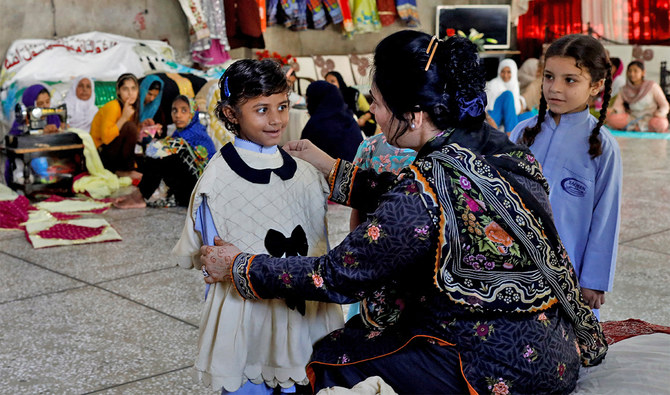

KARACHI: Women pedal sewing machines, deftly lining up seams and pleats as they assemble brightly colored dresses for young girls at an orphanage in Pakistan, in preparation for Eid Al-Fitr, which ends the Muslim fasting month of Ramadan.
Yet as an economic crisis forces people to tighten their belts, fewer find themselves able to afford charity donations for the approaching festival, usually a time of generosity.
“This year no dress came from outside,” said Laiba, a 16-year-old who lives in the home in the southern city of Karachi, as she was being measured for her clothes.
“But Bhabi purchased us unstitched cloth which we will wear after stitching here,” she added, referring by an affectionate name to Saba Edhi, who is in charge of the network of orphanages across the South Asian nation.
“It is good,” added Laiba, who goes by one name. She is one of about 30 residents of the home who said they were glad to get new shoes and clothes, despite the rising cost of living.

Faisal Edhi, a philanthropist and chief of the Edhi Foundation, a non-profit social welfare programme, along with his wife Saba Edhi, sits with children taking shelter at the Edhi Home Orphanage Centre, in Karachi, Pakistan on April 17, 2023. (REUTERS)
Edhi, who was helping to embroider the clothes, said she had to dip into savings to cover the cost of the Eid gifts, as this year no donations of readymade garments or unstitched cloth had come in, unlike previous years.
“We purchased some readymade items and unstitched cloth, jewelry, bangles, shoes and other things from our own funds.”

Women, who are taking shelter at the Edhi Home Orphanage Centre of the Edhi Foundation, a non-profit social welfare programme, stitch cloths for the children ahead of Eid al-Fitr celebrations, in Karachi, Pakistan on April 17, 2023. (REUTERS)
The crisis drove inflation to a record high of 35 percent in March, following a depreciating rupee currency, a rollback in subsidies and higher tariffs, while food inflation rose to more than 47 percent.
“Slowly, the hardships are increasing,” said philanthropist Faisal Edhi, the head of Pakistan’s largest charity operation, the Edhi Foundation, which runs the orphanages, home to more than 8,000 children.

Volunteers unload sacks of second-hand clothing to distribute among children, ahead of Eid al-Fitr celebrations, at the Edhi Home Orphanage Centre of the Edhi Foundation, a non-profit social welfare programme, in Karachi, Pakistan on April 17, 2023. (REUTERS)
The three truckloads of donated items, such as old clothes, shoes and other household effects that the Edhi centers in Karachi usually received every week have dwindled to just one now, he added.
“We are worried,” he said. “We are trying to get more donations but people have tightened the purse strings, and we are receiving fewer items as donations now.”
With less than a month’s worth of foreign exchange reserves, Pakistan awaits a bailout tranche of $1.1 billion from the IMF delayed since November over policy changes sought by the lender.
That is part of a $6.5-billion bailout package approved in 2019, which analysts say is critical for the nation of 220 million to avert default on external payment obligations.
Still, despite growing pressure on the Foundation’s resources, Edhi was undaunted.
“We will stand with our country at this moment of distress and we will try to fulfill needs with our limited resources,” he said.


