

Aramco and SABIC dispatch first accredited low-carbon ammonia shipment to Japan

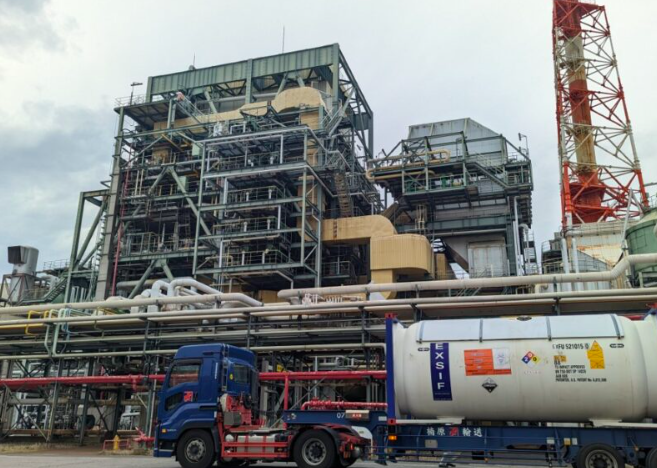
The shipment is the result of a successful multiparty collaboration across the low-carbon ammonia value chain (Supplied)
Short Url
Updated 20 April 2023
Follow

Aramco and SABIC dispatch first accredited low-carbon ammonia shipment to Japan

A first shipment of independently-certified low-carbon ammonia has arrived in Japan for use as fuel in power generation.

This initiative is part of broader efforts by Aramco and Saudi Basic Industries Corp. Agri-Nutrients to establish a global supply network for this lower-carbon fuel.

Aramco and SABIC AN also aim to supply low-carbon ammonia to other players to meet their early demand needs.

The shipment is the result of a successful multiparty collaboration across the low-carbon ammonia value chain.

The ammonia was produced by SABIC Agri-Nutrients with feedstock from Aramco, and sold by Aramco Trading Company to the Fuji Oil Company.

Mitsui OSK Lines was tasked with shipping the liquid to Japan, then the low-carbon ammonia was transported to the Sodegaura Refinery for use in co-fired power generation, with technical support provided by Japan Oil Engineering Co..

The ammonia is categorized as low-carbon because CO2 from the associated manufacturing process was captured and utilized in downstream applications.

Japan’s Ministry of Economy, Trade and Industry has announced plans to increasingly harness ammonia as a fuel for power generation and for ship propulsion, as part of the country’s 2050 decarbonization goals.

The low-carbon ammonia that reached Japan is part of broader efforts by Aramco and SABIC AN to establish a global supply network for this lower-carbon fuel.

Aramco and SABIC AN aim to supply low-carbon ammonia to other players to meet their early demand needs.

Olivier Thorel, Aramco senior vice president of chemicals, said: “This is another milestone that highlights the possibilities for low-carbon hydrogen and ammonia made from Aramco feedstock, with the potential to play a role in a lower-carbon future.

“Not only is low-carbon ammonia a means to transport lower-carbon hydrogen, it is an important energy source in its own right that can help decarbonize key sectors – including power generation for both utilities and industries. By dispatching this accredited low-carbon ammonia to Japan, we are helping chart a course for the development of this vital commodity.”

Abdulrahman Shamsaddin, SABIC AN CEO, said: “Our aim is to capitalize on this important milestone to grow and expand our positive contribution toward carbon neutrality. SABIC Agri-Nutrients made a public commitment not only to become carbon neutral by 2050 but also to collaborate with customers to help them achieve their net-zero emission targets.

“Customers in the energy, fertilizer and chemical sectors are looking for suppliers of lower-carbon hydrogen and ammonia. And we can meet their demand by leveraging our long-standing strengths across the value chain.”

Shigeto Yamamoto, FOC representative director and president, said: “As Japan aims to achieve carbon neutrality by 2050, low-carbon ammonia is expected to be a next-generation fuel that can contribute to the reduction of CO2 emissions.

“In order to reduce CO2 emissions from our own operations, we have been working on co-firing ammonia, which is a by-product of the petroleum refining process, in the boiler at our Sodegaura Refinery, and we plan to burn low-carbon ammonia imported this time with the cooperation of our partners in the same boiler.

"We will continue these efforts to contribute to the construction of the ammonia supply chain.”

Mohammed Al-Mulhim, Aramco Trading Company CEO, said: “This landmark achievement is an example of excellent collaboration across businesses within Aramco, SABIC, Aramco Trading and our Japanese partners, and indeed a major boost for our sustainability efforts.”

Toshiaki Tanaka, MOL Representative Director, executive vice president executive officer, said: “Ammonia is expected to be in great demand as a next-generation, clean energy source. Japan aims to achieve a carbon-neutral society by 2050, and we are very pleased to transport independently-certified low-carbon ammonia from Saudi Arabia to Japan.

“We are aiming for a track record of safe, reliable services across multiple transportation modes, in accordance with our customers’ needs. By combining accumulated knowledge and proactively participating in a broad range of value chains, we hope to contribute to the decarbonization of society.”



PIF-backed EV maker Lucid hits 16k 2025 deliveries, sets sights on robotaxi deployment

Updated 8 sec ago
Follow

PIF-backed EV maker Lucid hits 16k 2025 deliveries, sets sights on robotaxi deployment

RIYADH: Electric vehicle manufacturer Lucid Group, majority-owned by Saudi Arabia’s Public Investment Fund, announced a surge in deliveries in 2025 with volumes reaching 15,841 units, a 55 percent increase year-on-year.

According to a statement, the EV maker also provided an optimistic production outlook for 2026, signaling confidence in its operational turnaround and strategic shift toward autonomy.

In September 2023, the group opened its first-ever international car manufacturing facility in the Kingdom. The hub serves as the company’s second Advanced Manufacturing Plant and its first outside of the US.

According to the earnings report, the company delivered 5,345 vehicles in the fourth quarter of 2025, up 72 percent from the same period in the previous year, marking its eighth consecutive quarter of record deliveries.

Interim CEO Marc Winterhoff said that 2025 “was all about execution and strategy adjustment to set Lucid up for long-term success. Against a challenging macro backdrop, we nearly doubled production, gained market share, reduced unit costs, and strengthened our financial position.”

This commercial momentum translated directly into financial gains. Lucid’s fourth-quarter revenue soared 123 percent to $522.7 million, while full-year 2025 earnings climbed 68 percent to $1.35 billion. The company ended the quarter with a robust liquidity position of approximately $4.6 billion.

A key driver of the improved performance was the ramp-up of production, including the launch of the Lucid Gravity SUV. Despite facing supply chain and tariff headwinds, Lucid nearly doubled its total production for the year.

The company clarified its final production figures for 2025, reporting a total of 17,840 vehicles. This aligns with its previous guidance of approximately 18,000 units.

Lucid explained that a preliminary estimate of 18,378 units, announced in early January, was revised after 538 vehicles were found not to have completed the final internal validation procedures required to be classified as “produced.”

These vehicles are expected to be finalized in 2026, and the company stressed the revision does not impact previously reported financial results.

The manufacturer expects to produce between 25,000 and 27,000 vehicles in 2026, representing growth of up to 51 percent compared with 2025.

Chief Financial Officer Taoufiq Boussaid said: “Q4 marked a clear step-change in production and unit economics. The progress we made is structural, creating a more repeatable and stable operating cadence heading into 2026.”

Beyond the production numbers, Lucid outlined a pivot toward software and autonomy. Winterhoff highlighted the company’s ambition to become an “early mover in the emerging robotaxi market” by leveraging its industry-leading EV technology and strategic partnerships.

To fund these future growth platforms while maintaining financial discipline, the company is making targeted adjustments to its workforce.

“As we prepare for the next stage of our product and volume expansion, we are making targeted adjustments to our US-based, non-manufacturing workforce to reallocate resources to support the next stage of our growth and margin progression,” Boussaid added.

He reiterated the company’s commitment to “financial rigor, operational efficiency, and thoughtful capital allocation.”

In January 2025, the EV maker became the first global automotive company to join the Kingdom’s “Made in Saudi” program, granting it the right to use the “Saudi Made” label on its products, symbolizing the nation’s focus on quality and innovation.

Lucid’s facility, located in King Abdullah Economic City, can currently assemble 5,000 vehicles annually during its first phase. Once fully operational, the complete manufacturing plant, including the assembly line, is expected to produce up to 155,000 electric cars per year. 

This comes as the Kingdom is promoting the adoption of electric vehicles as part of its Vision 2030 strategy, which aims to achieve net-zero carbon emissions by 2060.
A critical target of the initiative is for 30 percent of all vehicles in Riyadh to be electric by 2030, contributing to a broader goal of reducing emissions in the capital by 50 percent.