India’s heatwaves putting economy, development goals at risk — study

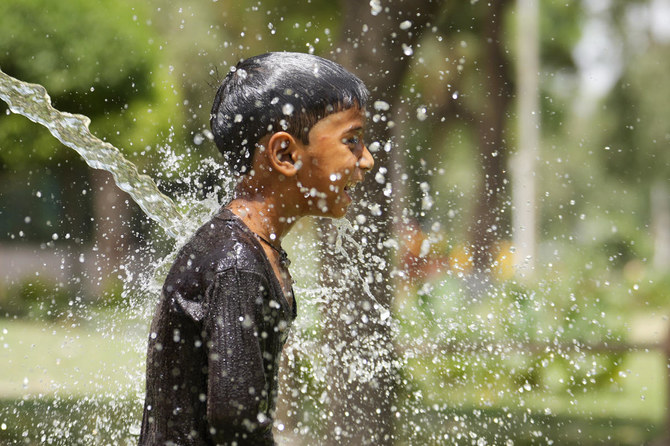
A boy cools himself under an irrigation water pipe as northern Indian continues to reel under intense heat wave in Lucknow in the the Indian state of Uttar Pradesh, Wednesday, April 19, 2023. (AP)
Short Url
Updated 20 April 2023
Follow

India’s heatwaves putting economy, development goals at risk — study

  • The researchers also warned that heatwaves were weakening India’s efforts to meet its “Social Development Goals,” a list of 17 UN objectives to cut poverty, hunger, inequality and disease

SINGAPORE: Killer heat waves are putting “unprecedented burdens” on India’s agriculture, economy and public health, with climate change undermining the country’s long-term efforts to reduce poverty, inequality and illness, a new study showed.
Extreme heat has caused more than 24,000 deaths since 1992 and has also driven up air pollution and accelerated glacial melt in northern India, said a team of scholars led by the University of Cambridge’s Ramit Debnath.
India is now “facing a collision of multiple, cumulative climate hazards,” with extreme weather happening almost every day from January to October last year, they said.
Debnath told Reuters that it was “very important to figure out how we measure vulnerabilities to frequent extreme events,” with the Indian government’s own “climate vulnerability index” believed to underestimate the impact that longer, earlier and more frequent heatwaves will have on development.
As much as 90 percent of India’s total area now lies in extreme heat danger zones, and it is not fully prepared, he warned.
“India has already done quite a bit in terms of heat mitigation — they actually now recognize heatwaves as part of their disaster relief package,” he said. “But there’s a need to optimize the pace of these plans.”
“The adaptation measures that are being put on paper are quite substantial ... and I think they have a very strong solid plan, but it’s how they are implemented.”
The researchers also warned that heatwaves were weakening India’s efforts to meet its “Social Development Goals,” a list of 17 UN objectives to cut poverty, hunger, inequality and disease.
Extreme heat could ultimately lead to a 15 percent decline in “outdoor working capacity,” reduce the quality of life of up to 480 million people and cost 2.8 percent of GDP by 2050, they said.
Falling productivity caused by extreme high temperatures could already be costing India 5.4 percent of its GDP, according to the Climate Transparency Report published by environmental groups last year.


Italian police fire tear gas as protesters clash near Winter Olympics hockey venue

Updated 08 February 2026
Follow

Italian police fire tear gas as protesters clash near Winter Olympics hockey venue

  • Police vans behind a temporary metal fence secured the road to the athletes’ village, but the protest veered away, continuing on a trajectory toward the Santagiulia venue

MILAN: Italian police fired tear gas and a water cannon at dozens of protesters who threw firecrackers and tried to access a highway near a Winter Olympics venue on Saturday.
The brief confrontation came at the end of a peaceful march by thousands against the environmental impact of the Games and the presence of US agents in Italy.
Police held off the violent demonstrators, who appeared to be trying to reach the Santagiulia Olympic ice hockey rink, after the skirmish. By then, the larger peaceful protest, including families with small children and students, had dispersed.
Earlier, a group of masked protesters had set off smoke bombs and firecrackers on a bridge overlooking a construction site about 800 meters (a half-mile) from the Olympic Village that’s housing around 1,500 athletes.
Police vans behind a temporary metal fence secured the road to the athletes’ village, but the protest veered away, continuing on a trajectory toward the Santagiulia venue. A heavy police presence guarded the entire route.
There was no indication that the protest and resulting road closure interfered with athletes’ transfers to their events, all on the outskirts of Milan.
The demonstration coincided with US Vice President JD Vance’s visit to Milan as head of the American delegation that attended the opening ceremony on Friday.
He and his family visited Leonardo da Vinci’s “The Last Supper” closer to the city center, far from the protest, which also was against the deployment of US Immigration and Customs Enforcement agents to provide security to the US delegation.
US Homeland Security Investigations, an ICE unit that focuses on cross-border crimes, frequently sends its officers to overseas events like the Olympics to assist with security. The ICE arm at the forefront of the immigration crackdown in the US is known as Enforcement and Removal Operations, and there is no indication its officers are being sent to Italy.
At the larger, peaceful demonstration, which police said numbered 10,000, people carried cardboard cutouts to represent trees felled to build the new bobsled run in Cortina. A group of dancers performed to beating drums. Music blasted from a truck leading the march, one a profanity-laced anti-ICE anthem.
“Let’s take back the cities and free the mountains,” read a banner by a group calling itself the Unsustainable Olympic Committee. Another group called the Association of Proletariat Excursionists organized the cutout trees.
“They bypassed the laws that usually are needed for major infrastructure project, citing urgency for the Games,” said protester Guido Maffioli, who expressed concern that the private entity organizing the Games would eventually pass on debt to Italian taxpayers.
Homemade signs read “Get out of the Games: Genocide States, Fascist Police and Polluting Sponsors,” the final one a reference to fossil fuel companies that are sponsors of the Games. One woman carried an artificial tree on her back decorated with the sign: “Infernal Olympics.”
The demonstration followed another last week when hundreds protested the deployment of ICE agents.
Like last week, demonstrators Saturday said they were opposed to ICE agents’ presence, despite official statements that a small number of agents from an investigative arm would be present in US diplomatic territory, and not operational on the streets.