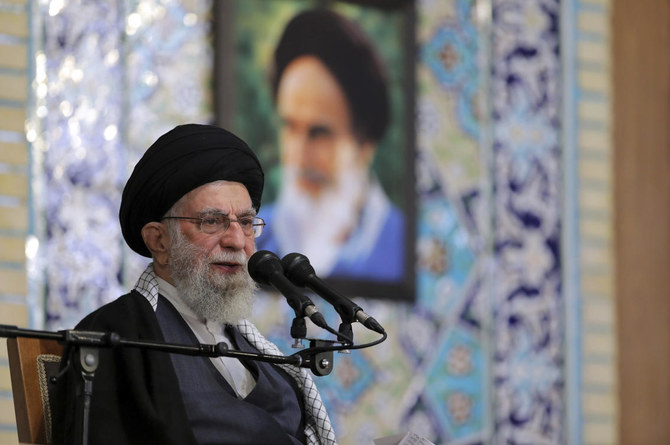
DUBAI: Iran’s supreme leader on Tuesday ruled out the holding of popular referendums on state policies.
Iran faced calls for a referendum on the Islamic Republic itself during anti-government protests last year, and a moderate former president recently suggested such votes should be held to decide major policies as a way of reducing divisions.
Supreme Leader Ayatollah Ali Khamenei, who has the final say over such policies, rejected the idea when asked about it during a meeting with university students.
“Where in the world is this done? Is it possible to hold a referendum for various issues of the country?” he asked. “For any single issue, the country would be engaged in debate and arguments and polarization for six months, so that a referendum can be held on that issue.”
He appeared to be referring to recent remarks by former President Hassan Rouhani, a relative moderate, who had suggested holding referendums on domestic and foreign policies.
Iran holds regular presidential and parliamentary elections overseen by clerical bodies that vet candidates. Under the constitution, a referendum is only possible if two-thirds of parliament votes for it and a 12-member constitutional body — half of whom are appointed by the supreme leader — approves.
Iran saw months of nationwide anti-government protests sparked by the death in September of a 22-year-old woman who was detained by the morality police for allegedly violating the country’s strict Islamic dress code. The protests rapidly escalated into calls for the overthrow of the ruling clerics, marking a major challenge to their four-decade rule.
The protests died down earlier this year amid a violent crackdown by authorities, though there are lingering signs of discontent.
Iran held referendums to establish an Islamic Republic and approve a new constitution shortly after the 1979 revolution. It held another referendum in the late 1980s to amend the constitution.


![]()

Iran’s top leader rules out referendums on divisive issues
Short Url
https://arab.news/jg6ys
Iran’s top leader rules out referendums on divisive issues
- Holding of such votes was impractical and would only worsen the country’s polarization
- Iran holds regular presidential and parliamentary elections overseen by clerical bodies that vet candidates


Latest updates


Recommended


© 2026 SAUDI RESEARCH & PUBLISHING COMPANY, All Rights Reserved And subject to Terms of Use Agreement.