

Soaring inflation dampens Eid holiday spirit in crisis-hit Pakistan

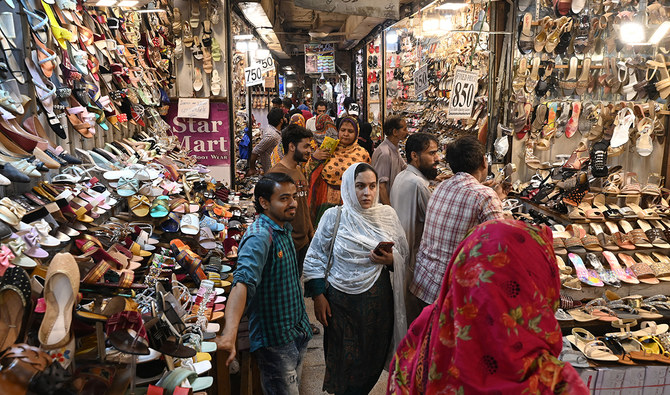
In this picture taken on April 16, 2023, people throng a market during shopping ahead of the upcoming festival of Eid al-Fitr in Lahore. The holiday that marks the end of the Muslim fasting month of Ramadan used to be a guaranteed earner for Pakistan's small shops and businesses -- a big-spending week that could match the take from the rest of the year. (AFP/FILE)
Short Url
Updated 19 April 2023
Follow

Soaring inflation dampens Eid holiday spirit in crisis-hit Pakistan

  • Eid used to be a guaranteed earner for Pakistan’s small shops and businesses, a big-spending week that could match the take from the rest of the year
  • This year, many worry they will not even be able to pay their monthly rent, amid political turmoil and inflation hitting highest levels in decades

LAHORE: The holiday that marks the end of the Muslim fasting month of Ramadan used to be a guaranteed earner for Pakistan’s small shops and businesses — a big-spending week that could match the take from the rest of the year.

This year, however, many worry they will not even make enough to pay their monthly rent, with inflation hitting its highest levels in decades and political turmoil miring the country in uncertainty.

“There are no customers, there are no buyers,” said Shehzad Ahmed, who runs a shop selling bags, jewelry and other goods in the eastern city of Lahore.

The South Asian country of more than 220 million people saw year-on-year inflation hit 35.4 percent in March. Food prices surged more than 47 percent in 12 months, with transport costs rising by 55 percent.

Pakistan is deeply in debt and needs to introduce tough reforms to unlock a tranche of a $6.5 billion bailout from the International Monetary Fund in order to avoid default.

The economy has been wrecked by years of financial mismanagement and political instability — a situation exacerbated by a global energy crisis and devastating floods that left a third of the country under water last year.

The end of Ramadan, Eid Al-Fitr, is celebrated by Muslims around the world by feasting with relatives and friends, exchanging gifts, and dressing up in new clothes and shoes.

The dire economic straits have, however, cast a decidedly somber mood across the country’s normally vibrant markets.

“There are significantly fewer shoppers compared to last year — and it’s because of inflation,” trader Saif Ali told AFP.

Sheikh Amir, who runs a small shop selling glass bangles and imitation jewelry, said he was usually able to earn enough for the whole year during Eid.

“It’s become very difficult these days,” he said. “We are just going through the motions in the hope that we will be able to make enough to pay the rent for our shops.”

Major shopping districts across the country usually see a surge in spending in the week leading up to the holiday, which begins with the sighting of the new moon, expected this weekend.

In urban centers, markets and shops stay open until after midnight — many putting on special offers or sales to attract customers.

Twinkling holiday lights adorn many bazaars to attract customers, while street vendors set up stalls offering special holiday treats.

This year, all have reported a significant drop in sales.

“Our business is slow,” said Ali, who was hoping to sell hundreds of embroidered shawls in the run-up to Eid.

For Fatima Azhar Mehmood, a mother of seven daughters, this Eid will be a budget-conscious one.

“I have to shop for them, and at the same time I have to buy things for the house,” she said.

Instead of buying off-the-rack clothes for the girls, Fatima went shopping for fabric in the Old Lahore district and plans to home-stitch their holiday outfits.

“We have to buy rations, buy things for the children... and our rent is going to be due soon too,” she said.

“Everything is upon us at the same time.”

Shocked at the price of goods this year, Amna Asim decided that in her household, only the children would get gifts this year — adult relatives would have to go without.

“Shopping for the kids is a must,” she said.

“We can’t leave the kids out. Even if we don’t get anything for ourselves we must get something for the kids.”


Pakistani, Bangladeshi officials discuss trade, investment and aviation as ties thaw

Updated 28 December 2025
Follow

Pakistani, Bangladeshi officials discuss trade, investment and aviation as ties thaw

  • Pakistan and Bangladesh were once one nation, but they split in 1971 as a result of a bloody civil war
  • Ties between Pakistan, Bangladesh have warmed up since last year and both nations have resumed sea trade

ISLAMABAD: Pakistan's High Commissioner to Bangladesh Imran Haider on Sunday met Chief Adviser Muhammad Yunus in Dhaka, the latter's office said on, with the two figures discussing trade, investment and aviation.

Pakistan and Bangladesh were once one nation, but they split in 1971 as a result of a bloody civil war, which saw the part previously referred to as East Pakistan seceding to form the independent nation of Bangladesh.

Ties between Pakistan and Bangladesh have warmed up since former prime minister Sheikh Hasina’s ouster as a result of a student-led uprising in August 2024. Relations remain frosty between Dhaka and New Delhi over India’s decision to grant asylum to Hasina.

Pakistan has attempted to forge closer ties with Bangladesh in recent months and both South Asian nations last year began sea trade, followed by efforts to expand government-to-government commerce.

"During the meeting, both sides discussed ways to expand cooperation in trade, investment, and aviation as well as scaling up cultural, educational and medical exchanges to further strengthen bilateral relations between the two South Asian nations," Yunus's office said in a statement on X.

In 2023-24 Pakistan exported goods worth $661 million to Bangladesh, while its imports were only $57 million, according to the Trade Development Authority of Pakistan. In Aug. this year, the Pakistani and Bangladeshi commerce ministries signed a memorandum of understanding to establish a Joint Working Group on Trade, aiming to raise their bilateral trade volume to $1 billion in the financial year that began in July.

The Pakistani high commissioner noted that bilateral trade has recorded a 20 percent growth compared to last year, with business communities from both countries actively exploring new investment opportunities, according to the statement.

He highlighted a significant increase in cultural exchanges, adding that Bangladeshi students have shown strong interest in higher education opportunities in Pakistan, particularly in medical sciences, nanotechnology, and artificial intelligence. Haider also said that Dhaka-Karachi direct flights are expected to start in January.

"Chief Adviser Professor Muhammad Yunus welcomed the growing interactions between the two countries and emphasized the importance of increased visits as well as cultural, educational and people-to-people exchanges among SAARC (South Asian Association for Regional Cooperation) member states," the statement read.

"Professor Yunus also underscored the need to further boost Bangladesh–Pakistan trade and expressed hope that during Mr. Haider’s tenure, both countries would explore new avenues for investment and joint venture businesses."