JAKARTA: Sweeping his small fingers over the white pages of a thick book, Rohman carefully pronounces invisible Arabic words, as he gets better, day by day, in reading the sacred scripture of Islam.
The 15-year-old lost his sight due to undiagnosed illness when the coronavirus pandemic wreaked havoc in Indonesia in 2020. He has since been learning to adapt to life with a disability and last year enrolled in the Raudlatul Makfufin madrasah for the blind in Serpong, near the Indonesian capital, Jakarta, where he learns to read the Qur’an in Braille — by touch.
“I think it is important to learn religion, because I want to make sure my parents go to heaven,” Rohman said, as he sat in front of the school’s mural showing students with the scripture and the motto “Without sight, there is still light.”
Rohman knew about the Raudlatul Makfufin school from a friend, and after joining seven months ago has already learnt how to pray according to the rules and to recite the Qur’an, which he studies every day.
“Learning here, thank God, I am now able to pray smoothly and solemnly, and I can recite Qur’an every day,” he said.
“I am studying at this school for the blind because I want to change my life.”
Established in 1991, Raudlatul Makfufin Islamic Boarding School is run by the Raudlatul Makfufin Foundation.
The school’s Arabic-origin name means “Garden of the Blind” and it is a haven for 26 children.
The school’s headmaster, Ade Ismail, who is also blind, told Arab News that the 13 boys and 13 girls “come here to study religion, especially to learn to read the Qur’an in Braille, and to learn religion, the hadiths, fiqh, ethics and faith.”
Faith is what keeps many of them going, offering not only hope, but also healing and confidence that they can achieve things in life, like some of the most prominent figures in Islamic history, including Imam Bukhari, the ninth-century scholar widely regarded one of the greatest Muslim compilers and of the hadith; Imam Shatibi, the 14th-century scholar of Islamic law; and Abdullah Ibn Umm Maktum, one of the companions of the Prophet Muhammad.
“New students will be told stories about the prominent ulama who were also blind,” Ustad Wijaya, teacher and Raudlatul Makfufin principal, told Arab News.
“For the students who are unable to accept their situation, this school will motivate them, so sooner or later, they will find solace.”
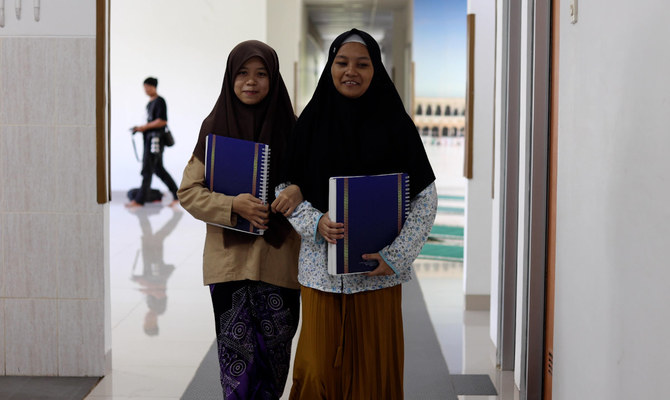
Fedia Jelila, 17, lost her sight only a few years ago.
“Use your time well while you are still able to see. We never know what will happen in the future. Like me, I didn’t even know, I never knew that I would become blind,” she said.
“I was able to see, and now I am able to touch. But there is no regretting, because I know that it all is a story, which not everyone has gone through, but I am experiencing it to inspire others.”
Jelila said that religion played an important role in adapting to her new reality. She read the Qur’an when she could still see, but after her vision went, she had to learn a new way and a new system, Braille, to continue doing so.
At the Raudlatul Makfufin school, her studies focused on religion, but helped her embrace other things and find herself.
“Religion has become my therapy, one that has made me find this school, find friends who are just like me, feel more grateful than before, feel like ‘oh, I have many talents that I did not even realize before, when I still had my sight,’” she said.
“It turned out that I can play table tennis, it turned out that I can write poems, it turned out that I can write short stories, it turned out I can do this and that. It was amazing to discover that I could be independent.”


![]()

For blind Indonesian children, learning Qur’an offers new lease of life
Short Url
https://arab.news/nhrfv
For blind Indonesian children, learning Qur’an offers new lease of life
- Raudlatul Makfufin school near Jakarta is dedicated to teaching blind students
- Faith keeps many of them going, offering not only hope, but also healing


Latest updates


Recommended


© 2026 SAUDI RESEARCH & PUBLISHING COMPANY, All Rights Reserved And subject to Terms of Use Agreement.