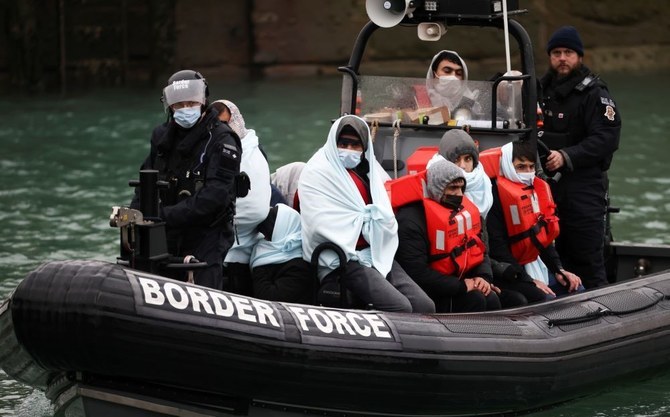

LONDON: Police in the UK have been collecting sensitive information from hundreds of unaccompanied children seeking asylum and then sharing it with immigration authorities, raising concerns that it might be used against them in deportation proceedings, The Observer newspaper reported on Sunday.
In 2016, British authorities launched Operation Innerste in an effort to prevent unaccompanied migrant children living in Home Office-provided hotel accommodation from falling victim to human traffickers. Police officers meet children to have what is described as a “welfare conversation” to help establish a “trusting relationship.” During the interview, the officers take the child’s photograph and fingerprints, and are authorized to use force to ensure the child remains at the location, the Observer said.
According to data released under freedom of information rules, officers have so far collected biometric information on 2,400 children. The Observer also discovered that at one time police were instructed to download the contents of children’s mobile phones. A checklist with Immigration Enforcement, a Home Office department, branding posted on the website of child protective services in Sussex stated that “mobile devices and any SIM cards are to be downloaded” and shared with the Home Office’s command and control unit.
The Home Office said the checklist was out of date and came from either Sussex Police or local authorities in the county, and that “the downloading of phones or devices in the possession of any child does not form a routine part of the safeguarding process.” However, police and local authorities said the checklist originated with the Home Office.
It is unclear whether any children have faced any form immigration enforcement activities, such as detention or deportation, as a result of information gathered during Operation Innerste. When The Observer asked for this information, the Home Office declined to provide it on the grounds that the records of each individual child would need to be checked manually.
“There are legitimate concerns about what this ‘safeguarding’ involves, when some police forces are prosecuting illegal entry and the Home Office is collecting data from these encounters, while seeking to undermine the right to claim asylum,” Benny Hunter, a youth worker and campaigner for the rights of child asylum seekers, told The Observer.
Meanwhile, there is little evidence that Operation Innerste has had much success in its stated aim of preventing young asylum seekers from disappearing. According to the Home Office, 13 of 30 children reported missing between April 2020 and November 2022 were found but 17 remain unaccounted for.
However, The Observer reported in January that 136 children had disappeared during the preceding 18 months from a single hotel in Sussex used to house asylum seekers, 79 of whom remained unaccounted for. Shortly after the story was published, Home Office minister Simon Murray admitted that his department had no idea where 200 missing children might be.
Patricia Durr, chief executive of children’s rights organization Every Child Protected Against Trafficking, told the Observer that a better approach to preventing unaccompanied minors from going missing would be to prioritize appropriate care, accommodation and support, in particular by ending the practice of putting them up in hotels.
A Home Office spokesperson told The Observer “We make no apologies for safeguarding unaccompanied migrant children and it is completely inappropriate to suggest that police should not be part of this process.
“The police conduct vital safeguarding checks for unaccompanied child migrants who arrive into the UK.
“Information is shared with the Home Office and local authorities to support these children’s welfare and safety, and to identify potential offenders and persons likely to expose children to harm.”