

33 Europe-bound migrants dead in boat sinking off Tunisia

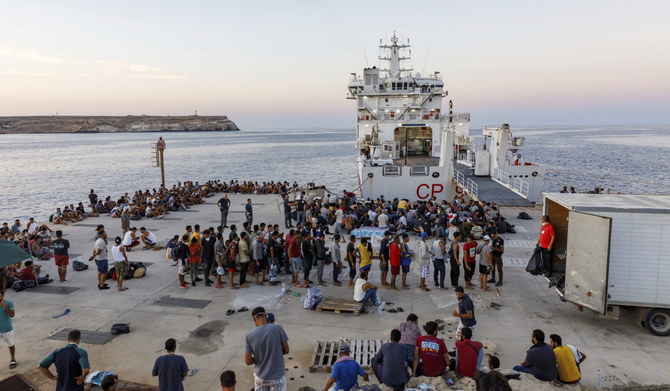
Migrants wait to board an Italian Coast Guard ship in the Sicilian Island of Lampedusa, Italy, Wednesday, Aug. 3, 2022. (AP)
Short Url
Updated 15 April 2023
Follow

33 Europe-bound migrants dead in boat sinking off Tunisia

  • Attempts at illegal migration have increased in recent weeks from the Tunisian coast toward the nearby Italian coast, leaving dozens dead and many missing

TUNIS: The Tunisian coast guard has recovered eight more bodies from a migrant boat that sank off the country’s shores this week, raising the death toll to 33, the coast guard said on Friday.
A wooden boat packed with about 110 African migrants sank on Wednesday off the city of Sfax. Seventy-six people were rescued.
The costguard said four other decomposing bodies were also recovered, apparently from old shipwrecks.
Drowning accidents off Tunisia have increased in recent weeks, leaving dozens dead and missing, amid a sharp rise in migrant boats heading toward Italy from the Tunisian coast.
Tunisia has overtaken Libya as a main departure point for people fleeing poverty and conflict in Africa and the Middle East in the hope of a better life in Europe.
The Tunisian National Guard said this month that more than 14,000 migrants, mostly from sub-Saharan Africa, were intercepted or rescued in the first three months of the year while trying to cross to Europe, five times more than figures recorded in the same period last year.
Attempts at illegal migration have increased in recent weeks from the Tunisian coast toward the nearby Italian coast, leaving dozens dead and many missing.
The central Mediterranean is the most dangerous migration route in the world, according to the International Organization for Migration.
European countries rely on countries in North Africa to police migration, and Italy on Thursday pledged Tunisia a host of investments and help negotiating an International Monetary Fund bailout as the Italian government seeks to stem the number of migrant arrivals.
Tensions around migration have risen in Tunisia this year after President Kaïs Saied ordered a crackdown on sub-Saharan African migrants and lashed out at a perceived plot to erase Tunisia’s identity.
The comments fanned racist abuse target Black people in Tunisia, and prompted international criticism and concern.


Hundreds flee to government-held areas in north Syria ahead of possible offensive

Updated 56 min 18 sec ago
Follow

Hundreds flee to government-held areas in north Syria ahead of possible offensive

  • Many of the civilians who fled used side roads to reach government-held areas
  • Men, women and children arrived in cars and pickup trucks that were packed with bags of clothes

DEIR HAFER, Syria: Scores of people carrying their belongings arrived in government-held areas in northern Syria on Friday ahead a possible attack by Syrian troops on territory held by Kurdish-led fighters east of the city of Aleppo.
Many of the civilians who fled used side roads to reach government-held areas because the main highway was blocked with barriers at a checkpoint that previously was controlled by the Kurdish-led and US-backed Syrian Democratic Forces, Associated Press journalists observed.
The Syrian army said late Wednesday that civilians would be able to evacuate through the “humanitarian corridor” from 9 a.m. to 5 p.m. Thursday. The announcement appeared to signal plans for an offensive against the SDF in the area east of Aleppo.
There were limited exchanges of fire between the two sides.
Men, women and children arrived in cars and pickup trucks that were packed with bags of clothes, mattresses and other belongings. They were met by local officials who directed them to shelters.
In other areas, people crossed canals on small boats and crossed a heavily damaged pedestrian bridge to reach the side held by government forces.
The SDF closed the main highway but about 4,000 people were still able to reach government-held areas on other roads, Syrian state TV reported.
A US military convoy arrived in Deir Hafer in the early afternoon but it was not immediately clear whether those personnel will remain. The US has good relations with both sides and has urged calm.
Inside Deir Hafer, many shops were closed and people stayed home.
“When I saw people leaving I came here,” said Umm Talal, who arrived in the government-held area with her husband and children. She added that the road appeared safe and her husband plans to return to their home.
Abu Mohammed said he came from the town of Maskana after hearing the government had opened a safe corridor, “only to be surprised when we arrived at Deir Hafer and found it closed.”
SDF fighters were preventing people from crossing through Syria’s main east-west highway and forcing them to take a side road, he said.
The tensions in the Deir Hafer area come after several days of intense clashes last week in Aleppo, previously Syria’s largest city and commercial center, that ended with the evacuation of Kurdish fighters from three neighborhoods north of the city that were then taken over by government forces.
The fighting broke out as negotiations stalled between Damascus and the SDF over an agreement reached in March to integrate their forces and for the central government to take control of institutions including border crossings and oil fields in the northeast.
The US special envoy to Syria, Tom Barrack, posted on X Friday that Washington remains in close contact with all parties in Syria, “working around the clock to lower the temperature, prevent escalation, and return to integration talks between the Syrian government and the SDF.”
The SDF for years has been the main US partner in Syria in fighting against the Daesh group, but Turkiye considers the SDF a terrorist organization because of its association with Kurdish separatist insurgents in Turkiye.