

UAE industry minister discusses COP28 with Japan’s foreign minister

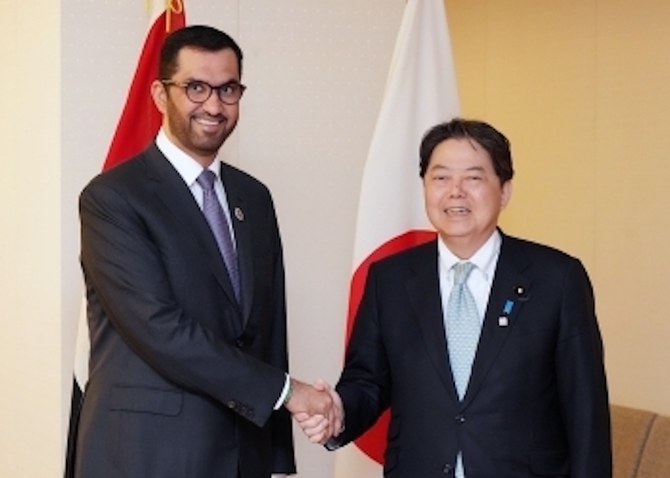
Japanese foreign minister Yoshimasa Hayashi on Friday met with Sultan Al-Jaber, the UAE’s Minister of Industry and Advanced Technology. (MOFA)
Short Url
Updated 14 April 2023
Follow

UAE industry minister discusses COP28 with Japan’s foreign minister

TOKYO: Japanese Foreign Minister Yoshimasa Hayashi on Friday met with Sultan Al-Jaber, the UAE’s Minister of Industry and Advanced Technology who is visiting Japan to participate in the G7 Ministers’ Meeting on Climate, Energy and Environment in Sapporo.

Minister Jaber explained the status of preparations for COP28, which will take place in Dubai in late November and early December.

Hayashi expressed his congratulations on Minister Jaber’s appointment as the COP28 President-Designate and stated that Japan is fully committed to contributing fully to the negotiations for achieving a satisfactory outcome from COP28.


Japanese Foreign Minister Yoshimasa Hayashi on Friday met with Sultan Al-Jaber, the UAE’s Minister of Industry and Advanced Technology. (MOFA)

Hayashi added that Japan attaches great importance to its strategic partnership with the UAE and looks forward to further cooperation in various fields.

The two ministers confirmed that they will continue to work together under the Comprehensive and Strategic Partnership Initiative and exchanged views on cooperation in the fields of defense and on the situation in Ukraine.

Minister Jaber expressed his hopes for further strengthening bilateral relations with Japan.

This story originally appeared on Arab News Japan


Climate change fueled deadly rainstorms in Iberia, Morocco: scientists

Updated 10 sec ago
Follow

Climate change fueled deadly rainstorms in Iberia, Morocco: scientists

  • Nine storms across the three countries have killed more than 50 people and forced over 200,000 to flee their homes, mostly in Morocco
  • The volume of rainfall in places like Grazalema is “staggering,” said Garcia, a climate scientist

MADRID: Human-driven climate change intensified torrential downpours that killed dozens and forced thousands of people from their homes across Morocco, Spain, and Portugal earlier this year, a network of climate scientists said Thursday.
Precipitation during the region’s wettest days now entail around one-third more rainfall compared with the pre-industrial climate, which was 1.3C cooler, according to a report by the World Weather Attribution (WWA), whose scientists study the link between extreme weather events and climate change.
Nine storms unleashed torrential rain and hurricane-force winds across the three countries from 16 January to 17 February, killing more than 50 people and forcing over 200,000 to flee their homes, mostly in Morocco.
Grazalema, one of the hardest-hit municipalities in southern Spain, saw more than a full year’s expected rainfall in just a few days, according to the WWA.
Videos on social media showed residents breaking through the walls of their homes to drain water and prevent further flooding damage.
The volume of rainfall in places like Grazalema is “staggering,” said David Garcia-Garcia, a climate scientist at the University of Alicante and study co-author, calling it a “massive shock” to infrastructure and soil.
The WWA estimates that rainfall intensity is now about 11 percent higher in northern Portugal and northwestern Spain than in pre-industrial times.
The researchers were unable to quantify the exact impact of climate change on rainfall in southern Iberia and northern Morocco, as the available data show regional variations.
“This is exactly what climate change looks like: weather patterns that used to be more manageable are now turning into more dangerous disasters,” said Friederike Otto, a climate scientist at Imperial College London who also worked on the study.
A “blocked” high-pressure system over Scandinavia and Greenland channelled “storm after storm” toward western Europe, resulting in wetter-than-usual conditions, according to the study.
Abnormally warm Atlantic waters west of the Iberian Peninsula “supercharged” the storms with moisture, it added.
The WWA is a pioneer in attribution science, which uses peer-reviewed methods to quickly assess the possible influence of climate change on extreme weather events.
This allows a comparison of a drought or flood today against simulations that consider the climate before the industrial revolution of the 1800s and the smass foss fuel burning that came with it.
The study looked at weather data — in this case the most extreme one-day rainfall events in the three nations — and extrapolated trends back to the pre-industrial era to see how this type of event has changed over time.