

German foreign minister embarks on post-Macron ‘damage control’ in China trip

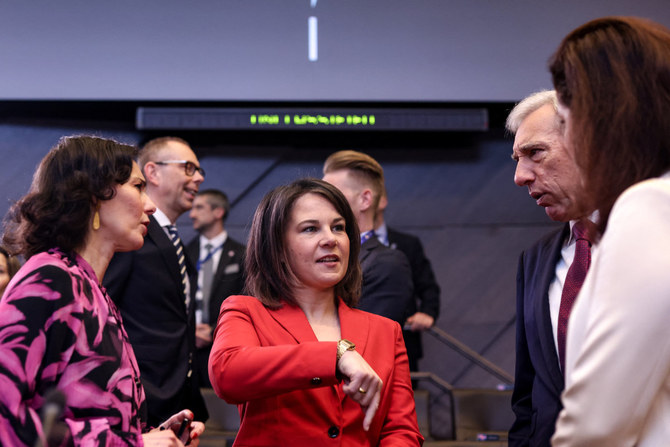
German Foreign Minister Annalena Baerbock (center) meeting with counterparts in the European Union during NATO round table meeting in Brussels on April 5, 2023. (AFP file)
Short Url
Updated 13 April 2023
Follow

German foreign minister embarks on post-Macron ‘damage control’ in China trip

  • Baerbock should show EU solidarity on China, politicians say
  • No interest in economic decoupling from China, Baerbock says

BERLIN: Germany’s foreign minister begins a visit to China on Thursday aiming to reassert a common European Union policy toward Beijing days after remarks by French President Emmanuel Macron suggested disarray in the continent’s approach to the rising superpower.

Macron provoked a backlash in the United States and Europe when he called on the European Union to reduce dependence on the US and cautioned against being drawn into a crisis over Taiwan driven by an “American rhythm and a Chinese overreaction.”
Many European politicians, diplomats and analysts saw Macron’s comments in an interview with Politico and French daily Les Echos as a gift to what they called Beijing’s goal of dismantling transatlantic unity.
As a result, the stakes of the inaugural trip by German Foreign Minister Annalena Baerbock have risen, with many EU members hoping Berlin will use this opportunity to set out a clear and united EU line on China, analysts said.
Macron was widely seen as taking a weak line on Taiwan by warning Europe should not get “caught up in crises that are not ours” – although his office insisted this was not his intended meaning and his position on Taiwan and China had not changed.
“Now it is about damage control to a large degree ... But the cloud of Macron’s visit is very big and still it’s very unclear how this balance will play out in the end,” Alicja Bachulska, a China-EU relations researcher at the European Council on Foreign Relations in Warsaw, told Reuters.
Even without Macron’s remarks the trip would have been delicate for Baerbock, who has been more hawkish on China than Chancellor Olaf Scholz and is drafting a China policy aimed at reducing Germany’s economic dependence on Beijing.
“She was sort of perceived as being a troublemaker. I’d be surprised if this does not play a role at all in her visit,” Tim Ruehlig, China expert at the German Council on Foreign Relations, told Reuters.
Baerbock must now make Germany’s position on Taiwan clear during her visit, German foreign policy parliamentarian Nils Schmid told Reuters, adding Macron’s remarks had destroyed a hoped-for impetus for a common European China policy.
The foreign minister is due to meet her counterpart Qin Gang and China’s top diplomat Wang Yi on the two-day trip.
Speaking ahead of her visit, Baerbock said the top of her agenda would be reminding China of its responsibility to influence Russia to end its invasion of Ukraine and underlining a common European conviction that a unilateral change in the status quo in the Taiwan Strait would be unacceptable.
Europe’s view of China as partner, competitor and systemic rival is the compass of its policy, she added.
“It is clear to me that we have no interest in economic decoupling ... but we must take a more systematic look at the risks of one-sided dependencies and reduce them,” Baerbock said.
Some EU capitals — particularly those in Central and Eastern Europe, which cherish their ties with the US — will be hoping Baerbock’s stance is closer to the one expressed by European Commission President Ursula von der Leyen who visited Beijing at the same time as Macron.
Many analysts drew a contrast between Macron’s remarks and those from von der Leyen that were widely seen as more critical of Beijing. Just days before the visit she said Europe must “de-risk” diplomatically and economically with a hardening China.
“More von der Leyen than Macron should be her guideline,” conservative foreign policy lawmaker Johann Wadephul, who will join Baerbock on her trip, told Reuters.


Journalists in Bangladesh demand protection amid rising attacks

Updated 5 sec ago
Follow

Journalists in Bangladesh demand protection amid rising attacks

  • Media industry in the South Asian country is being systematically targeted
  • Interim government blamed for failing to adequately respond to the incidents
DHAKA: Journalists, editors and owners of media outlets in Bangladesh on Saturday demanded that authorities protect them following recent attacks on two leading national dailies by mobs.
They said the media industry in the South Asian country is being systematically targeted in the interim government headed by Nobel Peace Prize laureate Muhammad Yunus. They said the administration failed to prevent attacks on the Daily Star, the country’s leading English-language daily, and the Prothom Alo, the largest Bengali-language newspaper, both based in Dhaka, the capital.
In December, angry mobs stormed the offices of the two newspapers and set fire to the buildings, trapping journalists and other staff inside, shortly after the death of a prominent Islamist activist.
The newspaper authorities blamed the authorities under the interim government for failing to adequately respond to the incidents despite repeated requests for help to disperse the mobs. Hours later, the trapped journalists who took shelter on the roof of the Daily Star newspaper were rescued. The buildings were looted. A leader of the Editors Council, an independent body of newspaper editors, was manhandled by the attackers when he arrived at the scene.
On the same day, liberal cultural centers were also attacked in Dhaka.
It was not clear why the protesters attacked the newspapers, whose editors are known to be closely connected with Yunus. Protests had been organized in recent months outside the offices of the dailies by Islamists who accused the newspapers of links with India.
On Saturday, the Editors Council and the Newspapers Owners Association of Bangladesh jointly organized a conference where editors, journalist union leaders and journalists from across the country demanded that the authorities uphold the free press amid rising tensions ahead of elections in February.
Nurul Kabir, President of the Editors Council, said attempts to silence media and democratic institutions reflect a dangerous pattern.
Kabir, also the editor of the English-language New Age daily, said unity among journalists should be upheld to fight such a trend.
“Those who want to suppress institutions that act as vehicles of democratic aspirations are doing so through laws, force and intimidation,” he said.
After the attacks on the two dailies in December, an expert of the United Nations said that mob attacks on leading media outlets and cultural centers in Bangladesh were deeply alarming and must be investigated promptly and effectively.
“The weaponization of public anger against journalists and artists is dangerous at any time, and especially now as the country prepares for elections. It could have a chilling effect on media freedom, minority voices and dissenting views with serious consequences for democracy,” Irene Khan said in a statement.
Yunus came to power after former Prime Minister Sheikh Hasina fled the country amid a mass uprising in August, 2024. Yunus had promised stability in the country, but global human rights groups including Human Rights Watch and Amnesty International have blamed the government for its failure to uphold human and other civil rights. The Yunus-led regime has also been blamed for the rise of the radicals and Islamists.
Dozens of journalists are facing murder charges linked to the uprising on the grounds that they encouraged the government of Hasina to use lethal weapons against the protesters. Several journalists who are known to have close links with Hasina have been arrested and jailed under Yunus.