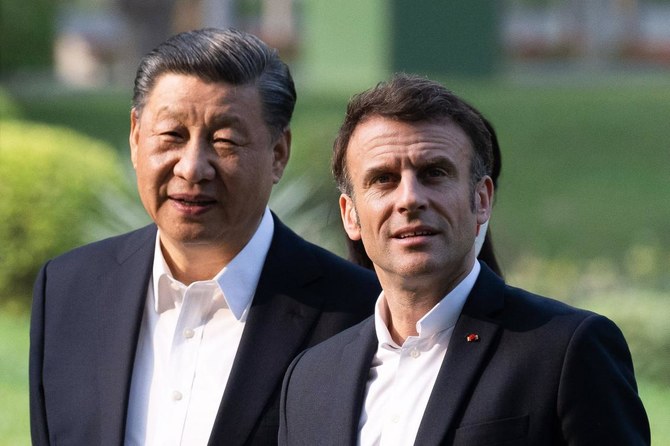
PARIS: French President Emmanuel Macron said in an interview published Sunday that Europe must not be a “follower” of either the US or China on Taiwan, saying that the bloc risks entanglement in “crises that aren’t ours.”
His comments risk riling Washington and highlight divisions in the European Union over how to approach China, as the US steps up confrontation with its closest rival and Beijing draws closer to Russia in the wake of its invasion of Ukraine.
“The worst thing would be to think that we Europeans must be followers and adapt ourselves to the American rhythm and a Chinese overreaction,” Macron told media including French business daily Les Echos and Politico as he returned Friday from a three-day state visit to Beijing.
Citing his prized ideal of EU “strategic autonomy,” the French leader said that “we must be clear where our views overlap with the US, but whether it’s about Ukraine, relations to China or sanctions, we have a European strategy.”
“We don’t want to get into a bloc versus bloc logic,” he added, saying Europe “should not be caught up in a disordering of the world and crises that aren’t ours.”
China views democratic, self-ruled Taiwan as part of its territory and has vowed to take it one day, by force if necessary.
Angered by Taiwanese president Tsai Ing-wen’s meeting last week with US House Speaker Kevin McCarthy, Beijing launched massive military exercises around the island immediately after Macron departed for France, including simulated strikes on its territory.
Macron discussed Taiwan with Chinese leader Xi Jinping on Friday, during a visit in which he was feted but more hawkish EU Commission President Ursula von der Leyen was kept mostly at arm’s length.
His Elysee Palace office said the talks had been “dense and frank” and that the French president was concerned about “growing tensions in the region” that could lead to “a terrible accident.”
Macron was “simply talking about the risk of Chinese ‘overreaction’, forgetting China wishes to change the status quo by taking over Taiwan one way or the other,” Antoine Bondaz of the Paris-based Foundation for Strategic Research (FRS) commented on Twitter.
“Why this desire never to recall we have an interest in maintaining stability?” he added, warning that “this ambiguity... instils doubt in our like-minded partners.”
Taiwan island was just one area that risked “an acceleration of tensions breaking out between the duopoly” of China and the US, Macron said.
If the confrontation escalates too quickly, Europeans “won’t have the time or the resources to finance our strategic autonomy and will become vassals, whereas we can build a third pole if we have a few years,” he added.
Europe’s emergence as an independent geostrategic player has been a goal of Macron’s for years, in line with a tradition going back to Fifth Republic founding president Charles de Gaulle who saw France as a balancing power between the Cold War blocs.

Macron says Europe must not be ‘follower’ of US, China on Taiwan
https://arab.news/r32sc
Macron says Europe must not be ‘follower’ of US, China on Taiwan
- His comments risk riling Washington and highlight divisions in the European Union over how to approach China
- China views democratic, self-ruled Taiwan as part of its territory and has vowed to take it one day
US senators visit key Ukrainian port city as they push for fresh sanctions on Russia
- The visit and the push for Congress to take up sanctions on Russia come at a crucial moment in the conflict
WASHINGTON: A delegation of US senators was returning Wednesday from a trip to Ukraine, hoping to spur action in Congress for a series of sanctions meant to economically cripple Moscow and pressure President Vladimir Putin to make key concessions in peace talks.
It was the first time US senators have visited Odesa, Ukraine’s third-most populous city and an economically crucial Black Sea port that has been particularly targeted by Russia, since the war began nearly four years ago. Democratic Sens. Jeanne Shaheen, Chris Coons, Richard Blumenthal and Sheldon Whitehouse made the trip. Republican Sen. Thom Tillis had planned to join but was unable to for personal reasons.
“One of the things we heard wherever we stopped today was that the people of Ukraine want a peace deal, but they want a peace deal that preserves their sovereignty, that recognizes the importance of the integrity of Ukraine,” Shaheen said on a phone call with reporters.
The visit and the push for Congress to take up sanctions on Russia come at a crucial moment in the conflict. Delegations for the two sides were also meeting in Switzerland for two days of US-brokered talks, but neither side appeared ready to budge on key issues like territory and future security guarantees. The sanctions, senators hoped, could prod Putin toward settling for peace, as the US has set a June deadline for settlement.
“Literally nobody believes that Russia is acting in good faith in the negotiations with our government and with the Ukrainians,” Whitehouse said. “And so pressure becomes the key.”
Still, legislation to impose tough sanctions on Russia has been on hold in Congress for months.
Senators have put forward a range of sanction measures, including one sweeping bill that would allows the Trump administration to impose tariffs and secondary sanctions on countries that purchase Russia’s oil, gas, uranium and other exports, which are crucial to financing Russia’s military. The Senate Foreign Relations Committee has also advanced a series of more-targeted bills that would sanction China’s efforts to support Russia’s military, commandeer frozen Russian assets and go after what’s known as Moscow’s “shadow fleet” of oil tankers being used to circumvent sanctions already in place.
Republican Sen. Lindsey Graham, who has co-sponsored the Senate’s sweeping sanctions and tariff legislation, also released a statement during the Munich Security Conference this weekend saying that Senate Majority Leader John Thune had committed to bringing up the sanctions bill once it clearly has the 60 votes needed to move through the Senate.
“This legislation will be a game changer,” Graham said. “President Trump has embraced it. It is time to vote.”
Blumenthal, who co-sponsored that bill alongside Graham, also said there is bipartisan support for the legislation, which he called a “very tough sledgehammer of sanctions and tariffs,” but he also noted that “we need to work out some of the remaining details.” Democrats, and a handful of Republicans, have been opposed to President Donald Trump’s campaign to impose tariffs around the world in an effort to strike trade deals and spur more manufacturing in the US
In the House, Democrats are opposed to the tariff provisions of that bill. Instead, a bipartisan group of lawmakers, led by Republican Rep. Brian Fitzpatrick, has proposed separate legislation that makes it more difficult for Trump to waive sanctions, but does away with the tariff provisions.
A separate bill, led by the top Democrat on the House Foreign Affairs Committee, Rep. Gregory Meeks, would bolster US military support for Ukraine by $8 billion. Democrats currently need one more Republican to support an effort to force a vote on that bill.
Once they return to the US, the senators said they would detail how US businesses based in Ukraine have been attacked by Russia. The Democrats are also hoping to build pressure on Trump to send more US weapons to Ukraine. “Putin understands weapons, not words,” Blumenthal said.
Still, the lawmakers will soon return to a Washington where the Trump administration is ambivalent about its long-term commitments to securing peace in Ukraine, as well as Europe. For now, at least, they were buoyed by the conversations from their European counterparts and Republican colleagues.
“We and the Republican senators who were with us in Munich spoke with one voice about our determination to continue to support Ukraine,” Coons said.