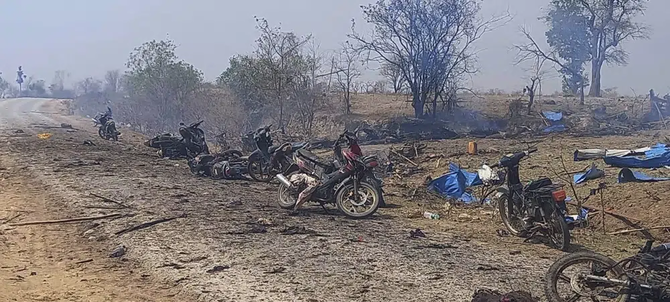
YANGON: At least 100 people have been killed in a Myanmar military airstrike, leaving relatives to recover the charred bodies of victims on Wednesday following one of the deadliest attacks since the junta seized power two years ago.
The military air attack struck Kanbalu township in the central Sagaing region early on Tuesday, where hundreds, mostly civilians, had gathered to celebrate the opening of a local administration office under the authority of the shadow National Unity Government.
Like much of Sagaing, Pa Zi Gyi village and surrounding areas are not under the control of the junta, which confirmed the attack late on Tuesday and accused NUG’s armed wing, the People’s Defense Forces, of coercing residents into supporting them.
“I lost my youngest brother, brother-in-law, aunty, uncle, niece and nephew in the airstrike,” Myo, a resident of Pa Zi Gyi, told Arab News on Wednesday.
“It’s proof that the junta is a ruthless organization led by the dictator and they acted like a mad dog,” he said. “I will fight against that cruel regime regardless of my life and soul.”
Infants and the elderly were among those killed in the strike, villagers told Arab News.
“People in the area have never fought against the military, but still I have no idea why the junta launched an attack on the area and killed the people,” Zaw, another resident, said.
Zaw said that his uncle and cousins were killed in the airstrike.
“I am in despair, but I don’t cry,” he said. “Because our village is severely harmed by that brutal attack by the military, I want the People’s Defense Force to continue protecting our village.”
Arab News has used aliases for Myo and Zaw to protect their identity.
The initial death toll from Tuesday’s attacks stood at 53, but was later raised to about 100 by independent media and voluntary rescuers at the scene.
Images shared online, which appeared to have been taken after the attack, showed people in civilian clothes dead on the ground beside a destroyed structure.
The airstrike has sparked widespread condemnation, as human rights organizations called for more concrete action from the international community.
Human Rights Watch said the latest airstrike should lead to an international arms embargo against the Myanmar junta.
“This is part of a larger pattern that we are seeing across Myanmar, where the security forces are targeting civilians in a systematic way. These are the sorts of crimes against humanity that we have been speaking about,” Phil Roberston, Human Rights Watch Asia division deputy director, said in a video statement.
Myanmar’s military has carried out a string of deadly airstrikes, including one targeting a concert in Kachin state in October that killed at least 60 people.
“It’s quite clear that the civil war in Myanmar is intensifying. There’s no doubt about that. We are entering a situation where neither side is conceding anything, that there are attacks happening every day all across the country. And I expect it will intensify further.”


![]()

Myanmar military airstrike on village gathering kills at least 100
Short Url
https://arab.news/wy6ke
Myanmar military airstrike on village gathering kills at least 100
- Deadly attack targeted a largely civilian gathering in central Sagaing region
- Witnesses recount horror of bombing and death of family members


Latest updates


© 2026 SAUDI RESEARCH & PUBLISHING COMPANY, All Rights Reserved And subject to Terms of Use Agreement.