

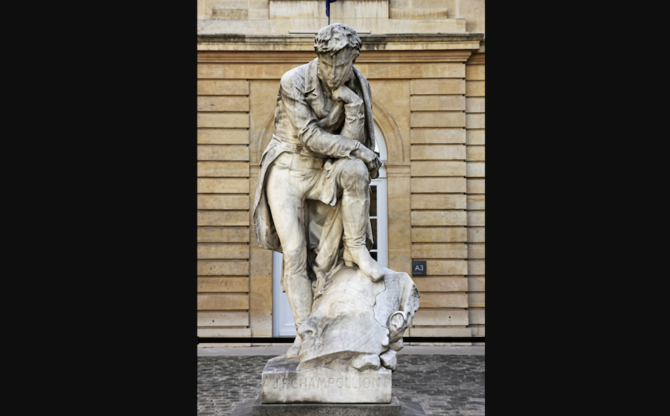
Zahi Hawass calls for removal of ‘offensive’ Champollion statue at College de France

The statue in question, located in the courtyard of College de France, depicts Champollion standing with his foot on the head of the statue of Ramses. (Wikimedia Commons/NonOmnisMoriar/CC BY-SA 3.0)
Short Url
Updated 09 April 2023
Follow

Zahi Hawass calls for removal of ‘offensive’ Champollion statue at College de France

  • Artwork depicts French archeologist with foot on head of Ramses
  • Egypt repeats request for the return of an array of precious antiquities

CAIRO: Dr. Zahi Hawass, the world-renowned archaeologist and Egyptologist, has called for the removal or relocation of the statue of French archeologist Jean Francois Champollion, which is located in the courtyard of College de France, because it is offensive to the Egyptian people.

The statue depicts Champollion standing with his foot on the head of the statue of Ramses.

Hawass made the request during a lecture recently delivered at a major antiquities exhibition in Paris entitled “Ramses the Great and the Gold of the Pharaohs,” which continues until Sept. 17.

“This statue shows contempt and a lack of appreciation that is not reciprocated by the Egyptian people, who appreciated Champollion’s role in the field of Egyptology and named a street after him,” Hawass said.

“Therefore, we demand the same amount of respect.”

In addition to the coffin of one of ancient Egypt’s longest-ruling pharaohs, Ramses II, the exhibition includes an array of ancient Egyptian artefacts, including solid gold and silver jewelry, statues, amulets, masks and other sarcophagi.

State-of-the-art multimedia reproductions are showcasing ancient Egyptian civilization and provide visitors insight into the life and accomplishments of Ramses II.

The traveling exhibition has been held in several major cities.

It was inaugurated in Houston in November 2021 before moving to San Francisco in August last year.

Champollion’s statue is made from limestone, crafted from a single stone block. Champollion is the French scholar who unlocked the secrets of ancient Egypt’s hieroglyphs. It was sculpted by Frederic Auguste Bartholdi in 1875.

Meanwhile, Hawass also called on France to return other antiquities. “The Zodiac ceiling (Dendera zodiac) currently displayed in the Louvre Museum must be returned to its original home, to be placed in the Dendera Temple in Qena Governorate (southern Egypt).”

The Dendera zodiac is an ancient Egyptian depiction of the sky and stars. It is a circular bas-relief carving from the ceiling of the Temple of Hathor in Dendera.

The zodiac is one of the oldest known depictions of the constellations.

Gen. Louis Desaix, a member of Napoleon’s expedition to Egypt, was so captivated by the Zodiac Ceiling that he commissioned artist Denon to draw it for the Description de L’Egypte, the record of the expedition's exploration of Egypt.

The ceiling’s beauty and significance did not go unnoticed by French collector Sebastien Saulnier. He decided that such a remarkable piece should belong to France.

However, Saulnier was determined to keep his plan a secret and announced that he was excavating at Thebes, where he purchased mummies and antiquities to cover his tracks.

During this time, some English visitors were also sketching at Dendera, and only after they left did Saulnier return.

With the help of his French agent, Saulnier removed the Ceiling of the Temple and transported it to Paris.

The ceiling was eventually sold to King Louis XVIII for 150,000 francs.

Last October, Hawass launched an electronic signature campaign to demand the return of the Rosetta Stone from the British Museum in London and the Zodiac Ceiling from the Louvre Museum in France.

Hawass said at the time: “The Zodiac is considered a unique and important Egyptian artifact, and removing it from its original location is immoral as it is a symbol of Egyptian civilization that must be returned to its rightful place.”


Hamas to hold leadership elections in coming months: sources

Updated 4 sec ago
Follow

Hamas to hold leadership elections in coming months: sources

  • A Hamas member in Gaza said Hayya is a strong contender due to his relations with other Palestinian factions, including rival Fatah, which dominates the Palestinian Authority, as well as his regional standing

GAZA CITY, Palestinian Territories: Hamas is preparing to hold internal elections to rebuild its leadership following Israel’s killing of several of the group’s top figures during the war in Gaza, sources in the movement said on Monday.
“Internal preparations are still ongoing in order to hold the elections at the appropriate time in areas where conditions on the ground allow it,” a Hamas leader told AFP.
The vote is expected to take place “in the first months of 2026.”
Much of the group’s top leadership has been decimated during the war, which was sparked by Hamas’s unprecedented attack on Israel in October 2023.
The war has also devastated the Gaza Strip, leaving its more than two million residents in dire humanitarian conditions.
The leadership renewal process includes the formation of a new 50-member Shoura Council, a consultative body dominated by religious figures.
Its members are selected every four years by Hamas’ three branches: the Gaza Strip, the occupied West Bank and the movement’s external leadership.
Hamas prisoners in Israeli prisons are also eligible to vote.
During previous elections, held before the war, members across Gaza and the West Bank used to gather at different locations including mosques to choose the Shoura Council.
That council is responsible, every four years, for electing the 18-member political bureau and its chief, who serves as Hamas’s overall leader.
Another Hamas source close to the process said the timing of the political bureau elections remains uncertain “given the circumstances our people are going through.”
After Israel killed former Hamas chief Ismail Haniyeh in Tehran in July 2024, the group chose its then-Gaza chief Yahya Sinwar as his successor.
Israel accused Sinwar of masterminding the October 7 attack.
He too was killed by Israeli forces in the southern Gaza city of Rafah, three months after Haniyeh’s assassination.
Hamas then opted for an interim five-member leadership committee based in Qatar, postponing the appointment of a single leader until elections are held and given the risk of being targeted by Israel.
According to sources, two figures have now emerged as frontrunners to be the head of the political bureau: Khalil Al-Hayya and Khaled Meshaal.
Hayya, 65, a Gaza native and Hamas’s chief negotiator in ceasefire talks, has held senior roles since at least 2006, according to the US-based NGO the Counter-Extremism Project (CEP).
Meshaal, who led the Political Bureau from 2004 to 2017, has never lived in Gaza. He was born in the West Bank in 1956.
He joined Hamas in Kuwait and later lived in Jordan, Syria and Qatar. The CEP says he oversaw Hamas’s evolution into a political-military hybrid.
He currently heads the movement’s diaspora office.
A Hamas member in Gaza said Hayya is a strong contender due to his relations with other Palestinian factions, including rival Fatah, which dominates the Palestinian Authority, as well as his regional standing.
Hayya also enjoys backing from both the Shoura Council and Hamas’s military wing, the Ezzedine Al-Qassam Brigades.
Another source said other potential candidates include West Bank Hamas leader Zaher Jabarin and Shoura Council head Nizar Awadallah.