

Israel hits Syria after rockets fired on Golan Heights

1 / 2
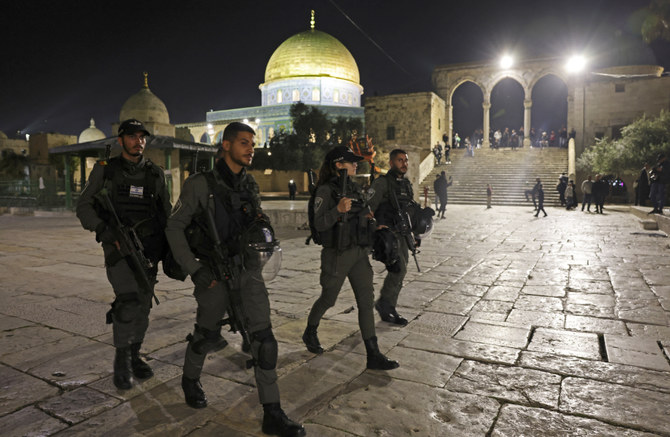
Israeli security forces patrol outside the Dome of the Rock shrine in Jerusalem's al-Aqsa Mosque compound during the holy fasting month of Ramadan, on April 8, 2023. (AFP)
2 / 2
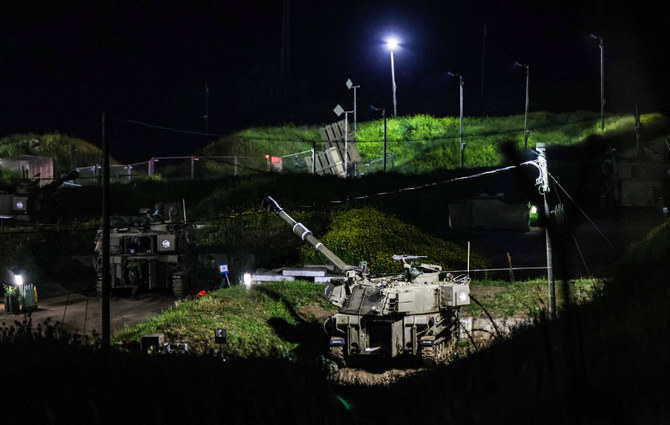
This file photo taken on April 6, 2023 shows a view of Israeli self-propelled artillery howitzers stationed at an Israeli army base in Zawra in the Israeli-annexed Golan Heights. (AFP)
Short Url
Updated 09 April 2023
Follow

Israel hits Syria after rockets fired on Golan Heights

  • In the occupied West Bank, Israeli security forces fatally shot a 20-year-old Palestinian in the town of Azzun, Palestinian health officials said, stirring protests in the area

JERUSALEM: Israel fired rockets at Syria early on Sunday in retaliation for launches against Israeli-controlled territory, the military said, as tension along Israel’s northern border remained high following a cross-border exchange of fire.
No damage was reported from any of the six rockets launched toward Israel, which Lebanon-Based Al Mayadeen TV said were claimed by Al-Quds Brigades, the armed wing of the Iranian-backed Palestinian Islamic Jihad movement.
Israel said it had launched artillery strikes and a drone against the rocket launchers in Syria. Only three of the rockets crossed into Israeli-controlled territory, with two falling into open ground and a third intercepted by air defense systems, the military said.
The strikes came amid sharply increased tensions between Israel and Palestinian groups following Israeli raids this week on Al-Aqsa mosque in Jerusalem during the Muslim holy month of Ramadan when police were filmed beating worshippers.
The police raid, which Israel said was intended to dislodge groups that had barricaded themselves into the mosque armed with firecrackers and stones, caused outrage among Arab countries and concern even among Israel’s US allies.
Despite fears of further violence around the mosque on Saturday, there were no reports of serious disturbances.
The site in Jerusalem’s Old City, holy to both Muslims and Jews, who know it as Temple Mount, has been a longstanding flashpoint, notably over the issue of Jewish visitors defying a ban on non-Muslim prayer in the mosque compound.
Clashes there in 2021 helped set off a 10-day war between Israel and Hamas and the exchange of crossborder fire this week Friday awakened memories of that conflict.
On Thursday, more than 30 rockets were fired toward Israel from southern Lebanon, drawing cross-border counterstrikes from Israel on sites linked to the Islamist movement Hamas in Lebanon and Gaza.
Israel seized the Golan Heights in the 1967 Middle East war and annexed the 1,200-square-km (460-square-mile) in 1981, a move not recognized by most of the international community.
In a separate incident, a Palestinian man was shot dead by Israeli forces during a confrontation in the occupied West Bank, Israel’s military and the Palestinian health ministry said.


Ambassadors, military attaches visit border villages, are briefed on weapons centralization south of Litani River

Updated 6 sec ago
Follow

Ambassadors, military attaches visit border villages, are briefed on weapons centralization south of Litani River

  • Aoun: Contacts ongoing at home and abroad to consolidate security in southern Lebanon

BEIRUT: A delegation of Arab and foreign ambassadors and military attaches toured areas south of the Litani River on Monday, accompanied by Lebanese Army Chief Gen. Rodolphe Haykal, for a briefing on the progress in implementing the plan to confine weapons to the state.

According to a military source, the visit aimed to “review the tasks being carried out by the Lebanese Army to implement the Homeland Shield Plan mandated by the Council of Ministers.”

The first phase of the plan is scheduled to conclude by the end of this month, after which the army will move to the next stage: centralizing all weapons north of the Litani line.

Diplomats are expected to convey their field observations to their respective governments on the eve of a US–Saudi–French meeting with the army commander on Dec. 17 and 18 in Paris, where they will also discuss supporting the Lebanese Army, the weapons centralization plan, and the progress achieved.

The commander of the southern Litani sector, Brig. Gen. Nicolas Thabet, briefed the diplomatic delegation on the operations being carried out by the army during a meeting held at the Benoit Barakat Barracks in Tyre, which was joined by the army commander and senior officers. The delegation then moved on to inspect the western sector.

Haykal stressed “the importance of supporting the army and the commitment of all parties to the ceasefire agreement and respect for Lebanese territorial sovereignty.”

While Thabet presented an operational overview to the ambassadors, diplomats focused on evaluating the first phase of the weapons centralization plan, the mechanisms for transitioning to the second phase, and the obstacles facing the army.

The diplomats inspected several army positions deployed along the forward edge, including the town of Aita Al-Shaab and the Wadi Zibqin area, where a Hezbollah facility had previously been located.

A week earlier, Thabet had disclosed that “during the execution of its mission south of the Litani, the army has dealt with 177 tunnels since the launch of the Homeland Shield Plan, closed 11 crossings along the Litani River, and seized 566 rocket launchers.”

Monday’s tour coincided with a meeting on the other side of the border between US Envoy Thomas Barrack and Israeli Prime Minister Benjamin Netanyahu in Tel Aviv, focused on de-escalating tensions with Lebanon and Syria.

On Monday, Israel continued through its media to promote the prospect of an imminent Israeli military escalation against Hezbollah unless it is disarmed by the end of the year.

According to the Lebanese Army, “the recent Israeli strikes targeted civilian homes. The army inspected them after they were hit and found no evidence that they contained any weapons.”

Army command further clarified that “after the Israeli enemy threatened two days ago to bomb homes, the Lebanese Army conveyed a message to the relevant mechanism expressing its readiness to inspect the houses before any strike to determine whether they contained weapons or ammunition.”

However, Israeli forces allegedly rejected the proposal and went ahead with air raids on the homes, destroying them.

For his part, President Joseph Aoun said on Monday before visitors that “contacts are ongoing domestically and internationally to consolidate security and stability in the south through negotiations via the mechanism committee, which will hold a meeting next Friday.”

He added that the mechanism’s work “enjoys Lebanese, Arab, and international support, particularly following the appointment of former Ambassador Simon Karam as head of the Lebanese delegation.”

Aoun noted that “the choice of negotiation is the alternative to war, which would yield no results but would cause further harm and destruction to Lebanon and the Lebanese without exception.”