Compounding crises dampen Easter joy for Lebanon’s Christian community

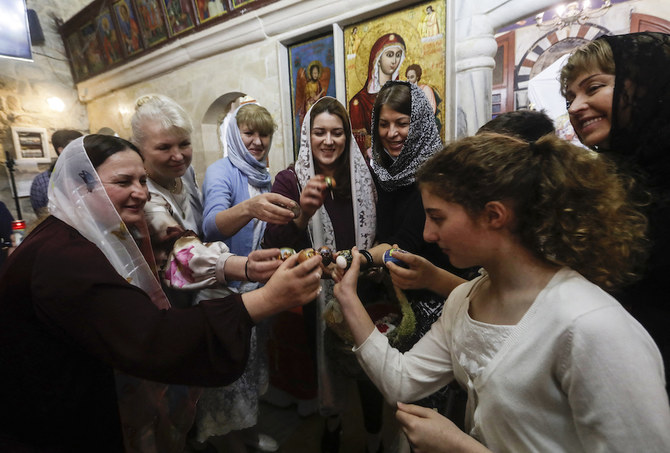
Egg tapping is an Easter tradition in Lebanon but competition may be scarce this year with a box of eggs costing 500,000 Lebanese pounds. (AFP)
Short Url
Updated 09 April 2023
Follow

Compounding crises dampen Easter joy for Lebanon’s Christian community

  • More than half of country’s population in need of food assistance, according to the UN World Food Programme
  • Easter items from candles to chocolates have become too expensive for many to afford as purchasing power drops

BEIRUT: As the women gather around the table to make maamoul cookies for Easter, they all feel that this year’s celebrations will be different, and probably for the worse.

Hala Dagher, speaking on behalf of her sisters, said: “This year we decided to split the cost of maamoul and only make half of the usual quantity.

“Maamoul cookies represent blessings and we cannot celebrate Easter without them, even in a small amount.”

The Lebanese are known for their attachment to family and traditions, especially on special occasions and holidays. One of the country’s traditions, especially at Easter, is that women gather a few days before the big weekend to make maamoul cookies filled with walnuts, pistachios, or dates.

The cookies are among the most famous Lebanese sweets prepared for Easter. The dough is made of semolina, sugar, butter, rose water and blossom water, and can be covered in icing sugar. The dough is traditionally made on Good Friday and the cookies baked the following day.
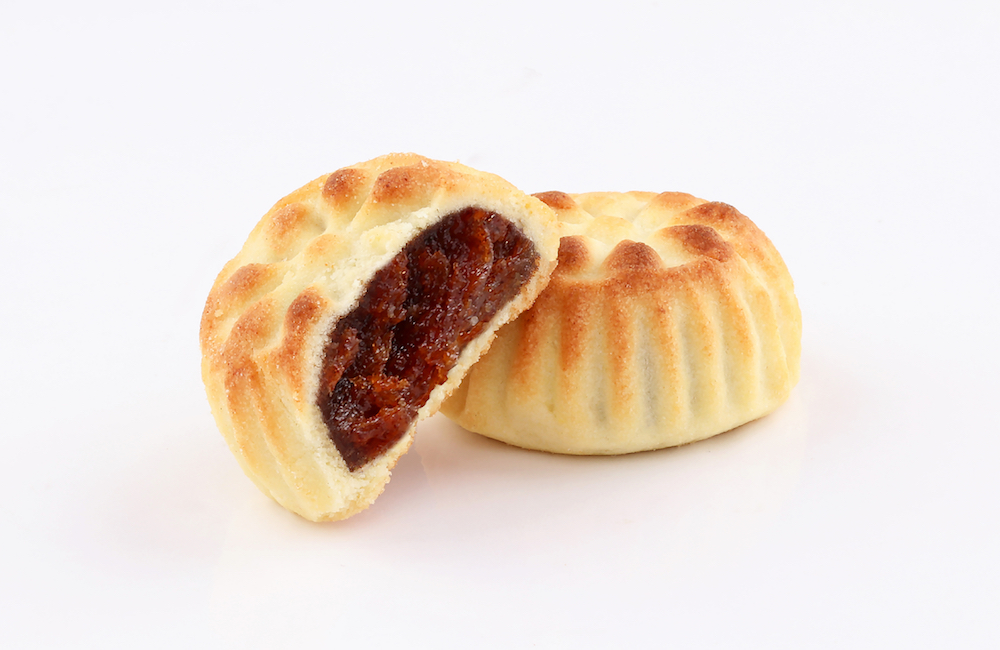


Maamoul cookies are among the most famous Lebanese sweets prepared for Easter. (Shutterstock)

However, austerity has hit many Lebanese homes as all ingredients are priced in US dollars.

Very few people have decorated for Easter this year, and many will not be buying eggs to paint as a symbol of resurrection and life.

Those who buy chocolate eggs are rare as the treats have become too expensive.

A World Food Program report showed that more people than ever are relying on food assistance across Lebanon as the country suffers from one of the world’s worst economic crises.

It said: “More than half of the Lebanese population are now in need of assistance to cover their food and other basic needs.

“The local currency’s sharp decline is paralyzing people’s purchasing power as the Lebanese lira reaches a new record low each day, propelling food price increases.”

Dagher said: “We have been dispensing with many holiday traditions because they are out of our budget.

“We even decided to make homemade Palm Sunday candles, using an olive branch and some ribbon to decorate them. We cannot deprive our children of joy. The simplest candle costs $15 and that’s 1,500,000 Lebanese pounds, the equivalent of half of my salary as a public sector employee.”

Samah Dagher, a relative of Hala’s, makes floral party decorations for private events.
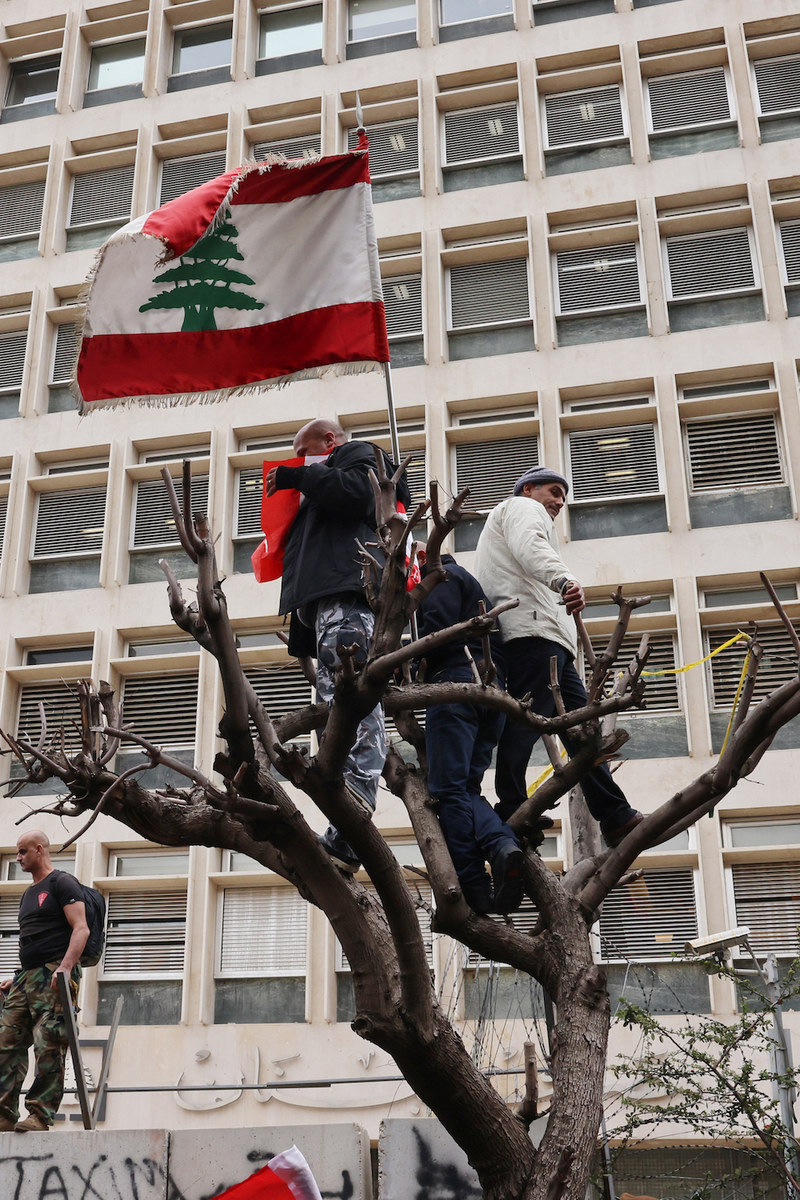


Protesters demand inflation adjustments to pensions outside the central bank in Beirut on March 30. (AFP)

She said: “Easter this year is the worst; the rich would rather spend the holidays abroad.

“Families who have relatives living abroad visit them for the holidays. The well-off families who remain in Lebanon are reluctant to spend their money on luxuries because they are afraid of a darker future.

“Their money has been withheld by banks so they are very cautious when it comes to spending their cash because they have no confidence in the state.

“Although I’m barely working, I still believe that all children must enjoy the holidays and carry candles on Palm Sunday, so I agreed with a priest in Beirut to split the cost of decorating children’s candles. The child brings the candle and we decorate it. That way we keep the joy of the holiday alive.”

Claudine Pichon, a Lebanese woman of French origins who sells homemade sweets, said: “Some families who used to order one kilogram of maamoul cookies are now ordering half a kilo. However, others are barely affected by the economic crisis and have not changed their usual orders.”

Pichon is amazed at the price differences from just a year ago.

She said: “A kilo of pistachios cost $16 last year; it’s $22 this year. A big box of butter costs 9,500,000 Lebanese pounds, compared to 3,000,000 Lebanese pounds last year.

“If we take into account the cost of gas, electricity, and delivery, the cost of making and selling maamoul cookies has doubled.”

Maamoul prices vary from one pastry shop to another but the price of a kilo with dates in popular stores ranges between $12 and $22.

The price of maamoul with walnuts is between $19 and $26, while with pistachios it exceeds $30. The price of a kilo of chocolate eggs is $35.
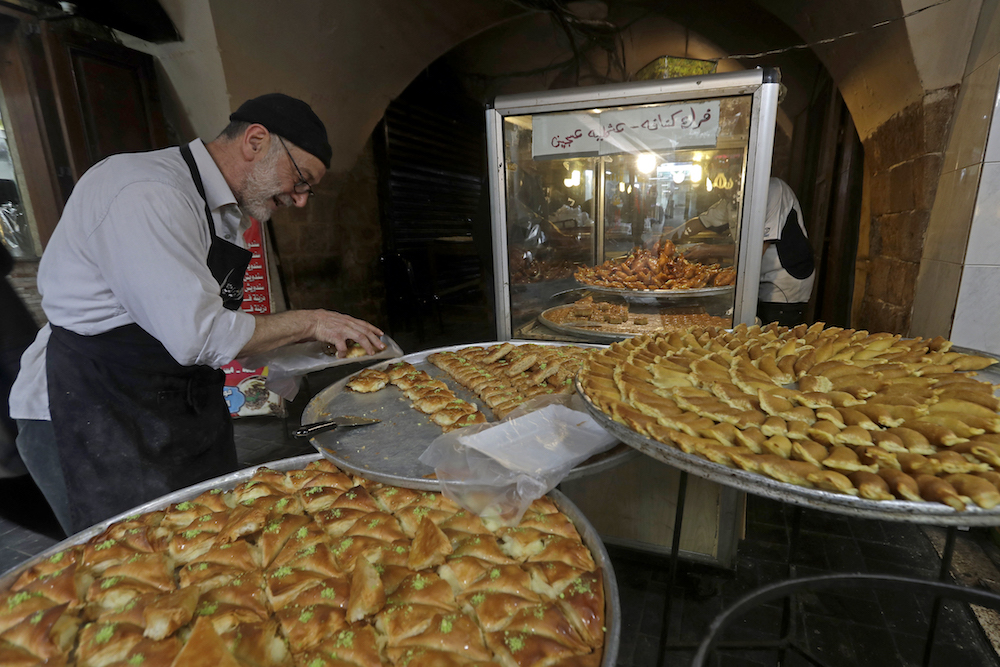


A vendor sells traditional sweets at a market in the southern city of Sidon on March 23, 2023 as Muslims shop during the holy fasting month of Ramadan. (AFP) 

Pichon added: “People want to rejoice at Easter, and we, as sweetmakers, cannot raise our prices much, otherwise no one will buy our products.”

A great Easter tradition in Lebanon is egg tapping. As family members gather after Sunday lunch, each person chooses a decorated colored egg before engaging in the egg-tapping competition. The person whose egg remains uncracked wins.

However, the competition may be scarce in the country this year with the price of a box of eggs at 500,000 Lebanese pounds.

Shops would usually be filled with chocolate eggs and Easter decorations at this time of year, but very few people are shopping ahead of the festival.

Nawal, a clothing store employee in the Furn El Chebbak, said: “Since everything is priced in US dollars but people are still getting paid in Lebanese pounds, the people’s purchasing power has significantly dropped.

“Many no longer visit shops that carry well-known brands and shop at outlet stores.”

Large numbers of Christian youths have left the country in the last three years, particularly in the aftermath of the Beirut port explosion.

The presidential vacuum is another issue, while tensions remain between Christian parties.

Christian lawmakers were scheduled to respond to the invitation of Maronite Patriarch Bechara Boutros Al-Rahi for a meeting of prayer and repentance on April 5, in an attempt to curb tensions.

Meanwhile, charities are struggling to provide relief and assistance for needy families. Religious authorities urge Christians to remain in Lebanon, but all the people can do this Easter is pray for their country’s resurrection.


Young Palestinian boy drowns in muddy water flooding his Gaza tent camp, UN says

Updated 4 sec ago
Follow

Young Palestinian boy drowns in muddy water flooding his Gaza tent camp, UN says

JERUSALEM: The UN said Thursday that a Palestinian boy in the Gaza Strip drowned in floods that engulfed his tent camp, with videos showing rescuers trying to pry his body out of muddy waters by pulling him by the ankle. It was the latest sign of the miseries that winter is inflicting on the territory’s population, with many left homeless by the devastation from two years of war.
Health officials also reported the death of another 9 year-old boy in Gaza Thursday, but the circumstances were not clear.
Meanwhile, in the West Bank, Israeli forces carried out a sweep of arrests, seizing around 50 Palestinians, many from their homes, a Palestinian group representing prisoners said.
As 2026 begins, the shaky 12-week-old ceasefire between Israel and Hamas has largely ended large-scale Israeli bombardment of Gaza. But Palestinians are still being killed almost daily by Israeli fire, and the humanitarian crisis shows no signs of abating. At least three Israeli soldiers have died in Gaza since the ceasefire came down, killed by militant attacks or explosive detonations.
Young boy drowned from flooding
UNICEF said Thursday that 7-year-old Ata Mai had drowned Saturday in severe flooding that engulfed his tent camp in Gaza City. Mai’s was the latest child death reported in Gaza as storms, cold weather and flooding worsen already brutal living conditions. Almost the entire population of more than 2 million people have lost their homes, and most are living in squalid tent camps with little protection from the weather.
UNICEF said Mai had been living with his younger siblings and family in a camp of around 40 tents. They lost their mother earlier in the war.
Video from Civil Defense teams, shown on Al Jazeera, showed rescue workers trying to get Mai’s body out of what appeared to be a pit filled with muddy water surrounded by wreckage of bombed buildings. The men waded into the water, pulling at the boy’s ankle, the only part of his body visible. Later, the body is shown wrapped in a muddy cloth being loaded into an ambulance.
Over past weeks, cold winter rains have repeatedly lashed the sprawling tent cities, causing flooding, turning Gaza’s dirt roads into mud and causing buildings damaged in Israeli bombardment to collapse. UNICEF says at least six children, including Mai, have now died of weather-related causes, including a 4-year-old who died in a building collapse.
The Gaza Ministry of Health says three children have died of hypothermia.
“Teams visiting displacement camps reported appalling conditions that no child should endure, with many tents blown away or collapsing entirely,” said Edouard Beigbeder, regional director for UNICEF’s Middle East and North Africa division.
West Bank arrest raid
The Palestinian Prisoner’s Society said Israeli troops had arrested at least 50 Palestinians across the West Bank and interrogated many of them overnight. Most of the arrests occurred in the Ramallah area, said the group, which is an official body within the Palestinian Authority.
“These operations were accompanied by widespread raids, abuse and assault against detainees and their families, in addition to extensive acts of vandalism and destruction inside citizens’ homes,” the group alleged.
Israel’s military did not immediately comment on the raid.
The society says that Israel has arrested 7,000 Palestinians in the West Bank and Jerusalem this year, and 21,000 since the war began Oct. 7, 2023. The number arrested from Gaza is not made public by Israel.
Violence in the West Bank has surged during the war in Gaza, with the Israeli military carrying out large-scale operations targeting militants that have killed hundreds of Palestinians and displaced tens of thousands. There has also been a rise in Israeli settler violence and Palestinian attacks on Israelis.
Boy in Gaza dies

A nine-year-old boy, Youssef Shandaghi, died in Jabaliya in northern Gaza, not far from the so-called “Yellow Line,” the ceasefire demarcation between the more than half of the Gaza Strip still held by the Israeli military and the rest of the territory, where most of the population lives.
Two officials from Gaza’s Shifa Hospital, Director Mohammed Abu Selmiya and Managing Director Rami Mhanna, said the boy was killed by Israeli gunfire coming from across the Yellow Line. Abu Selmiya cited the report from the doctor who received Shandaghi’s body. Israel’s military said it had no knowledge of the incident.
But an uncle of the boy said he was killed by unexploded ordnance he had come across while playing. It was not immediately possible to reconcile the conflicting accounts.
Israeli troops almost daily open fire on Palestinians who come too close to the Yellow Line, often killing or wounding some, according to medical personnel and witnesses. The Israeli military says it fires warning shots if someone crosses the line and fires at anyone judged to be posing a threat to troops. It has acknowledged some civilians have been killed, including young children.
Since the ceasefire began, 416 Palestinians have been killed and 1,142 wounded in Gaza, according to the Health Ministry. The overall Palestinian death toll from the war is at least 71,271. The ministry, which does not distinguish between militants and civilians in its count, is staffed by medical professionals and maintains detailed records viewed as generally reliable by the international community.