RAMALLAH: Christians of all denominations prepared to celebrate Easter in Jerusalem amid expectations that — like last year — Israeli authorities would limit the number of Palestinian Christians allowed to participate in these celebrations.
With Christian families from the West Bank and the Gaza Strip required to obtain permits to enter the Old City, and with military checkpoints stationed there and on roads leading to the Church of the Holy Sepulchre, many were dissuaded from participating in the celebrations, Arab News was told.
Ghadir Al-Najjar, a Christian from Bethlehem who lives in Jerusalem, noted that the Easter celebrations this year coincide with Ramadan, making it particularly special. She said that Christians who wanted to participate in the Holy Saturday celebrations in the Church of the Holy Sepulchre were likely to have arrived a day or two in advance and hid in a relative’s or friend’s house in the Old City so that, on the day, they could reach the church without passing through the checkpoints.
Jack Nassar, a Christian from Ramallah who holds a Jerusalem identity card, told Arab News that Jerusalem is more significant to Christians than Bethlehem or Nazareth. He said that the Israelis would not always grant entry permits to all family members at Easter time — sometimes they would be given to parents but not children, or vice-versa.
Nassar said that many Christians in the West Bank no longer participate in Easter celebrations in Jerusalem because of the traffic jams at the Qalandia and Bethlehem checkpoints leading to Jerusalem, adding that the Israeli police at checkpoints in the Old City discriminate between Arab Christians and foreign Christians.
“During the Holy Saturday celebrations in the Church of the Holy Sepulchre, an Israeli policeman stood and shouted at the thousands of Christians who flocked to the church to attend the celebrations, saying, ‘The Arab Christian stands on the right and the foreign Christian on the left,’ which angered the Palestinian Christians,” Nassar told Arab News.
Nassar claimed that he was beaten by the Israeli police in front of the Church of the Holy Sepulcher five years ago when participating in Good Friday celebrations. He said that the police asked him what denomination he and his two friends belonged to, and that when he told them they were “Arab Christians without a sect,” a police officer pushed him “violently” out of the church and beat him.
Israeli authorities say that the Church of the Holy Sepulchre can only accommodate a limited number of people — far fewer than the numbers that flock to it at Easter time. “They do not allow Palestinian Christians to enter the Old City under the pretext that the church cannot accommodate thousands,” Archbishop Munib Younan, former head of the Lutheran Union, told Arab News. Nassar also does not accept the Israelis’ claims.

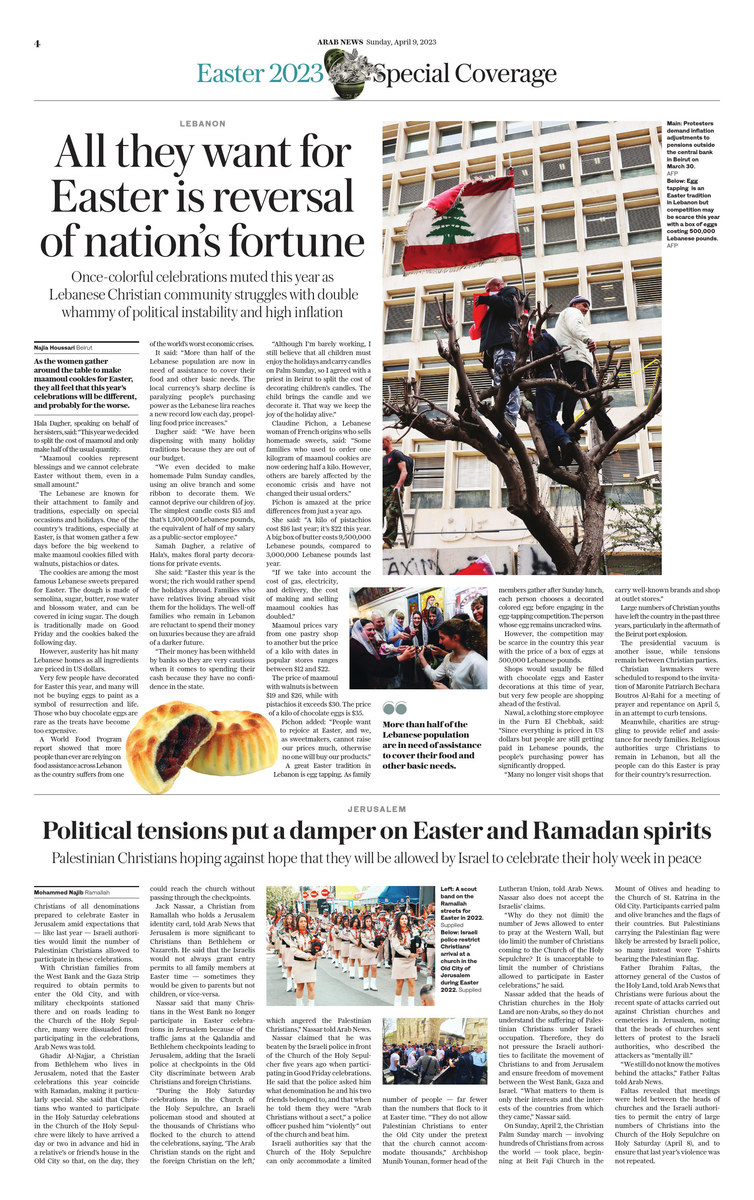
A scout band on the Ramallah streets for Easter in 2022. (Supplied)
“Why do they not (limit) the number of Jews allowed to enter to pray at the Western Wall, but (do limit) the number of Christians coming to the Church of the Holy Sepulchre? It is unacceptable to limit the number of Christians allowed to participate in Easter celebrations,” he said.
Nassar added that the heads of Christian churches in the Holy Land are non-Arabs, so they do not understand the suffering of Palestinian Christians under Israeli occupation. Therefore, they do not pressure the Israeli authorities to facilitate the movement of Christians to and from Jerusalem and ensure freedom of movement between the West Bank, Gaza and Israel.
“What matters to them is only their interests and the interests of the countries from which they came,” Nassar said.
On Sunday, April 2, the Christian Palm Sunday march — involving hundreds of Christians from across the world — took place, beginning at Beit Faji Church in the Mount of Olives and heading to the Church of St. Katrina in the Old City. Participants carried palm and olive branches and the flags of their countries. But Palestinians carrying the Palestinian flag were likely be arrested by Israeli police, so many instead wore T-shirts bearing the Palestinian flag.
Father Ibrahim Faltas, the attorney general of the Custos of the Holy Land, told Arab News that Christians were furious about the recent spate of attacks carried out against Christian churches and cemeteries in Jerusalem, noting that the heads of churches sent letters of protest to the Israeli authorities, who described the attackers as “mentally ill.”
“We still do not know the motives behind the attacks,” Father Faltas told Arab News.
Faltas revealed that meetings were held between the heads of churches and the Israeli authorities to permit the entry of large numbers of Christians into the Church of the Holy Sepulchre on Holy Saturday (April 8), and to ensure that last year’s violence was not repeated.