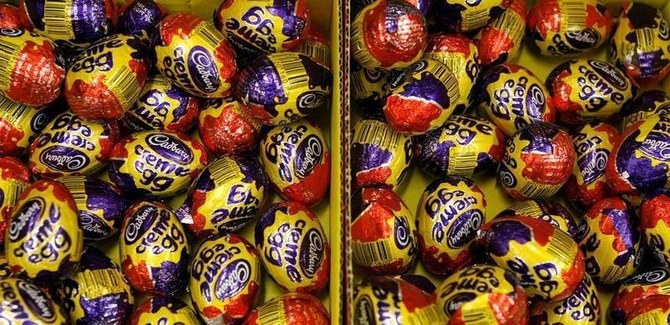

LONDON: It’s about the size of a modest hen’s egg, but it weighs in at 40g and delivers a hefty 177 kilocalories — more than in an actual egg and, comprised almost entirely of fats and sugars, an altogether less healthy option.
Meet the Creme Egg, the iconic product of the British-based global Cadbury chocolate company, which in 2010 was bought by US food and drinks giant Mondelez International for $19.5 billion.
With a thick milk chocolate shell stuffed with gooey white fondant and yellow “yolk,” the foil-wrapped egg is a “Marmite” product — with the equivalent of six teaspoons of sugar in every egg, you either find it too sickly-sweet to stomach or you’re addicted to the massive chocolate-clad calorie hit it delivers.
Either way, in Christian countries the Creme Egg comes into its own at Easter, but it also has a loyal following of fans around the world, including in the Middle East.
It is available in supermarkets such as Tamimi Markets and Carrefour in countries including Saudi Arabia and the UAE, where it is especially popular as a sweet treat during Ramadan, which this year happens to coincide with Easter.
In the UK, Easter is silly season for a media obsessed with all things “eggcellent,” and it is a mark of the fondness for the fondant-filled Creme Egg that it is frequently the star of many articles at this time of year.
Take the following headlines, from the past week alone:
“Police crack case of 200,000 stolen Creme Eggs.”
“I cooked a Cadbury’s Creme Egg in an air fryer and it was the best Easter recipe I’ve tried.”
“An East London cocktail bar is dipping French fries into a Cadbury Creme Egg.”
And, “Man accidentally eats Cadbury Creme Egg worth £10,000.”
That last one deserves an “eggsplanation.”

Its story began in 1824, when John Cadbury, the son of a wealthy Quaker family, opened a grocery shop in Birmingham and started selling cocoa and drinking chocolate. (Supplied)
As part of an Easter promotion that runs until April 9, Cadbury has planted 280 limited-edition, half-white, half-milk chocolate eggs in stores across the UK. With the slogan “Cadbury Creme Egg — How Do You Not Eat Yours?” the winning eggs must remain uneaten for the buyer to win the prize.
Unfortunately, YouTuber Adam Davis, broadcasting on his channel Adz Ventures, unwittingly wolfed one down live on camera before viewers pointed out his expensive mistake.
One could be forgiven for suspecting that any one of these stories — or, indeed, all of them, and many more besides, at this time of year — might well have originated in Cadbury’s PR department.
But even if they did, the willingness of mainstream media to swallow them whole is a measure of the affection felt for a confection that has been a bestseller in the UK for more than half a century.
The Cadbury Creme Egg made its debut in 1971, but its story began in 1824, when John Cadbury, the son of a wealthy Quaker family, opened a grocery shop in Birmingham and started selling cocoa and drinking chocolate.
From the outset, the company’s values reflected Cadbury’s convictions as a member of the Quakers, a Christian sect founded on the belief that “each individual can experience inner light, or the voice of God, without needing a priest, or the Bible.”

In 1985, Cadbury launched a successful ad campaign, “How do you eat yours?” and the eggs have only achieved more fame as a result. (Supplied)
The Quakers frowned on the use of tobacco and alcohol — as they still do today — and the Cadbury company says its founder’s products “weren’t just inspired by his tastes, they were driven by his beliefs. Tea, coffee, cocoa and drinking chocolate were seen as healthy, delicious alternatives to alcohol, which Quakers deemed bad for society.”
There are two ironies here.
The first is that sugar and sugar-based products, such as chocolate, are now also considered to be bad for people’s health. In a bid to reduce children’s sugar intake as part of a drive to tackle Britain’s growing obesity problem, the UK government is expected this year to introduce plans to restrict the advertising of foods high in sugar, while the positioning of sweets and chocolates at check-outs has already been banned.
The other irony is that whereas Quakers such as John Cadbury preached that there was “no need for churches, rituals, holy days, or sacraments, to practice religion,” the Creme Egg his company created is today linked inextricably with Easter, one of the principal festivals of the Christian church.
For those confused by the association of chocolate eggs and the attendant Easter imagery of chicks and rabbits with the holiday, there is rather more to it than the cynical commercial exploitation of a Christian festival marking the rebirth of Christ.
In fact, the association of eggs, chicks and bunnies with the pagan forerunner of Easter predates the Christian era.
For the Christian church, Easter Day, which this year falls on Sunday, April 9, marks the beginning of 50 days of celebrating the resurrection of Jesus Christ. But the very word “Easter” reflects the influence of pre-Christian paganistic beliefs and practices on the Christian religious calendar.
Academics and theologians continue to debate the precise origin of the word. But many argue that it is derived from “Eostre,” the name of a fertility goddess worshipped in Britain by pre-Christian Anglo-Saxons and, under various similar names, by Germanic pagans across northern Europe.
The Christian festival of Easter, goes the argument, was originally a pagan celebration of the return of spring, co-opted as a compromise by an early Christian church keen to win over converts from the old ways.
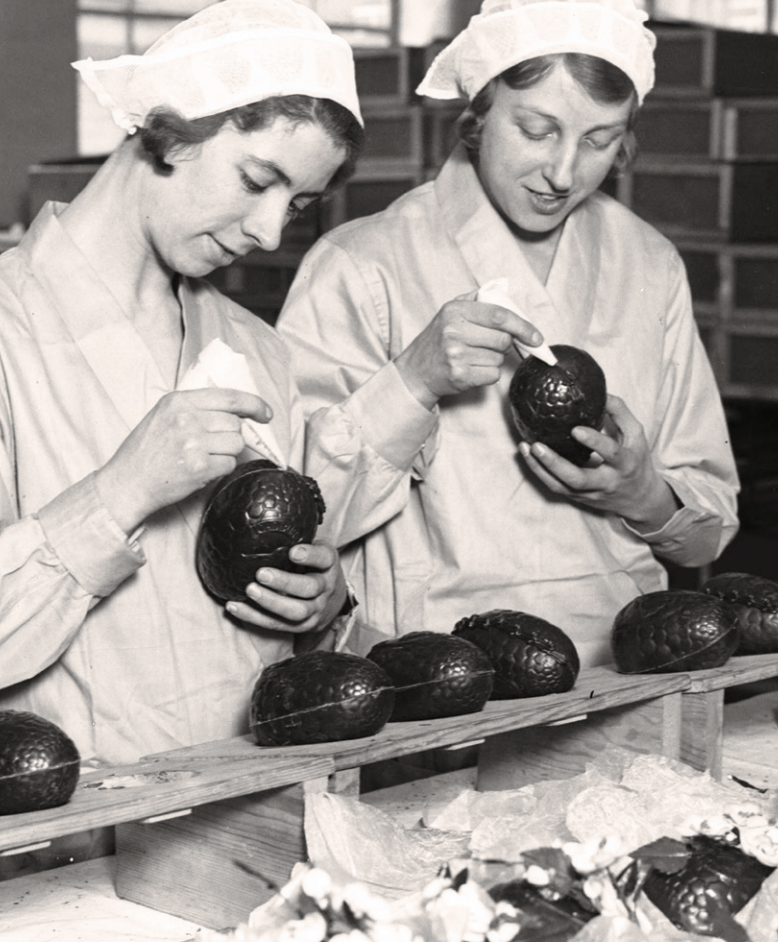
The Cadbury factory in Bournville model village, founded on Quaker values, has produced chocolates since the late 1800s. (Getty/Cadbury)
This association was first made in the eighth century by the English monk known as the Venerable Bede. In his treatise “The Reckoning of Time” he described some of the calendars of the ancient world, including that used by the Anglo-Saxons, for whom the month of “Eosturmonath,” corresponding to April, was named for the pagan goddess.
As for the Church of England today, it quietly acknowledges that “the eggs we give and receive at Easter have many different symbols attached to them.” At the very least, it adds, “they represent new life.”
John Cadbury retired in 1861, handing over the running of the company to his two sons, Richard and George. In 1878, inspired by their family’s Quaker principles and social conscience, they began building a new factory, out in the country and far from the squalid surroundings of its original plant in central Birmingham.
They named it Bournville, a model “factory in a garden,” complete with housing for the workers. “No man,” said George Cadbury, “ought to be condemned to live in a place where a rose cannot grow.”
Today the Bournville factory is still in operation, churning out an average of 1.5 million Creme Eggs — every single day.
The Cadbury Creme Egg was first marketed in 1963 as Fry’s Creme Egg, branded under the name of another British company, J.S. Fry & Sons of Bristol, which merged with Cadbury in 1919. In 1971 it was rebranded as Cadbury Creme Egg.
Another product, Fry’s Turkish Delight, which was launched in 1914, has retained its original name, but thankfully Cadbury long ago dropped the offensive advertising for the brand.
In one commercial shown on British TV in the ’60s, a turbaned “sheikh,” attended in his tent by black slaves, is presented with the gift of a slave girl, wrapped in a carpet. He frees her from her chains when she offers him a bar of Fry’s Turkish Delight, “Exotic, delicious, full of eastern promise.”
The company is famous for other brands that are still big sellers today — Bournville Chocolate, launched in 1908, Fry’s Turkish Delight (1914), Milk Tray (1915), Cadbury’s Flake (1920).
But it’s the Creme Egg, wrapped in its blue, red and yellow foil, that has won the hearts of Britain’s chocoholics — and quite possibly has pushed more than a few of them on the road to diabetes.

Today, the Cadbury factory makes 1.5 million Creme Eggs every day. (Getty/Cadbury)
The UK’s National Health Service recommends that adults should consume no more than 30g of free sugars a day, which is equivalent to about seven teaspoons of sugar — about the same amount found in every single Creme Egg.
And in case that is not sickly enough for your tastes, according to Guinness World Records there is even a record for the most Creme Eggs eaten in one minute.
Reflecting the product’s international appeal, it’s held by Canadian Pete Czerwinski, aka “Furious Pete,” a “competitive eater” who on April 11, 2014, stuffed down six of the things in 60 seconds.
It gets worse.
RecordSetter is a US site dedicated to “raising the bar of human achievement” in a range of fields, but we’re not talking medical breakthroughs or rocket science here.
An inventory of hundreds of dubious records includes “Longest wall sit while holding a 10-pound weight at shoulder height” (3 minutes, 16 seconds), “Most balloon bounces on alternate sides of a table tennis paddle in one minute while balancing a book on head” (170) and “Most toothpicks stuck in a grape in 30 seconds” (38).
And it also has an entire section dedicated to record attempts involving Creme Eggs.
In one particularly disturbing video filmed in Las Vegas in March 2013 and posted on the site, American competitive eater Miki Sudo (who also holds the women’s record for hot dogs, eating 40 at Nathan’s Famous International Hot Dog Eating Contest on Coney Island in 2022) can be seen consuming 50 Cadbury Creme Eggs in 6 minutes, 15 seconds.
This particular record comes with a health warning from RecordSetter: “Speed eating can be extremely dangerous. Please do not attempt this record unless you are above the age of 18 and trained as a professional eater.”
Most definitely, do not try this at home. You are likely to be “eggstremely” ill.