

Rockets fired at Israel from Lebanon raise risk of conflict

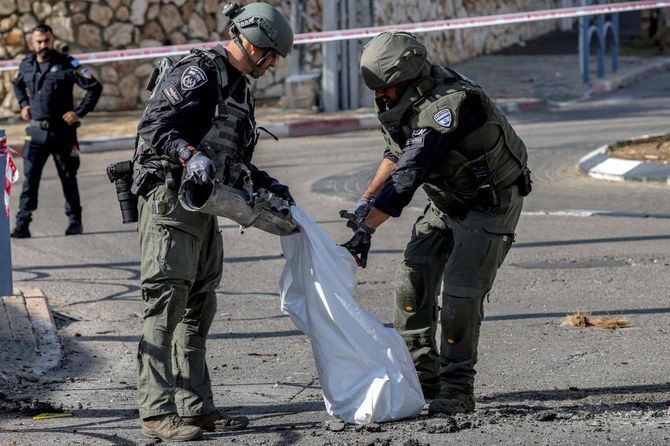
Israeli police bomb disposal unit members bag the remains of a shell fired from Lebanon and intercepted by Israel in its northern town of Shlomi on April 6, 2023. (AFP)
Short Url
Updated 06 April 2023
Follow

Rockets fired at Israel from Lebanon raise risk of conflict

  • The attack, one of the heaviest in years, ratcheted up regional tensions a day after Israeli police raided Jerusalem’s most sensitive holy site, Al-Aqsa Mosque
  • Israel’s military later said that 34 rockets had been fired from Lebanon in the 15-minute strike, with 25 intercepted, and at least four landing in Israel

BEIRUT: Militants in Lebanon launched a rocket barrage at villages across Israel’s northern frontier on Thursday, wounding two people and forcing hundreds to flee to bomb shelters, the Israeli military said.

The attack, one of the heaviest in years, ratcheted up regional tensions a day after Israeli police raided Jerusalem’s most sensitive holy site, Al-Aqsa Mosque.

Israel’s military later said that 34 rockets had been fired from Lebanon in the 15-minute strike, with 25 intercepted, and at least four landing in Israel.

Lebanese troops and the UN peacekeeping force were heavily deployed along the southern border with Israel on Thursday as investigations began into the attack.

The Israeli army said that its Iron Dome anti-missile system “intercepted multiple rockets fired from Lebanon.”

Earlier, warning sirens sounded in many Israeli settlements, prompting people to flee to shelters.

Media outlets in Israel initially estimated that up to 100 rockets were fired from Lebanon toward settlements and towns in the country’s north.

Israeli spy drones were seen flying over southern Lebanon following the attack.

UNIFIL described the situation in southern Lebanon as “extremely serious,” and urged “restraint and to avoid escalation.”

Candice Ardell, deputy director of UNIFIL Media Office, said in a statement: “Multiple rockets were fired from southern Lebanon toward Israel this afternoon. The Israeli army informed UNIFIL that it has activated its Iron Dome defense system in response to the attacks.”

She added that Maj. Gen. Aroldo Lazaro, UNIFIL head of mission and force commander, had been in contact with authorities on both sides of the demarcation line between Israel and Lebanon.

Social media activists on both sides of the border shared footage of the attack and rocket interceptions.

The Lebanese National News Agency said that Israeli artillery responded to the rocket strike by firing heavy shells from positions along the border with Lebanon.

According to the Israeli newspaper Maariv, security officials believe that the Palestinian militant group Hamas was behind the rocket attack.

A source close to Hezbollah said that the party had nothing to do with the incident, according to Al-Hadath channel.

“If we wanted to respond, it wouldn’t have been this way,” the source said.

Israeli Prime Minister Benjamin Netanyahu chaired a high-level security meeting to follow up on developments in the wake of the attack.

“No one should test us and we will take all the necessary measures to defend our country,” Israeli Foreign Minister Eli Cohen said.

Hamas political chief Ismail Haniyeh arrived in Beirut on Wednesday to take part in “events related to the Palestinian cause,” according to Hamas spokesperson in Lebanon, Walid Kilani.

Hezbollah usually commemorates “Al-Quds Day” during Ramadan every year.

Meanwhile, Lebanon condemned the Israeli attacks on Al-Aqsa Mosque.

Caretaker Prime Minister Najib Mikati said the raids “constitute a flagrant aggression and a transgression against holy sites,” and called on everyone with “a conscience to intervene and stop what is happening.”


A father awaits Rafah crossing reopening after 2-year separation from family in Gaza

Updated 4 sec ago
Follow

A father awaits Rafah crossing reopening after 2-year separation from family in Gaza

  • Belal, 51, has packed his suitcases, bought gifts for his children, and is ready to go as soon as he is allowed
  • Gaza has been closed to entry for Palestinians since Israel launched its retaliatory campaign against Hamas for its Oct. 7, 2023, attack on southern Israel

BADRASHIN, Egypt: Stranded in Egypt for the past two years, Raed Belal has had to watch helplessly as his wife and children in the Gaza Strip endured bombardment, displacement and hunger. Now he finally has hope he might return to them.
With Israel preparing to reopen the vital Rafah crossing between Egypt and Gaza, Belal, 51, has packed his suitcases, bought gifts for his children, and is ready to go as soon as he is allowed.
“It’s the moment I have been waiting for,” he said, speaking at the rented apartment where he has been living in the Egyptian village of Badrashin. “The moment when I reunite with my children, when I return to my home and homeland, even if everything is destroyed.”
Belal, who left Gaza to get treated for back pain three months before the war broke out, is one of tens of thousands of Palestinians eager to return to the territory, despite the vast destruction wreaked by Israel’s military campaign against Hamas. The Rafah border crossing is expected to reopen within days, a process jump-started by Israel’s recovery on Monday of the last hostage’s remains in Gaza, where a ceasefire with Hamas has held for four months.
Gaza has been closed to entry for Palestinians since Israel launched its retaliatory campaign against Hamas for its Oct. 7, 2023, attack on southern Israel. In the first months of the war, some 110,000 Palestinians were able to leave Gaza. The Rafah crossing was completely closed in May 2024 when Israeli troops took it over.
Since then, people like Belal have been trapped abroad – most of them in Egypt. Many feared Israel would never allow them back to Gaza.
A ‘limited opening’ of the Rafah crossing
Still, Palestinians will likely face a long wait before going home even after Rafah reopens. Israel intends to keep returns to a trickle.
The exact date of Rafah’s reopening has not been announced. Israeli Prime Minister Benjamin Netanyahu on Tuesday called it a “limited opening,” saying 50 Palestinians a day would be allowed into Gaza and that Israel will keep tight control over who enters, subject to security inspections. Before the war, several hundred people a day would enter Gaza from Egypt.
So far, some 30,000 Palestinians have registered with the Palestinian Embassy in Egypt to return to Gaza, according to an embassy official, speaking on condition of anonymity because details of the reopening remain under discussion.
Hamas in a statement Monday called on Israel to open the Rafah crossing in both directions “without restrictions.” Ali Shaath, head of the new Palestinian committee administering Gaza’s daily affairs, last week said the crossing would be opened this week to facilitate movement into and out of the territory.
Palestinians are also hoping that the crossing’s reopening will mean medical evacuations out of Gaza will increase. Some 20,000 Palestinians needing urgent treatment abroad for war wounds or chronic medical conditions have been waiting for evacuation, according to the Gaza Health Ministry.
Throughout the war, the numbers allowed out have been low. The ceasefire since October brought only a tiny uptick, with an average of only 25 medical evacuations a week, according to UN figures.
Watching his family’s trauma from afar
Belal, who owned a mobile phone store in the northern Gaza town of Beit Lahiya, left the territory in July 2023 to get treatment for his back. Weeks later, Hamas launched its attack on Israel, Israel’s massive bombardment of Gaza began, and Gaza’s borders slammed shut.
Belal was stranded, struggling to keep up with the turmoil that had enveloped his loved ones.
A few days into the war, he got a video call from his sons, who were rushing to move the merchandise out of the shop after they got a warning from the Israeli military that it was about to bomb the building, where both the shop and their family home was located.
The strike demolished the building, and Belal’s 15-year-old son Younis was wounded in the back, he said. At first, doctors said he might be paralyzed, but after months of treatment he was able to walk again.
That began a long trek for his wife and children, who were displaced 12 times over the course of the war. They first moved to a neighbor’s house, but that was bombed the next day. They sheltered for several weeks along with other displaced families in the nearby Indonesian Hospital, until Israeli forces besieged and raided the facility, forcing them to flee again in November 2023.
They eventually made it to a school-turned-shelter in the southern city of Khan Younis, but soon after Israeli forces invaded the area and they had to move again.
Sometimes, Belal spent days unable to reach his family because of communication blackouts.
One of his brothers, Mohammed, was killed along with his 2-year-old child when Israel bombed the school where they were sheltering in the Shati Refugee camp in northern Gaza in mid-2025.
At one point last year, Belal got a phone call from Gaza City’s Shifa Hospital telling him that his son Younis had been killed. They sent him a photo of the body of someone who looked like Younis. He couldn’t reach his family, and it was only after a day of torment that he was able to call them and learned it was a case of mistaken identity.
“Being far away, while your children and family were in such a situation is awful. You live in constant fear; you don’t eat because you’re thinking about your hungry children,” Belal said. “Sometimes you wake up at night, terrified. You rush to the phone and call them to make sure that they are OK.”
A family reunion that can’t come soon enough
Belal’s wife and five children now shelter in a tent in Gaza City, depending on charity kitchens for food. Belal has been sending them money when he can, but his wife, Asmahan, told the AP their savings have almost run out and they’ve had to borrow money from others to get by.
Asmahan said she has had to bear the burden of moving from place to place and keeping her children fed and safe.
“I’m mentally exhausted. The responsibility is immense,” she said. “We have been humiliated and degraded.”
“God willing, the crossing will open, my husband will return, and we will be reunited,” she said.
Belal’s brother, Jaber, left Gaza on Oct. 1, 2023, seeking a job in the West Bank. After the war began, Israel launched a crackdown in the occupied territory, carrying out destructive raids targeting armed groups and imposing tough restrictions on movement.
“Life became impossible in the West Bank,” Jabel said. So in February he joined his brother in Egypt, and he married an Egyptian woman in June. He, too, has registered to return to Gaza with his wife.
“This is our land. Our house is there, even though it’s destroyed. We will rebuild it and rebuild Gaza,” Jaber said.
Raed Belal knows it may still be a long time. After news of Rafah’s opening came, he said, his children “think it will happen tomorrow.” But it could be months, he said, before he presents the gifts he has bought for his children – shoes and clothes for his teenage sons, and makeup and perfume requested by his 8-year-old daughter.
With his bags packed, he is ready.