ISLAMABAD: The United Nations said Wednesday it cannot accept a Taliban decision to bar Afghan female staffers from working at the agency, calling it an “unparalleled” violation of women’s rights.
The statement came a day after the UN said it had been informed by Afghanistan’s ruling Taliban that Afghan women would no longer be allowed to work for the world body. That announcement came after the UN mission in the country expressed concern that its female staffers were prevented from reporting to work in eastern Nangarhar province.
Prior to Tuesday, Afghan women were already barred from working at national and international non-governmental organizations, disrupting the delivery of humanitarian aid. But the ban did not cover working for the UN
That changed this week. On Wednesday, the UN mission said that under the Taliban order, no Afghan woman is permitted to work for the UN in Afghanistan, and that “this measure will be actively enforced.”
The ban is unlawful under international law and cannot be accepted by the United Nations, the statement said.
The Taliban decision is “an unparalleled violation of women’s rights, a flagrant breach of humanitarian principles, and a breach of international rules,” Wednesday’s statement said.
The Taliban have not commented publicly on the ban.
The UN statement said several UN national female personnel have already experienced restrictions on their movements, including harassment, intimidation and detention.
“The UN has therefore instructed all national staff — men and women — not to report to the office until further notice,” the statement said.
The Taliban decision drew condemnation from the world’s most recognized organizations. A joint statement singed by the Save the Children, Norwegian Refugee Council, Danish Refugee Council, INTERSOS, Action Against Hunger, and World Vision urged the lifting of the ban on Afghan women aid workers that has been extended to UN agencies.
“Without our female staff, the humanitarian community cannot effectively reach women and girls. With more than 28 million people in desperate need of aid to survive, this act will cut off people’s lifelines,” said the statement.
“We call on the De Facto Authorities to lift the ban and allow all female aid workers in Afghanistan to return to work immediately,” it said. “With Afghanistan facing record levels of hunger, the cost of this ban will be measured by lives lost.”
Separately, UNICEF Executive Director Catherine Russell said Afghanistan is home to one of the world’s worst humanitarian crises. More than 28 million people, including over 15 million children, need humanitarian and protection assistance this year — a staggering increase of 4 million people over 2022. Hunger and disease are lurking and the economy is in tatters.
“Yet despite this devastating situation, the de facto authorities have taken the unconscionable and confounding decision to ban Afghan women from working with the United Nations in Afghanistan, including UNICEF,” Russell said in a statement. “Coming on the heels of the decree banning Afghan women from working with NGOs, this decision is yet another affront to women’s fundamental rights and further undermines the delivery of humanitarian assistance across the country.” She said Afghan women are the lifeblood of the humanitarian response. They are highly skilled and uniquely placed to reach the most vulnerable Afghans, including children and women, the sick and elderly, and those living with disabilities.
“They have access to populations that their male colleagues cannot reach,” she said.
Despite initial promises of a more moderate rule than during its previous stint in power in the 1990s, the Taliban have imposed harsh measures since taking over the country in 2021 as US and NATO forces were pulling out of Afghanistan after two decades of war.
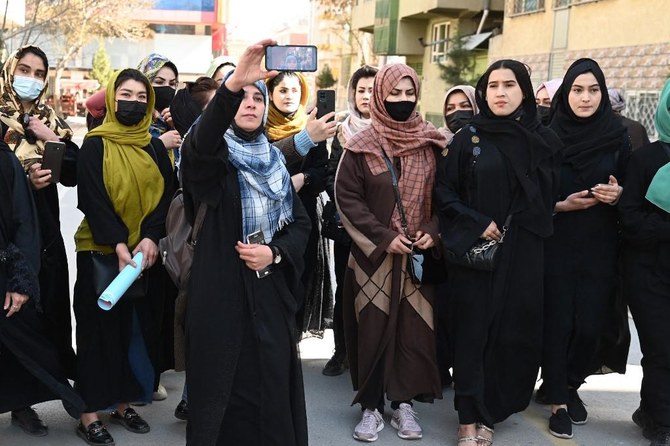
Girls are banned from education beyond sixth grade. Women are barred from working, studying, traveling without a male companion, and even going to parks. Women must also cover themselves from head to toe.
The secretary-general’s special representative for Afghanistan, Roza Otunbayeva, was engaging Taliban authorities to convey the UN’s protest and to seek an immediate reversal of the order. The UN said it is also engaging member states, the donor community and humanitarian partners.
“In the history of the United Nations, no other regime has ever tried to ban women from working for the Organization just because they are women,” said Otunbayeva. “This decision represents an assault against women, the fundamental principles of the UN, and on international law.”
Ramiz Alakbarov, the UN deputy special representative for Afghanistan, said at a news conference in New York that both male and female Afghan national staff have been asked to stay home until they can return to work under “normal conditions.”
“We will not have a situation where we are only working with all-male teams,” he said.
The UN has a staff of about 3,900 in Afghanistan, including approximately 3,300 Afghans and 600 international personnel. The total also includes 600 Afghan women and 200 women from other countries.
Alakbarov said this means all 3,300 UN national staff will stay home until the women can return to work, and they will be paid.
He said the ban doesn’t apply to international female staff and they are able to move freely and provide aid. But he said they are only about 30 percent or less of the total UN Afghanistan staff.
Alakbarov said the new UN policy in the country will be revised depending on what sort of exemptions or operational environment can be negotiated. However, he said there is no scenario in which the UN would provide aid in the country with men only.
“It is not possible to reach women without women. And without women, they will not be reached. And that’s the unfortunate reality,” he said.
Alakbarov said UN officials led by Otunbayeva met Tuesday with the Taliban’s foreign minister and they were told “there will be no additional order because the order was already issued in December,” apparently a reference to the Taliban decision that month to bar women from working for NGOs.
Taliban restrictions in Afghanistan have drawn fierce international condemnation. But the Taliban have shown no signs of backing down, claiming the bans are temporary suspensions in place allegedly because women were not wearing the Islamic headscarf, or hijab, correctly and because gender segregation rules were not being followed.


![]()


UN: Ban on Afghan female staffers by Taliban unacceptable
Short Url
https://arab.news/gavc4
UN: Ban on Afghan female staffers by Taliban unacceptable
- The statement Wednesday comes a day after the UN said it had been informed by Afghanistan’s ruling Taliban that Afghan women would no longer be allowed to work for the world body
Pentagon foresees ‘more limited’ role in deterring North Korea
- South Korea hosts about 28,500 US troops in combined defense against North Korea’s military threat
- In recent years, US officials have signaled a desire to make US forces in South Korea more flexible
The Pentagon foresees a “more limited” role in deterring North Korea, with South Korea taking primary responsibility for the task, according to a policy document released on Friday, a move that could lead to a reduction of US forces on the Korean Peninsula.
South Korea hosts about 28,500 US troops in combined defense against North Korea’s military threat and Seoul has raised its defense budget by 7.5 percent for this year.
“South Korea is capable of taking primary responsibility for deterring North Korea with critical but more limited US support,” the Pentagon said in the 25-page National Defense Strategy document that guides its policies.
“This shift in the balance of responsibility is consistent with America’s interest in updating US force posture on the Korean Peninsula.”
In recent years, US officials have signaled a desire to make US forces in South Korea more flexible, to potentially operate outside the Korean Peninsula in response to a broader range of threats, such as in defending Taiwan and checking China’s growing military reach.
South Korea has resisted the idea of shifting the role of US troops, but has worked to grow its defense capabilities in the past 20 years, with the goal of being able to take on the wartime command of combined US and South Korean forces. South Korea has 450,000 troops.
The Pentagon’s top policy official, Elbridge Colby, is due to travel to Asia next week and is expected to visit South Korea, a US official said.
The wide-ranging document, which each new administration publishes, said the Pentagon’s priority was defending the homeland. In the Indo-Pacific region, the document said, the Pentagon was focused on ensuring that China could not dominate the United States or US allies.
“This does not require regime change or some other existential struggle. Rather, a decent peace, on terms favorable to Americans but that China can also accept and live under, is possible,” the document said, without mentioning Taiwan by name.
China claims democratically governed Taiwan as its own territory and has not ruled out the use of force to take control of the island. Taiwan rejects Beijing’s sovereignty claims and says only the people of Taiwan can decide their future.
The Pentagon document is based on US President Donald Trump’s National Security Strategy, published last year, which said the United States will reassert its dominance in the Western Hemisphere, build military strength in the Indo-Pacific, and possibly reassess its relationship with Europe.
Iran seeks to rebuild military
President Trump said on Thursday the United States has an “armada” heading toward Iran but that he hoped he would not have to use it, as he renewed warnings to Tehran against killing protesters or restarting its nuclear program.
The deployments to the Middle East expand the options available to Trump, both to better defend US forces in the region at a moment of high tension and to take any additional military action after striking Iranian nuclear sites in June.
The Pentagon document said that while Iran had suffered setbacks in recent months, it was aiming to rebuild its military, with Tehran leaving open the possibility that it could “try again to obtain a nuclear weapon.”
Even with US troops heading to the region, the document said Israel was a “model ally” and could be further empowered to defend itself. The United States has had a sometimes strained relationship with Israel over its war in Gaza.
US to remain engaged in Europe
Trump’s National Security Strategy from last year drew an outcry from Europeans after it said that Europe faced “civilizational erasure” and may one day lose its status as a reliable US ally.
The Trump administration is putting pressure on Kyiv to reach a peace deal in the war triggered by Russia’s full-scale invasion in February 2022, with Moscow demanding Kyiv cede its entire eastern industrial area of Donbas before it stops fighting.
The Pentagon’s strategy document was more measured on European allies, saying that while the United States would remain engaged in Europe it would prioritize defending the United States and deterring China.
It said that Russia would remain a “persistent but manageable” threat for NATO’s eastern members, and that the Pentagon would provide Trump with options to “guarantee US military and commercial access to key terrain” in different parts of the world, including in Greenland.
Trump said earlier this week he had secured total and permanent US access to Greenland in a deal with NATO, whose head said allies would have to step up their commitment to Arctic security to ward off threats from Russia and China.
South Korea hosts about 28,500 US troops in combined defense against North Korea’s military threat and Seoul has raised its defense budget by 7.5 percent for this year.
“South Korea is capable of taking primary responsibility for deterring North Korea with critical but more limited US support,” the Pentagon said in the 25-page National Defense Strategy document that guides its policies.
“This shift in the balance of responsibility is consistent with America’s interest in updating US force posture on the Korean Peninsula.”
In recent years, US officials have signaled a desire to make US forces in South Korea more flexible, to potentially operate outside the Korean Peninsula in response to a broader range of threats, such as in defending Taiwan and checking China’s growing military reach.
South Korea has resisted the idea of shifting the role of US troops, but has worked to grow its defense capabilities in the past 20 years, with the goal of being able to take on the wartime command of combined US and South Korean forces. South Korea has 450,000 troops.
The Pentagon’s top policy official, Elbridge Colby, is due to travel to Asia next week and is expected to visit South Korea, a US official said.
The wide-ranging document, which each new administration publishes, said the Pentagon’s priority was defending the homeland. In the Indo-Pacific region, the document said, the Pentagon was focused on ensuring that China could not dominate the United States or US allies.
“This does not require regime change or some other existential struggle. Rather, a decent peace, on terms favorable to Americans but that China can also accept and live under, is possible,” the document said, without mentioning Taiwan by name.
China claims democratically governed Taiwan as its own territory and has not ruled out the use of force to take control of the island. Taiwan rejects Beijing’s sovereignty claims and says only the people of Taiwan can decide their future.
The Pentagon document is based on US President Donald Trump’s National Security Strategy, published last year, which said the United States will reassert its dominance in the Western Hemisphere, build military strength in the Indo-Pacific, and possibly reassess its relationship with Europe.
Iran seeks to rebuild military
President Trump said on Thursday the United States has an “armada” heading toward Iran but that he hoped he would not have to use it, as he renewed warnings to Tehran against killing protesters or restarting its nuclear program.
The deployments to the Middle East expand the options available to Trump, both to better defend US forces in the region at a moment of high tension and to take any additional military action after striking Iranian nuclear sites in June.
The Pentagon document said that while Iran had suffered setbacks in recent months, it was aiming to rebuild its military, with Tehran leaving open the possibility that it could “try again to obtain a nuclear weapon.”
Even with US troops heading to the region, the document said Israel was a “model ally” and could be further empowered to defend itself. The United States has had a sometimes strained relationship with Israel over its war in Gaza.
US to remain engaged in Europe
Trump’s National Security Strategy from last year drew an outcry from Europeans after it said that Europe faced “civilizational erasure” and may one day lose its status as a reliable US ally.
The Trump administration is putting pressure on Kyiv to reach a peace deal in the war triggered by Russia’s full-scale invasion in February 2022, with Moscow demanding Kyiv cede its entire eastern industrial area of Donbas before it stops fighting.
The Pentagon’s strategy document was more measured on European allies, saying that while the United States would remain engaged in Europe it would prioritize defending the United States and deterring China.
It said that Russia would remain a “persistent but manageable” threat for NATO’s eastern members, and that the Pentagon would provide Trump with options to “guarantee US military and commercial access to key terrain” in different parts of the world, including in Greenland.
Trump said earlier this week he had secured total and permanent US access to Greenland in a deal with NATO, whose head said allies would have to step up their commitment to Arctic security to ward off threats from Russia and China.
Latest updates


© 2026 SAUDI RESEARCH & PUBLISHING COMPANY, All Rights Reserved And subject to Terms of Use Agreement.