

Pakistan condemns Israeli forces’ raid on Al-Aqsa mosque

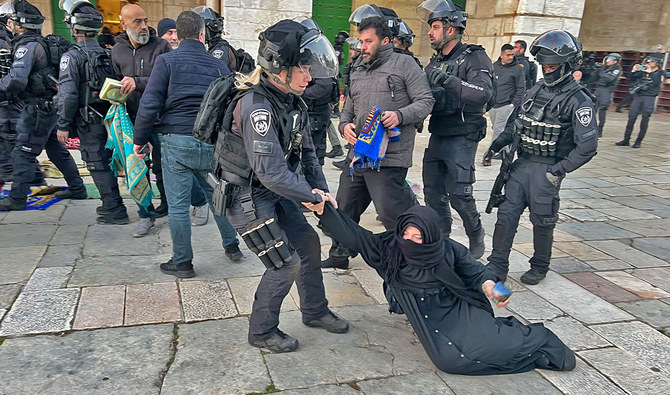
Israeli security forces remove Palestinian Muslim worshippers sitting on the grounds of the Al-Aqsa mosque compound in Jerusalem, early on April 5, 2023 during Islam's holy month of Ramadan. (AFP)
Short Url
Updated 06 April 2023
Follow

Pakistan condemns Israeli forces’ raid on Al-Aqsa mosque

  • Early on Wednesday, Israeli police stormed into mosque in Jerusalem’s Old City, firing stun grenades at Palestinian youths
  • Raid, coming as Muslims mark Ramadan, has drawn condemnation from Pakistan, Saudi Arabia and the Arab League

ISLAMABAD: Pakistan on Wednesday condemned a raid by Israeli forces on the Al-Aqsa mosque in Jerusalem, calling upon the international community to take “immediate action” to end Israel’s hostilities.

Israeli forces this week escalated raids on the Al-Aqsa mosque compound located in occupied East Jerusalem. Early on Wednesday, police stormed into the mosque in Jerusalem’s Old City, firing stun grenades at Palestinian youths who retaliated with firecrackers.

The raids, coming as Muslims mark the holy month of Ramadan and Jews prepare to begin the Passover festival on Wednesday evening, drew condemnations from Pakistan, Saudi Arabia and the Arab League and raised fears of a wider conflagration. Similar violence two years ago erupted into an 11-day conflict.

“Pakistan condemns in the strongest possible terms the brutal attack by Israeli occupation forces beating Palestinian worshippers in the prayer hall in Al Aqsa Mosque,” Foreign Office Spokesperson Mumtaz Zahra Baloch told reporters during a weekly media briefing.

“Continuous such impulsive actions from the part of Israel in the holy month of Ramadan in recent years not only violate the religious freedom of Palestinian people but also hurts the religious sentiments of Muslims around the world.”

Baloch called on the international community to fulfill its responsibility and take “immediate action to end such inhuman acts of violence against unarmed and innocent civilians.”

The mosque, a site of tensions and violence between Israel and Palestine for decades, is considered the third holiest site in Islam by Muslims while Jews refer to it as the Temple Mount, the holiest site in their religion. The conflicting claims fuel constant tensions that have spilled over into violence numerous times in the past.

Tensions in the region have been steadily rising since Israeli Prime Minister Benjamin Netanyahu’s new far-right government took office late last year. The police force is also overseen by Itamar Ben-Gvir, an ultranationalist with a history of violent rhetoric against the Palestinians.

Saudi Arabia’s Ministry of Foreign Affairs also condemned the storming of Al-Aqsa mosque, the official Saudi Press Agency (SPA) reported.

In a statement, the ministry “expressed the Kingdom of Saudi Arabia’s condemnation and rejection of the blatant storming of Al-Aqsa Mosque’s compound, these practices undermine peace efforts, reaffirming its firm position in supporting all efforts aimed at ending the occupation and reaching a just and comprehensive solution to the Palestinian cause.”

The raid occurred during the month of Ramadan, a time of spirituality and prayer in Islam, the ministry said.

“Such actions violate international principles and norms regarding respect for religious sanctities,” the statement said.

The Arab League has also condemned the raid.

“The extremist approaches that control the policy of the Israeli government will lead to widespread confrontations with the Palestinians if they are not put to an end,” League Secretary General Ahmed Aboul Gheit said in a statement.


Pakistan confers highest civilian award on Jordan’s King Abdullah II

Updated 5 sec ago
Follow

Pakistan confers highest civilian award on Jordan’s King Abdullah II

  • King Abdullah II, President Asif Ali Zardari review regional and global developments, with a focus on the Middle East
  • The two leaders reject any displacement of Palestinians, emphasize need for a Two-State solution, Zardari’s office says

ISLAMABAD: President Asif Ali Zardari on Sunday conferred Pakistan’s highest civilian award, ‘Nishan-e-Pakistan,’ on Jordan’s King Abdullah II during his state visit to the South Asian country, President Zardari’s office said.

The honor was bestowed on the visiting monarch at a special investiture ceremony attended by Prime Minister Shehbaz Sharif, members of the federal cabinet, military chiefs and members of the diplomatic corps.

On the occasion, the Jordanian king also conferred on President Zardari the ‘Wisam Al-Nahdah Al-Mursa,’ or the Order of the Renaissance, according to the Pakistan president’s office.

Jordan’s King Abdullah II conferrs ‘Wisam Al-Nahdah Al-Mursa,’ or the Order of the Renaissance, on Pakistan President Asif Ali Zardari on November 16, 2025. (PID)

President Zardari and King Abdullah earlier held a meeting, at which they reaffirmed longstanding, fraternal ties between Pakistan and Jordan, and discussed the full range of bilateral relations.

“They also reviewed regional and international developments of mutual concern, with particular focus on peace, stability and security in the Middle East,” the president’s office said in a statement.

“They noted the need to build on the strength of these relations and to encourage greater people-to-people contact between the two countries.”

Both sides underlined the importance of working together in multilateral forums and of promoting humanitarian and development cooperation, according to President Zardari’s office.

On Palestine, the president and the Jordanian king reiterated their shared principled position on post-war Gaza.

“They rejected any displacement of Palestinians and emphasized the need for a Two-State solution. They called for the establishment of an independent, sovereign, viable and contiguous State of Palestine on pre-June 1967 borders with Al-Quds Al-Sharif as its capital,” the statement read.

“Both leaders expressed confidence in the future direction of Pakistan-Jordan relations and agreed to maintain close coordination on bilateral, regional and global issues.”