

Dogecoin jumps as Musk's Twitter flips logo to Shiba Inu dog

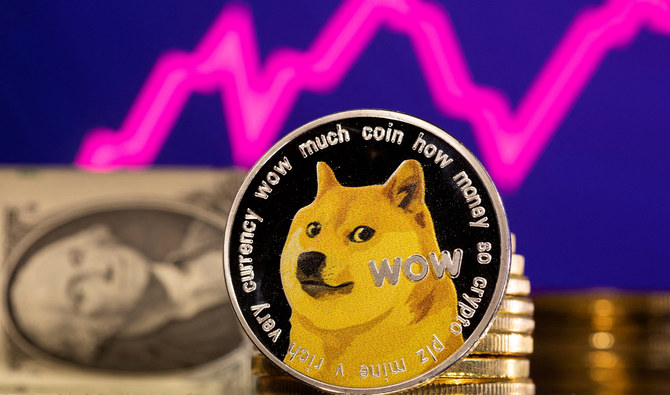
A representation of cryptocurrency dogecoin is seen in front of a stock graph and U.S. dollar in this illustration taken, January 24, 2022. (REUTERS)
Short Url
Updated 05 April 2023
Follow

Dogecoin jumps as Musk's Twitter flips logo to Shiba Inu dog

  • Token was born as a satire of a cryptocurrency frenzy in 2013 and has no fundamental use
  • Musk is a vocal proponent of cryptocurrencies, has heavily influenced prices in the past

Dogecoin's Shiba Inu dog replaced Twitter's blue bird as the social media company's logo on Monday, helping the meme coin add as much as $4 billion to its market value.

The token, born as a satire of a cryptocurrency frenzy in 2013 and has no fundamental use, on Tuesday surged to 10 cents around 1500 EST from 7 cents as Elon Musk indicated in a tweet he had delivered on his promise of changing the social media app's logo to dogecoin's dog.

With a market capitalization of $13.7 billion, dogecoin is now the seventh biggest cryptocurrency, according to data site CoinMarketCap.com. Its market value stood at around $10 billion before the news.

Musk, who is ranked the second-richest person in the world by Forbes, is a vocal proponent of cryptocurrencies and has heavily influenced prices for dogecoin and bitcoin in the past.

The Tesla (TSLA.O) boss on Friday asked a U.S. judge to throw out a $258 billion racketeering lawsuit accusing him of running a pyramid scheme to support dogecoin.

Dogecoin more than doubled in October after Musk, dubbed "the dogefather" by retail traders, sealed a $44 billion deal to take over Twitter.

Cryptocurrency exchange Binance, which invested $500 million into Musk's buyout of Twitter, had said it was brainstorming strategies on how blockchain and crypto could be helpful to Twitter.

"A year later, Twitter has yet to announce any crypto specific initiatives," said Stéphane Ouellette, Chief Executive at digital asset investment platform FRNT Financial (FRNT.V).

"It remains to be seen whether the appearance of the DOGE logo is more than a joke."

The shiba inu token, a spinoff of dogecoin which trades in fractions of cents, rose 5.6% to $0.000014 on Tuesday.


SIDF finances 5k projects with over $53.3bn 

Updated 10 December 2025
Follow

SIDF finances 5k projects with over $53.3bn 

RIYADH: The Saudi Industrial Development Fund has approved up to 5,000 projects — representing about 40 percent of the Kingdom’s industrial base — with a total investment value nearing SR200 billion ($53.3 billion), according to Khalil Al-Nammari, executive vice president for strategic planning and business development at the fund, who spoke to Al-Eqtisadiah.

This brought the fund’s total approved investments since its establishment in the 1970s to more than SR700 billion. 

During the Vision 2030 period alone, the fund approved loans ranging between SR86 billion and SR90 billion, Al-Nammari said. 

These loans attracted nearly SR190 billion in investments, highlighting the scale of expansion and growth in industrial lending and related sectors. 

Repositioning within national ecosystem 

Al-Nammari noted that the fund has repositioned itself within the national economic ecosystem in recent years, benefiting from the major transformation driven by Saudi Vision 2030. 

He said the fund, which marked its 50th anniversary last year, has shifted from its traditional role of financing industry to a broader mandate covering industry, energy, mining, and logistics, adding that the expansion required a comprehensive strategic shift in lending mechanisms, services, and programs offered to these new sectors. 

The fund launched innovative financing solutions and established the Industrial Fund Academy, which has so far trained more than 11,000 trainees from the public and private sectors. 

According to the executive vice president, the scale of work and results achieved since the launch of Vision 2030 is equivalent to what was achieved over 36 years since the fund's establishment, underscoring the momentum generated by the vision and its derived strategies. 

Long-term development partnership 

Al-Nammari stressed that the fund's success is measured by the ability of projects to be built, operated, exported, and scaled, not only by the size of financing, pointing out that relationships with clients often extend 15 to 20 years due to the long-term nature of development loans. 

On measuring development impact, Al-Nammari said economic feasibility studies, market analysis, and engineering assessments form the foundation before any loan is approved. 

He added that the SIDF evaluates project performance after operations begin by monitoring financial statements, operational progress, production capacity, and sales growth, as well as export capabilities. 

He added that the fund also assesses job creation and quality, all of which are indicators factored into lending decisions from the outset and monitored throughout the loan term. 

As part of this effort, the fund conducts regular visits to more than 1,000 active projects in its portfolio to track construction and operational phases, assess financing needs, and provide solutions, advisory support, and academic services. 

The goal is to ensure factories achieve their production targets, adhere to business plans, and enter local and global markets, contributing to industrial growth, higher exports, and greater sector contribution to gross domestic product. 

New financing channels to attract capital 

In the coming years, the fund will continue to focus on the sectors identified by the national strategy, spanning 12 areas, including food and pharmaceutical security, as well as future-oriented sectors such as clean energy, hydrogen, and electric vehicle components, as well as renewable energy, and supporting supply chains. 

Al-Nammari said the fund has recently focused on creating new financing channels aimed at attracting capital from the private sector, banks, and investment funds. 

In this context, the fund has launched the SIDF Investment Co., which holds existing commitments of SR50 million in funds and firms that support investment in the industrial sector. 

Moreover, it has introduced the Supply Chain Financing program, the largest of its kind globally, aimed at providing financing solutions for the invoices of suppliers to major national companies. 

The program is currently operating with firms such as Saudi Aramco and the Saudi Electricity Co., helping to support national supply chains and enhance the sustainability of small, medium, and advanced industrial projects alike.