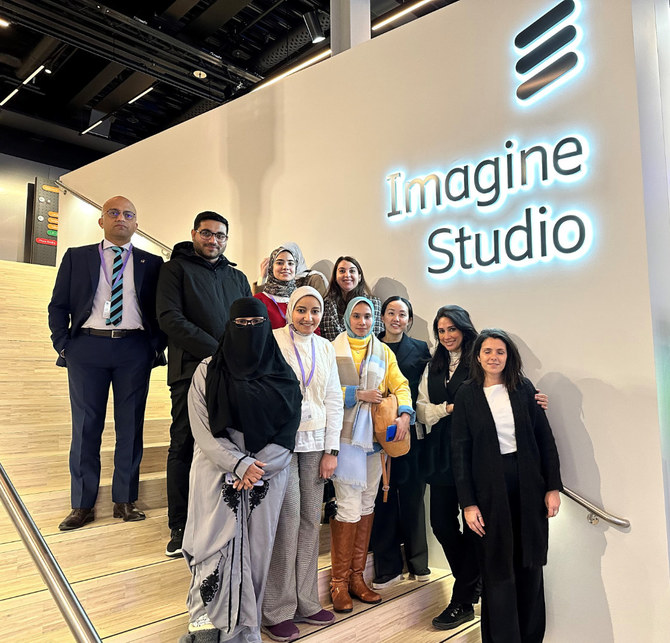
Hackathon winners from KSA visit Ericsson’s HQ in Sweden

The winning team, Team Green Intelligence, was welcomed at the Ericsson Imagine Studio.
Short Url
Updated 03 April 2023
Follow

Hackathon winners from KSA visit Ericsson’s HQ in Sweden

The winners of Ericsson’s “Together Apart Hackathon” from Saudi Arabia visited the Ericsson headquarters in Sweden from March 14-17, as part of the hackathon’s grand prize to get inspired, learn and exchange ideas with Ericsson’s technology experts. The hackathon, conducted last year in collaboration with the Ministry of Communications and Information Technology, was inspired by Saudi Vision 2030, and focused on identifying innovative and commercially viable solutions that showcased the power of connectivity and 5G.

The winning team, Team Green Intelligence, developed an innovative solution that offers a new way of addressing the challenge of limited land and space to grow plants in urban areas. The team was welcomed at the Ericsson Imagine Studio where the winners visited the experience center and met with Ericsson leaders, innovation experts and specialists. The experts shared their knowledge on Ericsson’s vision, innovations across technologies like 4G, 5G, Internet of Things and digital twins, social and corporate responsibility, and entrepreneurship. The winning team was presented with multiple demos and innovative use cases that showcase products, solutions and visionary scenarios, explore the potential and power of limitless connectivity, and witness the potential of information and communication technology in different sectors and industries.

Håkan Cervell, vice president and head of Saudi Arabia and Egypt at Ericsson Middle East and Africa, said: “We are thrilled to see the next generation of innovators and entrepreneurs from Saudi Arabia develop such a creative and impactful solution. This solution aligns with Saudi Vision 2030’s ambitious digital plan to diversify the economy and achieve sustainable development through technological innovation. We are excited to see the impressive impact of their project in creating green spaces, reducing air pollution, and promoting sustainable living in urban areas, and we are committed to supporting them every step of the way.”


World Defense Show 2026: KPMG highlights human capital as strategic defense asset

Updated 03 February 2026
Follow

World Defense Show 2026: KPMG highlights human capital as strategic defense asset

KPMG published a series of four white papers as official knowledge partner for the World Defense Show 2026, reinforcing its commitment to supporting Saudi Arabia’s Vision 2030 and the Kingdom’s ambition to build a sovereign, future-ready defense ecosystem grounded in integrated capability development, localization, and digital readiness.

As global defense priorities evolve from procurement-led models toward capability-driven ecosystems, one of the papers in the defense integration series highlights a clear inflection point for the sector. According to KPMG analysis, defense localization in Saudi Arabia has increased from around 4 percent in 2018 to 24.9 percent in 2024, with the Kingdom targeting 50 percent localization by 2030. At the same time, local content across the defense sector has reached 40.7 percent, up from 38.4 percent in 2023, reflecting deeper integration across procurement, industrial participation, technology adoption, and workforce development.

KPMG’s findings emphasize that modern defense power is no longer defined by platforms and equipment alone, but by the ability to design, operate, integrate, and sustain advanced systems at scale. While technology, infrastructure, and capital investment remain critical enablers, the firm’s WDS position paper highlights that defense transformation has a significant human-capital focus, recognizing that skills, data literacy, and local expertise are essential to maximizing the performance, resilience, and sovereignty of advanced defense capabilities.

Christopher Moore, head of defense and security, said: “Saudi Arabia’s defense transformation has a significant human-capital focus, alongside major investments in technology, equipment, and industrial capacity. The progress we are seeing in localization and local content demonstrates that the Kingdom is not only acquiring advanced systems, but also building the skills, institutions, and operating models required to sustain them. Through our partnership with the World Defense Show, KPMG is proud to contribute insight and frameworks that help translate Vision 2030 ambition into operational readiness.”

This human-capital perspective forms part of a broader KPMG defense thought-leadership series developed for WDS 2026, which examines defense transformation through multiple, interconnected pillars. These include accelerating sovereign defense ecosystems, integrating business and technology infrastructure, financing future deterrence through public-private partnerships, strengthening industrial and technological autonomy, and building a future-ready defense workforce — reflecting KPMG’s holistic view of defense as an integrated national ecosystem.

KPMG’s research also situates Saudi Arabia’s progress within a global economic context. International benchmarks cited in the firm’s WDS analysis show that every $1 billion in defense manufacturing output in the US supports approximately 5,700 jobs, while the UK defense sector contributes around £25 billion ($34.2 billion) to GDP and sustains 260,000 skilled jobs. Across the EU, defense industries employ more than 1.6 million people and generate approximately 70 billion euros ($82.9 billion) in annual value. KPMG notes that similar dynamics are beginning to emerge in Saudi Arabia as localization accelerates and private-sector participation expands.

To support measurable progress, KPMG has proposed a Defense Workforce Capability Index — a framework that links workforce outcomes directly to operational readiness. The index tracks localization rates, technical qualification levels in advanced and digital systems, and the share of maintenance and sustainment conducted domestically, aligning human-capital metrics with broader defense performance objectives.

Taking place in Riyadh from Feb. 8 to 12, the World Defense Show will bring together senior government leaders, defense manufacturers, and technology innovators from around the world. The other three papers in the defense integration series focus on sovereignty, financing and technology.