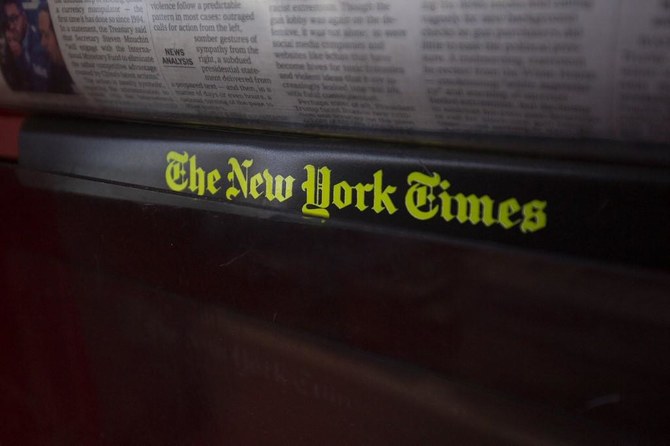
LONDON: Twitter has removed the verification check mark on the main account of The New York Times, one of CEO Elon Musk’s most despised news organizations.
The removal comes as many of Twitter’s high-profile users are bracing for the loss of the blue check marks that helped verify their identity and distinguish them from impostors on the social media platform.
Musk, who owns Twitter, set a deadline of Saturday for verified users to buy a premium Twitter subscription or lose the checks on their profiles. The Times said in a story Thursday that it would not pay Twitter for verification of its institutional accounts.
Early Sunday, Musk tweeted that the Times’ check mark would be removed. Later he posted disparaging remarks about the newspaper, which has aggressively reported on Twitter and on flaws with partially automated driving systems at Tesla, the electric car company, which he also runs.
Other Times accounts such as its business news and opinion pages still had either blue or gold check marks on Sunday, as did multiple reporters for the news organization.
“We aren’t planning to pay the monthly fee for check mark status for our institutional Twitter accounts,” the Times said in a statement Sunday. “We also will not reimburse reporters for Twitter Blue for personal accounts, except in rare instances where this status would be essential for reporting purposes,” the newspaper said in a statement Sunday.
The Associated Press, which has said it also will not pay for the check marks, still had them on its accounts at midday Sunday.
Twitter did not answer emailed questions Sunday about the removal of The New York Times check mark.
The costs of keeping the check marks ranges from $8 a month for individual web users to a starting price of $1,000 monthly to verify an organization, plus $50 monthly for each affiliate or employee account. Twitter does not verify the individual accounts to ensure they are who they say they are, as was the case with the previous blue check doled out to public figures and others during the platform’s pre-Musk administration.
While the cost of Twitter Blue subscriptions might seem like nothing for Twitter’s most famous commentators, celebrity users from basketball star LeBron James to Star Trek’s William Shatner have balked at joining. Seinfeld actor Jason Alexander pledged to leave the platform if Musk takes his blue check away.
The White House is also passing on enrolling in premium accounts, according to a memo sent to staff. While Twitter has granted a free gray mark for President Joe Biden and members of his Cabinet, lower-level staff won’t get Twitter Blue benefits unless they pay for it themselves.
“If you see impersonations that you believe violate Twitter’s stated impersonation policies, alert Twitter using Twitter’s public impersonation portal,” said the staff memo from White House official Rob Flaherty.
Alexander, the actor, said there are bigger issues in the world but without the blue mark, “anyone can allege to be me” so if he loses it, he’s gone.
“Anyone appearing with it=an imposter. I tell you this while I’m still official,” he tweeted.
After buying Twitter for $44 billion in October, Musk has been trying to boost the struggling platform’s revenue by pushing more people to pay for a premium subscription. But his move also reflects his assertion that the blue verification marks have become an undeserved or “corrupt” status symbol for elite personalities, news reporters and others granted verification for free by Twitter’s previous leadership.
Along with shielding celebrities from impersonators, one of Twitter’s main reasons to mark profiles with a blue check mark starting about 14 years ago was to verify politicians, activists and people who suddenly find themselves in the news, as well as little-known journalists at small publications around the globe, as an extra tool to curb misinformation coming from accounts that are impersonating people. Most “legacy blue checks” are not household names and weren’t meant to be.
One of Musk’s first product moves after taking over Twitter was to launch a service granting blue checks to anyone willing to pay $8 a month. But it was quickly inundated by impostor accounts, including those impersonating Nintendo, pharmaceutical company Eli Lilly and Musk’s businesses Tesla and SpaceX, so Twitter had to temporarily suspend the service days after its launch.
The relaunched service costs $8 a month for web users and $11 a month for users of its iPhone or Android apps. Subscribers are supposed to see fewer ads, be able to post longer videos and have their tweets featured more prominently.


![]()

Twitter pulls check mark from main New York Times account
Short Url
https://arab.news/vcxc8
Twitter pulls check mark from main New York Times account
- The New York Times becomes first high-profile organization to lose blue badge
- Decision came after newspaper said it would not pay Twitter for verification


Latest updates


© 2026 SAUDI RESEARCH & PUBLISHING COMPANY, All Rights Reserved And subject to Terms of Use Agreement.