

'My brain completely shut off': Kohli on World Cup masterclass that sunk Pakistan

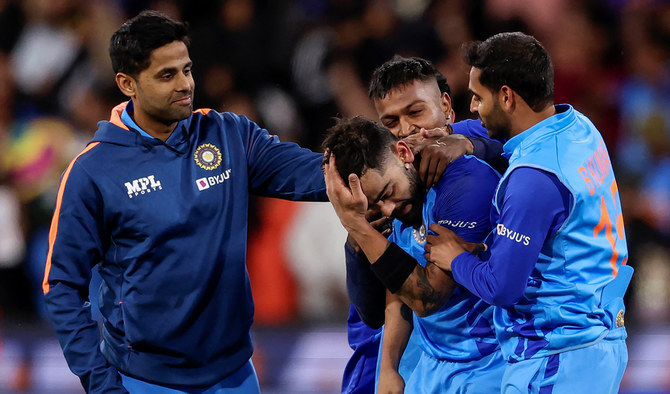
India's Virat Kohli (2nd R) celebrates with teammates after their win during the ICC men's Twenty20 World Cup 2022 cricket match between India and Pakistan at Melbourne Cricket Ground (MCG) in Melbourne on October 23, 2022. (AFP/File)
Short Url
Updated 03 April 2023
Follow

'My brain completely shut off': Kohli on World Cup masterclass that sunk Pakistan

  • Indian batter Virat Kohli scored a heroic 82 runs off 52 balls, which ultimately resulted in Pakistan's defeat
  • Kohli says when his "bran complete shut off", his instincts took over and guided his match-winning innings

ISLAMABAD: Former Indian cricket captain Virat Kohli said on Sunday that his brain had "completely shut off" while he delivered a batting masterclass against Pakistan in last year's T20 World Cup that helped India pull off a victory which is seen by cricket fans as nothing short of a miracle. 

The India-Pakistan cricket rivalry is one of the most passionate rivalries sports, with millions of fans waiting for years to catch the action when the Asian giants face each other at international events. Political tensions mean the two countries don't play bilateral series with each other but face off at international events.  

Pakistan last faced India at the massive MCG, with over 90,000 in attendance as the two sides battled during a World Cup fixture. Chasing a target of 160 runs, India were in serious trouble after Pakistan's pace battery took a flurry of quick wickets to dismiss batters Rohit Sharma, K.L.Rahul, Suryakumar Yadav and Axar Patel. 

Reeling at 31/4, Kohli steered his team out of trouble, building a solid partnership with all-rounder Hardik Pandya as the blue shirts managed to pull off a last-ball victory over Pakistan, driven mainly by Kohli's classic knock under pressure. He remained unbeaten on 82 from 52 balls, smashing six fours and four massive boundaries. 

At a recent corporate event, the former Indian captain was asked about his state of mind at the moment. In response, Kohli said he "still can’t make any sense of it."

"The fact of the matter is that I was so much under pressure that my mind had shut off completely by the 12th or 13th over," Kohli said, recalling that his earlier slump in 2021, which earned him a lot of flak from cricket fans and critics alike, was bearing heavily on his mind. 

Kohli said he was under so much stress when Pakistan had the upper hand that he still can't remember the advice Indian coach Rahul Dravid gave him during the drinks break. 

"I remember in the break, Rahul bhai came to me and I don't remember what he said. I swear and I even told him this as well. I told him, ‘I have no idea what you told me in that break because I was zoned out’," he said. 

Kohli said that when his mind "shut off", his instincts took over and guided his innings. 

"So, when I stopped thinking and planning, whatever God-given talent I have that came to the surface and then I felt like something higher was guiding me," he said. 

The former world number one batter said he learned the valuable lesson to not work his mind so much in such pressure situations, adding that "it actually pushes you away from real magic."

"What happened that night, I can never explain it and it won’t happen ever again," Kohli concluded. 


Islamabad says surge in aircraft orders after India standoff could end IMF reliance

Updated 22 min 17 sec ago
Follow

Islamabad says surge in aircraft orders after India standoff could end IMF reliance

  • Pakistani jets came into the limelight after Islamabad claimed to have shot down six Indian aircraft during a standoff in May last year
  • Many countries have since stepped up engagement with Pakistan, while others have proposed learning from PAF’s multi-domain capabilities

ISLAMABAD: Defense Minister Khawaja Asif on Tuesday said Pakistan has witnessed a surge in aircraft orders after a four-day military standoff with India last year and, if materialized, they could end the country’s reliance on the International Monetary Fund (IMF).

The statement came hours after a high-level Bangladeshi defense delegation met Pakistan’s Air Chief Marshal Zaheer Ahmed Baber Sidhu to discuss a potential sale of JF-17 Thunder aircraft, a multi-role fighter jointly developed by China and Pakistan that has become the backbone of the Pakistan Air Force (PAF) over the past decade.

Fighter jets used by Pakistan came into the limelight after Islamabad claimed to have shot down six Indian aircraft, including French-made Rafale jets, during the military conflict with India in May last year. India acknowledged losses in the aerial combat but did not specify a number.

Many countries have since stepped up defense engagement with Pakistan, while delegations from multiple other nations have proposed learning from Pakistan Air Force’s multi-domain air warfare capabilities that successfully advanced Chinese military technology performs against Western hardware.

“Right now, the number of orders we are receiving after reaching this point is significant because our aircraft have been tested,” Defense Minister Asif told a Pakistan’s Geo News channel.

“We are receiving those orders, and it is possible that after six months we may not even need the IMF.”

Pakistan markets the Chinese co-developed JF-17 as a lower-cost multi-role fighter and has positioned itself as a supplier able to offer aircraft, training and maintenance outside Western supply chains.

“I am saying this to you with full confidence,” Asif continued. “If, after six months, all these orders materialize, we will not need the IMF.”

Pakistan has repeatedly turned to the IMF for financial assistance to stabilize its economy. These loans come with strict conditions including fiscal reforms, subsidy cuts and measures to increase revenue that Pakistan must implement to secure disbursements.

In Sept. 2024, the IMF approved a $7 billion bailout for Pakistan under its Extended Fund Facility (EFF) program and a separate $1.4 billion loan under its climate resilience fund in May 2025, aimed at strengthening the country’s economic and climate resilience.

Pakistan has long been striving to expand defense exports by leveraging its decades of counter-insurgency experience and a domestic industry that produces aircraft, armored vehicles, munitions and other equipment.

The South Asian country reached a deal worth over $4 billion to sell military equipment to the Libyan National Army, Reuters report last month, citing Pakistani officials. The deal, one of Pakistan’s largest-ever weapons sales, included the sale of 16 JF-17 fighter jets and 12 Super Mushak trainer aircraft for basic pilot training.