

Gold drops as inflation risks after OPEC+ oil target cut raise Fed hike odds

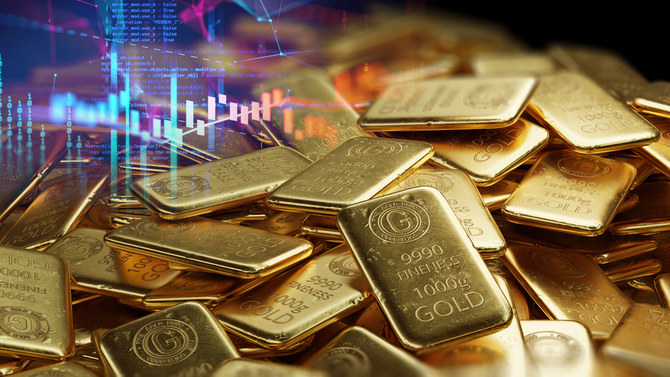
Spot gold was down 0.6 percent at $1,956.89 per ounce, as of 0709 GMT, its lowest in nearly a week (Shutterstock)
Short Url
Updated 03 April 2023
Follow

Gold drops as inflation risks after OPEC+ oil target cut raise Fed hike odds

BENGALURU: Gold prices slid on Monday after a surprise announcement from the Organization of the Petroleum Exporting Countries and its allies, known as OPEC+, about a cut to oil output sparked inflation concerns and raised bets of an interest rate hike at the US Federal Reserve’s upcoming May meeting, according to Reuters.

Spot gold was down 0.6 percent at $1,956.89 per ounce, as of 0709 GMT, its lowest in nearly a week. US gold futures shed 0.7 percent to $1,971.30.

The opportunity cost of holding non-yielding bullion rises when interest rates are increased to lower inflation.

Gold has fallen “as investors weigh up the lure of gold as a safe-haven asset, versus the potential for higher-for-longer interest rates. Clearly, fears of inflation and higher interest rates has won the argument,” said Matt Simpson, senior market analyst at City Index.

Oil prices surged after Saudi Arabia and other OPEC+ oil producers announced a round of output cuts, a potentially ominous sign for global inflation just days after a slowdown in US price data had boosted market optimism.

US consumer spending rose moderately in February and showed signs of cooling, even though it remained elevated.

“Gold is now vulnerable to a move down to $1,900, given the potential for a higher terminal Fed rate that markets are currently pricing in,” Simpson added.

Markets now see a 60.9 percent chance of the Fed hiking rates by a quarter point in May which, in turn, has lifted the US dollar and Treasury yields.

ANZ, in a note, observed gold’s “safe-haven demand easing as the US banking turmoil eased.”

Bullion had risen by nearly 8 percent last quarter after the recent global banking turmoil drove bets that the Fed would tone down its rate hike approach.

Standard Chartered analyst Suki Cooper said in a note that gold buying by central banks might “not be as strong as it was in 2022.”

Spot silver slipped 1.6 percent to $23.69 per ounce, platinum lost 0.5 percent to $986.83, and palladium fell 0.4 percent to $1,455.16.


Kuwait to boost Islamic finance with sukuk regulation

Updated 05 February 2026
Follow

Kuwait to boost Islamic finance with sukuk regulation

  • The move supports sustainable financing and is part of Kuwait’s efforts to diversify its oil-dependent economy

RIYADH: Kuwait is planning to introduce legislation to regulate the issuance of sukuk, or Islamic bonds, both domestically and internationally, as part of efforts to support more sustainable financing for the oil-rich Gulf nation, Prime Minister Sheikh Ahmad Abdullah Al-Ahmad Al-Sabah said on Wednesday.

Speaking at the World Governments Summit in Dubai, Al-Sabah highlighted that Kuwait is exploring a variety of debt instruments to diversify its economy. The country has been implementing fiscal reforms aimed at stimulating growth and controlling its budget deficit amid persistently low oil prices. Hydrocarbons continue to dominate Kuwait’s revenue stream, accounting for nearly 90 percent of government income in 2024.

The Gulf Cooperation Council’s debt capital market is projected to exceed $1.25 trillion by 2026, driven by project funding and government initiatives, representing a 13.6 percent expansion, according to Fitch Ratings.

The region is expected to remain one of the largest sources of US dollar-denominated debt and sukuk issuance among emerging markets. Fitch also noted that cross-sector economic diversification, refinancing needs, and deficit funding are key factors behind this growth.

“We are about to approve the first legislation regulating issuance of government sukuk locally and internationally, in accordance with Islamic laws,” Al-Sabah said.

“This enables us to deal with financial challenges flexibly and responsibly, and to plan for medium and long-term finances.”

Kuwait returned to global debt markets last year with strong results, raising $11.25 billion through a three-part bond sale — the country’s first US dollar issuance since 2017 — drawing substantial investor demand. In March, a new public debt law raised the borrowing ceiling to 30 billion dinars ($98 billion) from 10 billion dinars, enabling longer-term borrowing.

The Gulf’s debt capital markets, which totaled $1.1 trillion at the end of the third quarter of 2025, have evolved from primarily sovereign funding tools into increasingly sophisticated instruments serving governments, banks, and corporates alike. As diversification efforts accelerate and refinancing cycles intensify, regional issuers have become regular participants in global debt markets, reinforcing the GCC’s role in emerging-market capital flows.

In 2025, GCC countries accounted for 35 percent of all emerging-market US dollar debt issuance, excluding China, with growth in US dollar sukuk issuance notably outpacing conventional bonds. The region’s total outstanding debt capital markets grew more than 14 percent year on year, reaching $1.1 trillion.