

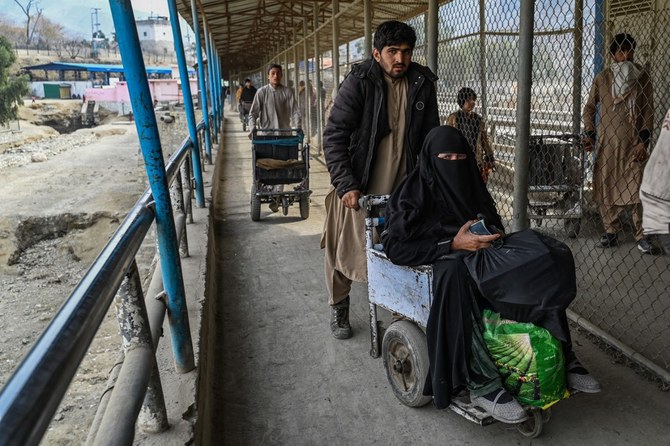

LONDON: More than 1,000 Afghans eligible to come to the UK for resettlement remain stuck in Pakistan, a report by The Independent has said.
The asylum seekers, mainly people who served alongside UK forces in Afghanistan and their families, have been stranded since the UK ceased chartering special Royal Air Force flights to evacuate Afghans from Pakistan in November, according to joint research with Lighthouse Reports.
Those left could face up to a year before they can travel on commercial flights due to a lack of safe housing in the UK and severe Home Office backlogs in processing asylum seekers. Whilst in Pakistan, they are left in legal limbo, with limited rights, sources of income and no access to education.
Among those stranded are former interpreters, medics and embassy employees, as well as at least 500 children.
There are also at least 4,600 people still stuck in Afghanistan, whilst the UK government has come in for criticism after it recently emerged that a former Afghan pilot, who had served alongside the British Army, had been threatened with deportation to Rwanda.
Johnny Mercer, the UK’s minister for veterans’ affairs, recently told MPs in the House of Commons: “The flow of people (from Afghanistan) to whom we have responsibility is not working as we would like at the moment.”
Armed Forces Minister James Heappey, meanwhile, admitted that 63 people stranded in Pakistan had been there over a year — with some having been there over 500 days.
Those identified are eligible to travel to the UK under the Afghan Relocation and Assistance Policy, but the number of those traveling since November has plummeted, with just 56 in total between December and February 2023, down from an average of 385 per month between January and November 2022.
One former interpreter, trapped in Pakistan for over a year, said: “This is my sin that I worked with British forces. I am like a prisoner and we are not safe in Pakistan.
“I don’t know what I am doing. I have anxiety. If they (the UK government) don’t give me an answer in two months I will run away from this place. I will go illegally to European countries to get to safety.”
Another man, a doctor whose father also worked as an interpreter for the British Army, is hoping to join his parents, currently living in a hotel in the UK.
“I’m all day long in one room; you could say it’s like being in jail, but without any crime. I am a professional doctor. I want to work. I am young. England needs doctors, but unfortunately I’m still here,” he told The Independent.
A former British Embassy worker and father of five, who was told he would have to source his own accommodation if he traveled to the UK, told The Independent: “Unfortunately I have no relatives in the UK. It’s impossible for me to arrange accommodation there. But they haven’t given us any alternative.”
Shadow Defence Secretary John Healey said: “This is a fundamental breach of our national obligation. Ministers must sort out the many failings in their Afghan scheme, and honour the UK’s promise of safety, freedom, and a chance to contribute to Britain.”
His Labour colleague Dan Jarvis MP, who served as a soldier in Afghanistan, said: “The government’s failure to get a grip on ARAP means we now find ourselves in a farcical situation, where people who risked their lives in support of our mission and have been promised safe passage to the UK are having to do the legwork and embark on a house-hunting mission if they want to get here.”
Maj. Gen. Charlie Herbert, who also served three tours in Afghanistan, added: “It’s heartbreaking to think of how they have been treated — many over several years — and to leave them and their families languishing indefinitely in cheap hotels in Islamabad with little confidence of onward movement to the UK is utterly disgraceful.”
Sarah Magill, managing director of the Free From Fear charity, said: “We should have rolled out the red carpet for these brave people who served alongside our troops; instead we are locking them up like battery hens. We must not delay their evacuation a moment longer.”
A UK government spokesperson said: “We owe a debt of gratitude to those interpreters and other staff eligible under the ARAP scheme who worked for, or with, UK forces in Afghanistan. The UK government has made a commitment to relocate eligible Afghans and their families to the UK under the ARAP scheme, and will honour this.
“We continue to support the movement of eligible people out of Afghanistan by working with a variety of partners and countries in the region. To date, we have relocated over 12,200 individuals to the UK under ARAP.”


