‘Better than jalebi’: Emirati Luqaimat adds crunch to Pakistani iftar meals

The undated picture shows Emirati Luqaimat, a popular Middle Eastern sweet dish. (Online)
Short Url
Updated 03 April 2023
Follow

‘Better than jalebi’: Emirati Luqaimat adds crunch to Pakistani iftar meals

  • The Middle Eastern sweet dish is prepared with yeast-leavened dough balls that are deep fried
  • Pakistani chef Naheed Ansari says luqaimat is a ‘form of Jalebi’ commonly consumed in Arab world

KARACHI: Emirati Luqaimat is a popular Middle Eastern sweet dish with a number of regional varieties across the world. Prominent Pakistani chef Naheed Ansari says the recipe is “easy and delicious” and can very well complement iftar platters in Pakistan during the holy month of Ramadan.  

Known as ‘luqmat Al-qadi’ in the 13th century Arabic cookery books, the sweet dish is prepared with yeast-leavened dough which are deep fried and drizzled with sugar syrup. It is consumed best when fresh and warm, crunchy on the outside and soft and airy on the inside.  

Muslims around the world abstain from food and drink from dawn till sunset during the holy month of Ramadan. In Pakistan, people spend Ramadan preparing special food items to consume at both sehri [pre-dawn meal] and iftar [fast-breaking evening meal].  

Ansari, who has around 30 years of experience in culinary arts, learned the recipe in the Middle East and has been making the sweet dish in her classes for over two decades.  

“Emirati Luqaimat is very easy and delicious, and people of all ages love it,” the famous chef told Arab News on Friday.  

“Luqaimat is specific to Ramadan and is better than jalebi. It becomes more delicious when consumed with milk or cream. Pakistanis want crunch every time so I tweaked the recipe accordingly.”
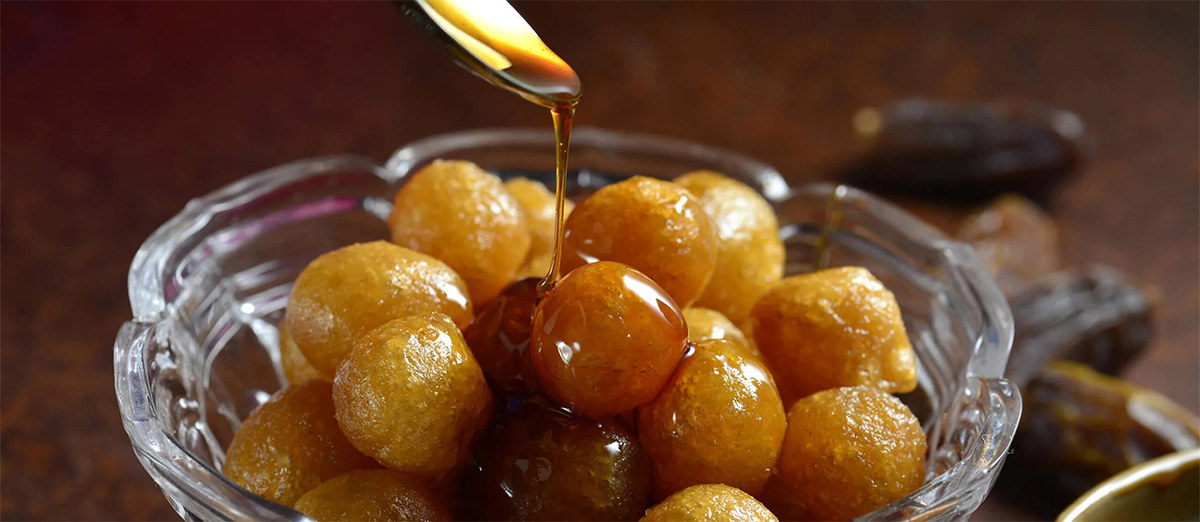


The undated picture shows Emirati Luqaimat, a popular Middle Eastern sweet dish. (Photo courtesy: Leisure Center)

Ansari shared a “simple recipe” for luqaimat that starts with mixing the all-purpose white flour (two cups), corn flour (two tbsp.), milk powder (two tbsp.) and oil (two tbsp.).  

The chef said Arabs do not add milk powder, but she has added it to the recipe to give it a little more taste and crunch. “For a healthier version, you can just use flour. But with flour, it won’t be crunchy,” she shared.  

The next step involves mixing of one tbsp. yeast, one-and-a-half cup of warm water and one tbsp. sugar *to the dry flour mixture.*

“I usually beat it with my hands. The more you beat it, the fluffier it gets,” Ansari said.  

She emphasized on beating the batter a lot before putting it aside for an hour to rise. For ‘sheera’ (sugar syrup), the chef asked to boil two cups of sugar in two cups of water before adding a slice of lemon and two tablespoons of lemon juice.  

“Boil it on high heat for 10 minutes and then close the flame,” Ansari said.

The easiest way is to take a water bottle and make a hole in the cap, according to Ansari. She recommended putting the batter in the bottle to make small balls and fry them.  

“Once they are crispy brown, put them in the sheera. Take it out after 2-3 minutes and garnish with pistachio [or not],” she said.  

Ansari suggested serving luqaimat in glasses or cups with milk or cream. For children, she said, it could even be served with chocolates or maple syrup.  

“It is good for Eid too,” the chef added.


Hear them out: The best Arab alternative albums of 2025 

Updated 25 December 2025
Follow

Hear them out: The best Arab alternative albums of 2025 

  • Bojan Preradovic’s pick of records released by indie artists from the Arab world this year 

Saint Levant 

‘Love Letters’ 

With his sophomore LP, the Palestinian artist matures from viral breakout to more vulnerable, multilingual pop and R&B, shaping a compact set of love songs with a firmly Palestinian center. He braids sleek synths, North African grooves, and earworm melodies into pieces that drift between late-night infatuation and clear-eyed reflections on home, distance, and belonging. “DALOONA,” a collaboration with Shamstep pioneers 47Soul, and “KALAMANTINA,” featuring Egyptian rap star Marwan Moussa, both lean into joyful release, while “EXILE” sits with the emotional cost of separation and absence. “Love Letters” threads romance, memory, and identity into understated, exceedingly replayable art. 


Zeyne 

‘Awda’ 

Rising Palestinian-Jordanian star Zeyne uses her debut LP to alchemize the last few years of upheaval and her meteoric ascent into a 13-track map of who she is and where she comes from. Folding contemporary R&B and pop into playful rhythms, dabke pulses, and Arabic melodic turns, she sings of home, pressure, and stubborn hope on tracks that feel both diaristic and cinematic. The record shifts between tenderness, unease, and quiet celebration, while guest appearances from Saint Levant and Bayou mix perfectly with the record’s unique flavors rather than overpowering them. This is an exhilarating, soul-searching foray into Arabic alt-pop that treats vulnerability and pride as two sides of the same coin. 


Yasmine Hamdan 

‘I remember I forget’  

A quietly piercing LP from the indie icon about what we choose to carry and what we try to erase. Recorded with her trusted musical confidant Marc Collin, the album folds muted electronics, trip-hop beats, oud, and Arabic strings into songs in which personal memory, folk echoes, and her country’s never-ending tumult blur into one. Album closer “Reminiscence” lets the record fade like a long-held breath, reminding us that Hamdan is still one of the few artists capable of molding private anxieties into a shared, luminous language.  


Kazdoura

 ‘Ghoyoum’ 

The Toronto-based duo’s debut weaves a story of migration and fracture into a quietly dazzling Arabic fusion record. Vocalist Leen Hamo and multi-instrumentalist John Abou Chacra root everything in Levantine maqams, then let the songs drift toward jazz, psychedelia, and dream pop without ever losing sight of the tarab they grew up on. From the yearning of opener “Marhaba Ahlen” and the fiery feminist chant of “Ya Banat” to the reworked folk of “Hmool El Safar” and the woozy sway of “Khayal” and “Titi Titi,” they sculpt homesickness, resilience, and slow healing into something genuinely transformative. 


Tamara Qaddoumi  

‘The Murmur’ 

On her first full-length album, Tamara Qaddoumi stretches the trip-hop and shadowy pop universe she explored on 2021’s EP “Soft Glitch” into a deeper, intensely moving world. Written with longtime collaborator Antonio Hajj, and produced by indie mainstay Fadi Tabbal, “The Murmer” leans on low-end throb, smoldering synths, and incisive guitar lines that feel both intimate and vast. Her voice hovers between confession and spell, circling questions of identity, grief, and attachment that evoke her own hybrid Kuwaiti, Palestinian, Lebanese, and Scottish heritage. The result is a delightfully cobwebby, absorbing LP that lingers long after it ends. 


Sanam 

‘Sametou Sawtan’ 

Recorded between Beirut, Byblos, and Paris, “Sametou Sawtan” – Arabic for “I heard a voice” – is a poignant, unsettled collision of noise rock, free jazz, and Arabic folk that fizzes with tension. Produced by Radwan Ghazi Moumneh, the eight tracks by the art-rock sextet are anchored by Sandy Chamoun’s remarkable vocals, which move from murmured prayer to visceral intensity, drawing on classical Arabic poetry and prose and her own lyrics to inhabit figures who are bewildered, grieving, or stubbornly alive. From the opening surge of “Harik” to the slow burn of “Hamam,” Sanam distill personal and collective unease into work that’s urgent, physical, and impossible to ignore. This is an act on the precipice of wider, global renown.  


Nabeel 


‘Ghayoom’  

On “Ghayoom,” the Iraqi-American songwriter — real name Yasir Razak — firmly plants the flag of an audacious musical explorer venturing across roads less traveled. He sings in Arabic over a wall of distorted guitars and slowcore drums, enveloped by captivating, shoegaze-colored soundscapes. The artwork, built from worn family photographs, hints at what the music is chasing. These eight tracks pair devotional tenderness with the grit of DIY rock. Opener “Resala” aches with unsent words; “Khatil” hits with uneasy momentum; while the elegant flicker of pop-tinged moments scattered throughout the album maintain a raw and bruised edge.  


Malakat 

Al Anhar Wal Oyoon 

On its first showcase, Jordan-based label Malakat gathers seven Arab woman artists and enables them to pull in seven different directions that end up flowing as a single current. “Al Anhar Wal Oyoon” (‘The Rivers and the Springs’), moves from Intibint’s hauntingly inspired vocalization to Liliane Chlela’s serrated electronics, and from Sukkar and DAL!A’s skewed pop to Sandy Chamoun’s voice-led piece, and Bint Mbareh’s closing track, developed in dialogue with visionary producer Nicolas Jaar. Mixed across Amman, the UK, and New York, and mastered by the highly-sought-after Heba Kadry, this is a deeply textured statement of intent from a label quietly redrawing the map of experimental Arab music.