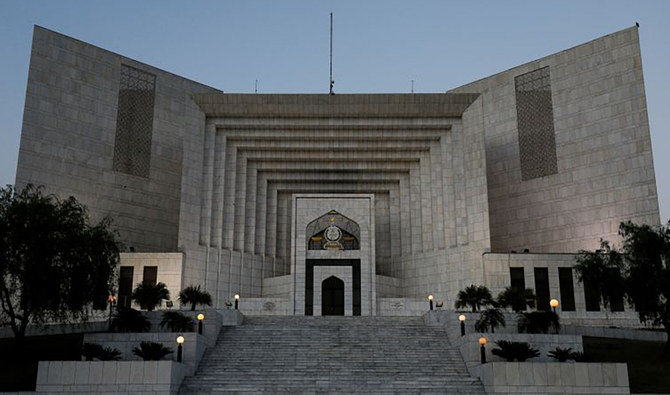
ISLAMABAD: The ongoing tussle between the government and judiciary intensified in Pakistan on Friday after a three-member bench resumed hearing a petition filed by former Prime Minister Imran Khan’s Pakistan Tehreek-e-Insaf (PTI) party against the election postponement in Punjab province, while refusing to form a full court to adjudicate the matter.
The country’s election commission announced the postponement of the Punjab polls this month, citing security, administrative, and financial reasons, after the province’s legislative assembly was dissolved by Khan’s party in January to force the incumbent administration to hold early general elections in the country. The PTI filed the petition against the commission’s decision since Pakistan’s constitution requires that elections must be held within 90 days of the dissolution of an assembly.
The Supreme Court’s proceedings were delayed on Friday after two senior judges, Justice Jamal Mandokhail and Justice Amin-ud-Din Khan, parted ways from the five-member bench that originally took up the PTI petition. The development followed the approval of a bill by the upper house of parliament on Thursday to curtail the chief justice’s power to use “suo motu” authority, which allows the court to open cases on its own to address issues that it deems to be of public interest.
The government, which recently presented a National Assembly resolution demanding an end to the top court’s “interference” in political matters, requested a full court hearing, although the chief justice said it would waste time since the bench had already heard the case for three consecutive days.
“It will take time for the new judges to understand the case,” Chief Justice Umar Ata Bandial remarked.
He said that the court was willing to “take a break” if the government and the opposition PTI party started negotiating over the election date. However, he also warned that the court would play its constitutional role if the political parties failed to make headway.
Giving reasons for a delay in the elections beyond 90 days, Attorney-General of Pakistan Mansoor Awan told the court that the country was running a deficit of Rs1,500 billion, which was expected to rise further until June.
The Supreme Court summoned defense and finance secretaries on Monday to get input on the security personnel and funds needed to hold the elections. The chief justice also hoped that next week’s sun would rise “with good news.”
LEGISLATION TO REDUCE CHIEF JUSTICE’S POWERS
Meanwhile, legal experts said the recent legislation to curtail the chief justice’s power would ultimately land in the courts for judicial review while commenting on the ongoing tussle between the government and judiciary.
“The fact that a law will also address some concerns raised by certain political parties is not a good enough reason to be suspicious about its constitutionality,” advocate Waqqas Mir said while speaking to Arab News.
“I feel the proposed law will force the Supreme Court to have an urgent conversation within its members about whether they want the important issues [relating to suo motu and constitution of benches] to be addressed by politicians or by themselves,” he added.
Mir said the recusals of the judges were not happening because they wanted the elections to be delayed but “the clearly stated reason for recusals is reasoned disagreements by judges about the exercise of discretion to form benches and exercise of powers under Article 184(3) of the constitution.”
“Disagreements over ideas, interpretations, and principled positions are not necessarily a bad thing,” he said. “As long as personal collegiality remains between judges, the institution should come out stronger.”
However, advocate Imran Shafique said the recusal of the judges in the elections delay case was a manifestation of a “full-blown crisis and unrest” in the Supreme Court, which would weaken the institution in the longer run.
“Unfortunately, the leadership capability of the chief justice has been questioned as he has failed to take all the judges along in dispensation of justice,” he told Arab News.
Asked about the legislation related to the chief justice’s powers, Shafique said it would help abolish the “dictatorship role” of the top judge at the Supreme Court.
“After the implementation of the legislation, the institution will be making decisions instead of an individual, which is a good thing to happen,” he added.


![]()

Political crisis deepens as CJ refuses to form full court in election postponement case
Short Url
https://arab.news/9z8qe
Political crisis deepens as CJ refuses to form full court in election postponement case
- Chief justice says the Supreme Court will take a break if political parties begin to negotiate and settle the matter
- Legal experts say CJ’s leadership capability has come under question after the recusal of two judges hearing the case
Latest updates





Recommended


© 2026 SAUDI RESEARCH & PUBLISHING COMPANY, All Rights Reserved And subject to Terms of Use Agreement.