

US-China divide may be defining issue of our time, CEO says

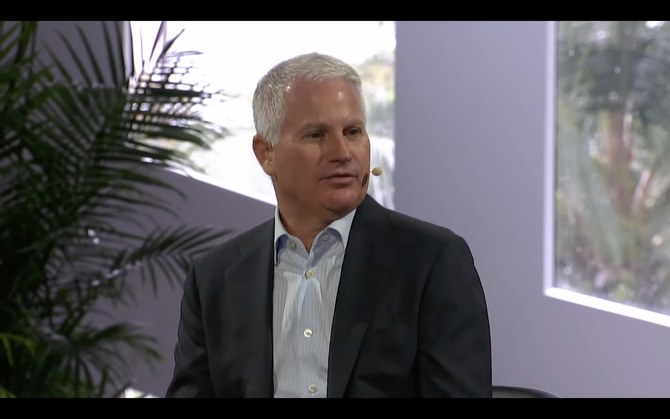
Speakers on the panel discussed the consequences of these adjustments on the global economy. (Screenshot/FII)
Short Url
Updated 30 March 2023
Follow

US-China divide may be defining issue of our time, CEO says

  • Chip Kaye of Warburg Pincus tells Miami conference that geopolitical frictions yet to stabilize, warns of ‘sticky’ inflation
  • Others say shift can offer opportunities for countries like Saudi Arabia 

MIAMI: Tensions between the US and China may be the “defining issue of our time” for business, a senior American CEO has said as the Future Investment Finance conference opened in Miami.

Chip Kaye, of private equity company Warburg Pincus, was discussing the dangers of increasingly fractured geopolitics with other business executives on a panel titled “Business in the new world order.” 

He said that everything from climate change to “very local issues… rely on some dimension of state capacity and some dimension of political discourse” to be solved.

“And that’s in short supply in an environment where two sides don’t understand each other at all. (The) US-China divide may be the defining issue of our time.”

Kaye said geopolitical frictions and cultural wars, not only between the US and China, were having far-reaching effects on economic stability.

“I think economic activity is all stronger than we think and the reality is, inflation is a little stickier than we think, and that we may live in a more elevated inflation environment for a longer stretch of time,” he said. “We’re at the very beginning of this adjustment, as opposed to the end.”

Speakers on the panel discussed the consequences of these adjustments on the global economy, and argued that despite the many obstacles it would not lead to the end of globalization.

“I don’t think globalization is dead,” said Jenny Johnson, CEO of investment company Franklin Templeton.

“It’s slowing down and there’s probably some themes that can inform some investments.”

Johnson pointed out how this shift could offer opportunities for investors, particularly for countries like Saudi Arabia that focus on “entrepreneurship, entrepreneurism, on education, where the government is supporting business.”

Speakers also said investors needed to focus more on micro-level problem-solving rather than trying to predict macro-level trends.

“I think macro should have humbled us all at this point,” said She Nyatta, founder of Bicycle Capital, a US-based growth equity investment firm.

“Trying to make big macro predictions over the last four years has been a complete fool’s errand.”

One way investors can support micro-level problem-solving was by investing in developing markets, which Nyatta said were fertile ground for innovation and problem-solving due to their lack of infrastructure and advanced technology.

“I think we need to look where problems are, and find ways to solve those problems at a micro level and those will turn into good businesses because a problem is being solved,” Nyatta said.

But “take risks. In an uncertain time don’t sit on your hands. Don’t wonder what’s going to happen. Take risks.”

Gulf-EU value chain integration signals shift toward long-term economic partnership: GCC secretary general

Updated 03 February 2026
Follow

Gulf-EU value chain integration signals shift toward long-term economic partnership: GCC secretary general

RIYADH: Value chains between the Gulf and Europe are poised to become deeper and more resilient as economic ties shift beyond traditional trade toward long-term industrial and investment integration, according to the secretary general of the Gulf Cooperation Council.

Speaking on the sidelines of the World Governments Summit 2026 in Dubai, Jasem Al-Budaiwi said Gulf-European economic relations are shifting from simple commodity trade toward the joint development of sustainable value chains, reflecting a more strategic and lasting partnership.

His remarks were made during a dialogue session titled “The next investment and trade race,” held with Luigi Di Maio, the EU’s special representative for external affairs.

Al-Budaiwi said relations between the GCC and the EU are among the bloc’s most established partnerships, built on decades of institutional collaboration that began with the signing of the 1988 cooperation agreement.

He noted that the deal laid a solid foundation for political and economic dialogue and opened broad avenues for collaboration in trade, investment, and energy, as well as development and education.

The secretary general added that the partnership has undergone a qualitative shift in recent years, particularly following the adoption of the joint action program for the 2022–2027 period and the convening of the Gulf–European summit in Brussels.

Subsequent ministerial meetings, he said, have focused on implementing agreed outcomes, enhancing trade and investment cooperation, improving market access, and supporting supply chains and sustainable development.

According to Al-Budaiwi, merchandise trade between the two sides has reached around $197 billion, positioning the EU as one of the GCC’s most important trading partners.

He also pointed to the continued growth of European foreign direct investment into Gulf countries, which he said reflects the depth of economic interdependence and rising confidence in the Gulf business environment.

Looking ahead, Al-Budaiwi emphasized that the economic transformation across GCC states, driven by ambitious national visions, is creating broad opportunities for expanded cooperation with Europe. 

He highlighted clean energy, green hydrogen, and digital transformation, as well as artificial intelligence, smart infrastructure, and cybersecurity, as priority areas for future partnership.

He added that the success of Gulf-European cooperation should not be measured solely by trade volumes or investment flows, but by its ability to evolve into an integrated model based on trust, risk-sharing, and the joint creation of economic value, contributing to stability and growth in the global economy.

GCC–EU plans to build shared value chains look well-timed as trade policy volatility rises.

In recent weeks, Washington’s renewed push over Greenland has been tied to tariff threats against European countries, prompting the EU to keep a €93 billion ($109.7 billion) retaliation package on standby. 

At the same time, tighter US sanctions on Iran are increasing compliance risks for energy and shipping-related finance. Meanwhile, the World Trade Organization and UNCTAD warn that higher tariffs and ongoing uncertainty could weaken trade and investment across both regions in 2026.