Give youth tools to overcome cost-of-living crisis, Saudi envoy to US tells FII Priority conference

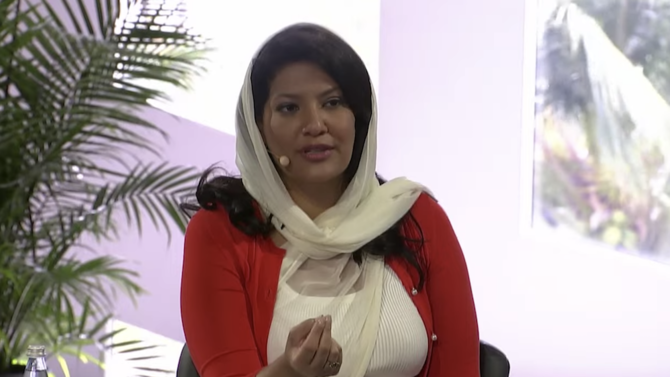
Princess Reema bint Bandar was speaking during a panel discussion of what the UN has described as the “largest cost-of-living crisis of the 21st century” at the FII Priority conference in Miami. (Screenshot/FII Priority)
Short Url
Updated 30 March 2023
Follow

Give youth tools to overcome cost-of-living crisis, Saudi envoy to US tells FII Priority conference

  • Princess Reema bint Bandar said that ‘having financial literacy and financial engagement at a younger age will allow us all to be more efficient citizens’
  • She highlighted the success of Saudi Arabia’s Vision 2030 national development project in engaging the Kingdom’s youth and the speed with which new opportunities have been created

MIAMI: Equipping the youth of the world with financial literacy and opportunities is vital if they are to overcome the growing cost-of-living crisis, Saudi Arabia’s ambassador to the US told the Future Investment Initiative’s Priority conference in Miami on Thursday.

Princess Reema bint Bandar was speaking during a panel discussion of what the UN has described as the “largest cost-of-living crisis of the 21st century,” and its disproportionate effects on young people around the globe, who are on the front lines of the crisis.

She said there certainly needs to be more personal accountability and understanding of what is needed at an individual level, but also at the national and international levels.

“We have all been overspending, overbuying and overconsuming and this ‘click button, immediate delivery’ has skewed our perception of what our personal costs are, personal needs and our engagement,” she said. “I think we have been thinking too macro; let’s go back to micro and have little bit more personal responsibility.

“I think (understanding) the concept of interconnectivity of our behavior and our actions, and having financial literacy and financial engagement at a younger age, will allow us all to be more efficient citizens, regardless of whether it’s in the Kingdom, the Middle East or the West.

“I think we’ve lost the concept of our personal impact on economies and other people’s lives,” she added.

The ambassador highlighted the success of Saudi Arabia’s Vision 2030 national development project in engaging the Kingdom’s youth and the speed with which new opportunities have been created outside of the traditional governmental and public sector.

Five years ago in Saudi Arabia, she said, very few young people had any desire to step outside the “comfort zone” of the government sector; now, 58 percent of young people aspire to entrepreneurship pathways, confident that a system is in place in the Kingdom to support them.

“The reason you’re seeing success among young people, not just entering the government but also the private sector, is because today every single young person knows their role in this vision of evolving our country,” she said.

“It is creating opportunity for the individual to be part of the collective and recognize that every piece or step of work or ambition they have adds to the collective well-being of everybody else. That is what’s really driving us as a nation.

“We’ve been able to create education pathways; over $100 million has been spent not just on traditional education but expanding the pipelines of opportunity for young people in (sectors such as) hospitality, tourism and sport,” Princess Reema added.

She also refuted criticism from outside the Kingdom of investment and job creation in these sectors being “culture-washing” or “sport-washing” by pointing out it had created 3 million jobs so that young people can earn a decent living and wage, which could “help them uplift not just themselves but their households and their families and create opportunities for others.”

She said she feels the Saudi approach in this regard is what is “inspiring about being in the Kingdom today,” adding: “We have a moment to inspire young people to not just take, but to also give.”

On the growing engagement of young Saudi women in the process, she said: “You cannot create an opportunity for one gender and not the other, and that’s something we’ve been able to accomplish through Vision 2030.”


Acwa signs key terms to develop 5GW of renewable energy capacity in Turkiye

Updated 23 February 2026
Follow

Acwa signs key terms to develop 5GW of renewable energy capacity in Turkiye

JEDDAH: Saudi utility giant Acwa has signed key investment agreements with Turkiye’s Ministry of Energy and Natural Resources to develop up to 5 gigawatts of renewable energy capacity, starting with 2GW of solar power across two plants in Sivas and Taseli.

Under the investment agreement, Acwa will develop, finance, and construct, as well as commission and operate both facilities, according to a press release.

The program builds on the company’s first investment in Turkiye, the 927-megawatt Kirikkale Independent Power Plant, valued at $930 million, which offsets approximately 1.8 million tonnes of carbon dioxide annually, the statement added.

A separate power purchase agreement has been concluded with Elektrik Uretim Anonim Sirketi for the sale of electricity generated by each facility.

Turkiye aims to boost solar and wind capacity to 120GW by 2035, supported by around $80 billion in investment, while recent projects have already helped prevent 12.5 million tonnes of CO2 emissions and reduced reliance on imported natural gas.

Turkiye’s energy sector has undergone a rapid transformation in recent years, with renewable power emerging as a central pillar of its strategy.

Raad Al-Saady, vice chairman and managing director of ACWA, said: “The signing of the IA (implementation agreement) and PPA key terms marks a pivotal moment in Acwa’s partnership with Turkiye, reflecting the country’s strong potential as a clean energy leader and manufacturing powerhouse.”

He added: “Building on our long-standing presence, including the 927MW Kirikkale Power Plant commissioned in 2017, this step elevates our partnership to a new level,” Al-Saady said.

In its statement, Acwa said the 5GW renewable energy program will deliver electricity at fixed prices, enhancing predictability for grid planning and supporting long-term industrial investment.

By replacing imported fossil fuels with domestically generated clean energy, the initiative is expected to reduce Turkiye’s exposure to global energy market volatility, strengthening energy security and lowering long-term power costs.

The company added that the economic impact will extend beyond the anticipated investment of up to $5 billion in foreign direct investment, with thousands of jobs expected during the construction phase and hundreds of high-skilled roles created during operations.

The energy firm concluded that its existing progress in Turkiye reflects a strong appreciation for Turkish engineering, construction, and manufacturing capacity, adding that localization has been a strategic priority, and it has already achieved 100 percent local employment at its developments in the country.