Amid deepening political uncertainty, Pakistani president says doubtful about October general elections

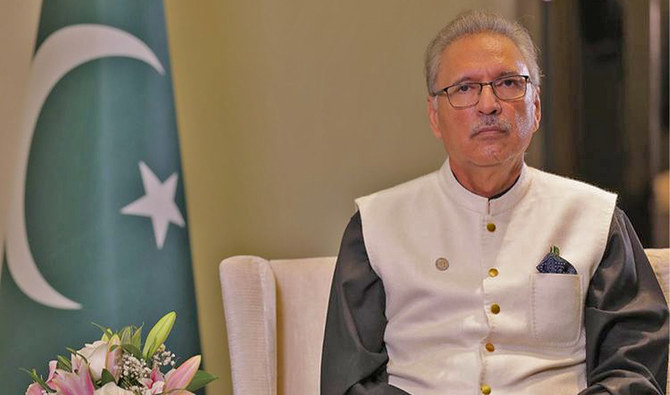
The undated picture shows Pakistan's President Dr. Arif Alvi. (Photo courtesy: APP)
Short Url
Updated 30 March 2023
Follow

Amid deepening political uncertainty, Pakistani president says doubtful about October general elections

  • President Arif Alvi says crisis solving not easy when different political stakeholders take extreme positions
  • He questions the timing of a legislation to reduce the CJ’s powers as the top court hear election delay case

ISLAMABAD: President Arif Alvi said on Wednesday he was doubtful that Pakistan would even hold general elections in October after the election commission decided to postpone the polls in Punjab and Khyber Pakhtunkhwa provinces in a move that further deepened political uncertainty and turmoil in the country.

The election dates in the two provinces came up for discussion after former prime minister Imran Khan’s Pakistan Tehreek-e-Insaf (PTI) party decided to dissolve their assemblies in January while trying to build pressure on the government to hold snap elections in the country.

After much political wrangling that led to judicial proceedings to settle the issue, the Election Commission of Pakistan (ECP) announced to hold general elections in Punjab and Khyber Pakhtunkhwa provinces on April 30 and May 28, respectively.

However, it later revisited the election schedule, citing security, administrative and financial reasons, and postponed the polls to October 8.

Discussing the current political developments in an interview with Geo News, Alvi said he had a feeling for the last 10 months that Pakistan’s constitution was facing challenges.

“Even before Imran Khan dissolved the assemblies, I told him and also highlighted in my speeches that even the October elections seemed to be under threat,” he said.

“The incumbent government says that Pakistan was moving toward a disaster when it decided to sacrifice [its political capital] to stabilize things,” he continued. “However, the public is not willing to accept it. That is why the government believes it has sacrificed a great deal and will be wiped out in the elections.”

The president maintained he was trying to play a constructive role in the country which was witnessing a highly polarized environment. However, he pointed out crisis solving was never easy when different political stakeholders take extreme positions.

Referring to his recent correspondence with Prime Minister Shehbaz Sharif, wherein Alvi raised concerns about rights violations in the country, he said he was “saddened” to be labelled a PTI partisan since he was trying to raise genuine concern over the constitutional and political crisis in the country.

The Pakistani president originally belongs to Khan’s political faction and was appointed to the top executive office by the former prime minister.

He also questioned the timings of a recent legislation in the country’s parliament to regulate the powers of Pakistan’s chief justice after the top court took up a PTI petition challenging the ECP’s decision to postpone the Punjab polls.


Pakistan opposition to continue protest over ex-PM Khan’s health amid conflicting reports

Updated 16 February 2026
Follow

Pakistan opposition to continue protest over ex-PM Khan’s health amid conflicting reports

  • Pakistan’s government insists that the ex-premier’s eye condition has improved
  • Khan’s personal doctor says briefed on his condition but cannot confirm veracity

ISLAMABAD: Pakistan’s opposition alliance on Monday vowed to continue their protest sit-in at parliament and demanded “clarity” over the health of jailed former prime minister Imran Khan, following conflicting medical reports about his eye condition.

The 73-year-old former cricket star-turned-politician has been held at the high-security Adiala prison in Rawalpindi since 2023. Concerns arose about his health last week when a court-appointed lawyer, Barrister Salman Safdar, was asked to visit Khan at the jail to assess his living conditions. Safdar reported that Khan had suffered “severe vision loss” in his right eye due to central retinal vein occlusion (CRVO), leaving him with just 15 percent sight in the affected eye.

On Sunday, a team of doctors from various hospitals visited the prison to examine Khan’s eye condition, according to the Adiala jail superintendent, who later submitted his report in the court. On Monday, a Supreme Court bench led by Chief Justice Yahya Afridi observed that based on reports from the prison authorities and the amicus curiae, Khan’s “living conditions in jail do not presently exhibit any perverse aspects.” It noted that Khan had “generally expressed satisfaction with the prevailing conditions of his confinement” and had not sought facilities beyond the existing level of care.

Having carefully perused both reports in detail, the bench observed that their general contents and the overall picture emerging therefrom are largely consistent. The opposition alliance, which continued to stage its sit-in for a fourth consecutive day on Monday, held a meeting at the parliament building on Monday evening to deliberate on the emerging situation and discuss their future course of action.

“The sit-in will continue till there is clarity on the matter of [Khan's] health,”  Sher Ali Arbab, a lawmaker from Khan's Pakistan Tehreek-e-Insaf (PTI) party who has been participating in the sit-in, told Arab News, adding that PTI Chairman Gohar Ali Khan and Opposition Leader in Senate Raja Nasir Abbas had briefed them about their meeting with doctors who had visited Khan on Sunday.

Speaking to reporters outside parliament, Gohar said the doctors had informed them that Khan’s condition had improved.

“They said, 'There has been a significant and satisfactory improvement.' With that satisfactory improvement, we also felt satisfied,” he said, noting that the macular thickness in Khan’s eye had reportedly dropped from 550 to 300 microns, a sign of subsiding swelling.

Gohar said the party did not want to politicize Khan’s health.

“We are not doctors, nor is this our field,” he said, noting that Khan’s personal physician in Lahore, Dr. Aasim Yusuf, and his eye specialist Dr. Khurram Mirza had also sought input from the Islamabad-based medical team.

“Our doctors also expressed satisfaction over the report.”

CONFLICTING ACCOUNTS

Despite Gohar’s cautious optimism, Khan’s personal physician, Dr. Yusuf, issued a video message on Monday, saying he could neither “confirm nor deny the veracity” of the government’s claims.

“Because I have not seen him myself and have not been able to participate in his care... I’m unable to confirm what we have been told,” Yusuf said.

He appealed to authorities to grant him or fellow physician, Dr. Faisal Sultan, immediate access to Khan, arguing that the ex-premier should be moved to Shifa International Hospital in Islamabad for specialist care.

Speaking to Arab News, PTI’s central information secretary Sheikh Waqas Akram said Khan’s sister and their cousin, Dr. Nausherwan Burki, will speak to media on Tuesday to express their views about the situation.

The government insists that Khan’s condition has improved.

“His eye [condition] has improved and is better than before,” State Minister Talal Chaudhry told the media in a brief interaction on Monday.

“The Supreme Court of Pakistan is involved, and doctors are involved. What medicine he receives, whether he needs to be hospitalized or sent home, these decisions are made by doctors. Neither lawyers nor any political party will decide this.”