


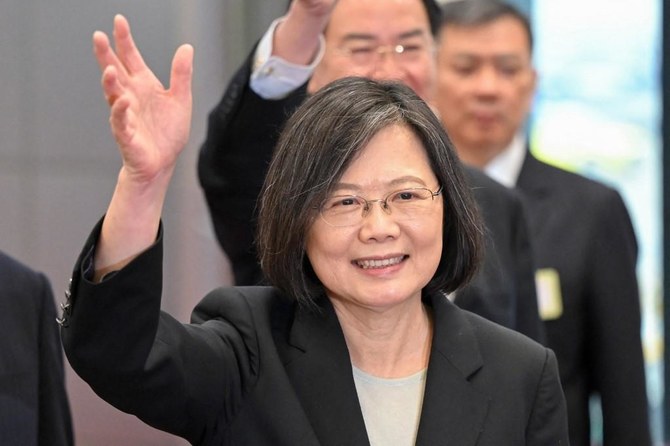
BEIJING: China has threatened “resolute countermeasures” over a planned meeting between Taiwanese president Tsai Ing-wen and US House speaker Kevin McCarthy during an upcoming visit in Los Angeles by the head of the self-governing island democracy.
Diplomatic pressure against Taiwan has ramped up recently, with Beijing poaching Taipei’s dwindling number of diplomatic allies while also sending military fighter jets flying toward the island on a near daily basis. Earlier this month, Honduras established diplomatic relations with China, leaving Taiwan with only 13 countries that recognize it as a sovereign state.
Tsai framed the trip as a chance to show Taiwan’s commitment to democratic values on the world stage, as she left Taiwan Wednesday afternoon to begin her 10-day tour of the Americas.
“I want to tell the whole world democratic Taiwan will resolutely safeguard the values of freedom and democracy, and will continue to be a force for good in the world, continuing a cycle of goodness, strengthening the resilience of democracy in the world,” she told reporters before she boarded the plane. “External pressure will not obstruct our resolution to engage with the world.”
Tsai is scheduled to transit through New York on March 30 before heading to Guatemala and Belize. On April 5, she’s expected to stop in Los Angeles on her way back to Taiwan, at which time the meeting with McCarthy is tentatively scheduled.
The US stops are the most closely watched of her trip.
Spokesperson for the Cabinet’s Taiwan Affairs Office Zhu Fenglian at a news conference Wednesday denounced Tsai’s stopover on her way to diplomatic allies in Central America and demanded that no US officials meet with her.
“We firmly oppose this and will take resolute countermeasures,” Zhu said. The US should “refrain from arranging Tsai Ing-wen’s transit visits and even contact with American officials, and take concrete actions to fulfill its solemn commitment not to support Taiwan independence,” she said.
Transit visits through the United States during broader international travel by the Taiwanese president have been routine over the years, senior US officials in Washington and Beijing have underscored to their Chinese counterparts.
In such unofficial visits in recent years, Tsai has met with members of Congress and the Taiwanese diaspora and has been welcomed by the chairperson of the American Institute in Taiwan, the US government-run nonprofit that carries out unofficial relations with Taiwan.
Tsai transited through the United States six times between 2016 and 2019 before slowing international travel with the coronavirus pandemic. In reaction to those visits, China lashed out rhetorically against the US and Taiwan.
However, the planned meeting with McCarthy has triggered fears of a heavy-handed Chinese reaction amid heightened frictions between Beijing and Washington over US support for Taiwan, trade and human rights issues.
Following a visit by then-House speaker Nancy Pelosi to Taiwan in 2022, Beijing launched missiles over the area, deployed warships across the median line of the Taiwan Strait and carried out military exercises in a simulated blockade of the island. Beijing also suspended climate talks with the US and restricted military-to-military communication with the Pentagon.
McCarthy, R-Calif., has said he would meet with Tsai when she is in the US and has not ruled out the possibility of traveling to Taiwan in a show of support.
Beijing sees official American contact with Taiwan as encouragement to make the island’s decades-old de facto independence permanent, a step US leaders say they don’t support. Pelosi, D-Calif., was the highest-ranking elected American official to visit the island since then-Speaker Newt Gingrich in 1997. Under the “One China” policy, the US acknowledges Beijing’s view that it has sovereignty over Taiwan, but considers Taiwan’s status as unsettled. Taipei is an important partner for Washington in the Indo-Pacific.
US officials are increasingly worried about China attempting to make good on its long-stated goal of bringing Taiwan under its control by force if necessary. The sides split amid civil war in 1949 and Beijing sees US politicians conspiring with Tsai’s pro-independence Democratic Progressive Party to make the separation permanent and stymy China’s rise as a global power.
The 1979 Taiwan Relations Act, which has governed US relations with the island, does not require Washington to step in militarily if China invades but makes it American policy to ensure Taiwan has the resources to defend itself and to prevent any unilateral change of status by Beijing.
Tensions spiked earlier this year when President Joe Biden ordered a Chinese spy balloon shot down after it traversed the continental United States. The Biden administration has also said US intelligence findings show that China is weighing sending arms to Russia for its ongoing war in Ukraine, but has no evidence Beijing has done so yet.
China, however, has provided Russia with an economic lifeline and political support, and President Vladimir Putin and Chinese leader Xi Jinping met in Moscow earlier this month. That was the first face-to-face meeting between the allies since before Russia launched its invasion of Ukraine more than a year ago.
The Biden administration postponed a planned visit to Beijing by Secretary of State Antony Blinken following the balloon controversy but has signaled it would like to get such a visit back on track.


