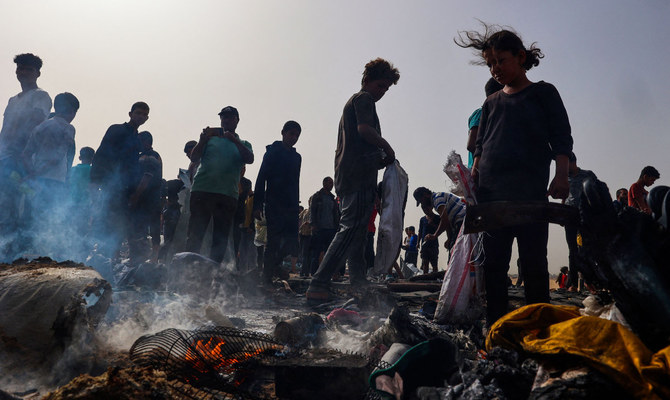
TEL AVIV, Israel: Prime Minister Benjamin Netanyahu said Monday that a “tragic mistake” was made in an Israeli strike in the southern Gaza city of Rafah that set fire to a camp housing displaced Palestinians and, according to local officials, killed at least 45 people.
The strike only added to the surging international criticism Israel has faced over its war with Hamas, with even its closest allies expressing outrage at civilian deaths. Israel insists it adheres to international law even as it faces scrutiny in the world’s top courts, one of which last week demanded that it halt the offensive in Rafah.
Netanyahu did not elaborate on the error. Israel’s military initially said it had carried out a precise airstrike on a Hamas compound, killing two senior militants. As details of the strike and fire emerged, the military said it had opened an investigation into the deaths of civilians.
Sunday night’s attack, which appeared to be one of the war’s deadliest, helped push the overall Palestinian death toll in the war above 36,000, according to the Gaza Health Ministry, which does not distinguish between fighters and noncombatants in its tally.
“Despite our utmost efforts not to harm innocent civilians, last night there was a tragic mistake,” Netanyahu said Monday in an address to Israel’s parliament. “We are investigating the incident and will obtain a conclusion because this is our policy.”
Mohammed Abuassa, who rushed to the scene in the northwestern neighborhood of Tel Al-Sultan, said rescuers “pulled out people who were in an unbearable state.”
“We pulled out children who were in pieces. We pulled out young and elderly people. The fire in the camp was unreal,” he said.
At least 45 people were killed, according to the Gaza Health Ministry and the Palestinian Red Crescent rescue service. The ministry said the dead included at least 12 women, eight children and three older adults, with another three bodies burned beyond recognition.
In a separate development, Egypt’s military said one of its soldiers was shot dead during an exchange of fire in the Rafah area, without providing further details. Israel said it was in contact with Egyptian authorities, and both sides said they were investigating.
An initial investigation found that the soldier had responded to an exchange of fire between Israeli forces and Palestinian militants, Egypt’s state-owned Qahera TV reported. Egypt has warned that Israel’s incursion in Rafah could threaten the two countries’ decades-old peace treaty.
The UN Security Council scheduled an emergency closed meeting for Tuesday afternoon on the situation in Rafah at the request of Algeria, the Arab representative on the council, two council diplomats told The Associated Press ahead of an official announcement.
Rafah, the southernmost Gaza city on the border with Egypt, had housed more than a million people — about half of Gaza’s population — displaced from other parts of the territory. Most have fled once again since Israel launched what it called a limited incursion there earlier this month. Hundreds of thousands are packed into squalid tent camps in and around the city.
Elsewhere in Rafah, the director of the Kuwait Hospital, one of the city’s last functioning medical centers, said it was shutting down and that staff members were relocating to a field hospital. Dr. Suhaib Al-Hamas said the decision was made after a strike killed two health workers Monday at the entrance to the hospital.
Netanyahu says Israel must destroy what he says are Hamas’ last remaining battalions in Rafah. The militant group launched a barrage of rockets Sunday from the city toward heavily populated central Israel, setting off air raid sirens but causing no injuries.
The strike on Rafah brought a new wave of condemnation, even from Israel’s strongest supporters.
The US National Security Council said in a statement that the “devastating images” from the strike on Rafah were “heartbreaking.” It said the US was working with the Israeli military and others to assess what happened.
French President Emmanuel Macron was more blunt, saying “these operations must stop” in a post on X. “There are no safe areas in Rafah for Palestinian civilians. I call for full respect for international law and an immediate ceasefire,” he wrote.
The Foreign Office of Germany, which has been a staunch supporter of Israel for decades, said “the images of charred bodies, including children, from the airstrike in Rafah are unbearable.”
“The exact circumstances must be clarified, and the investigation announced by the Israeli army must now come quickly,” the ministry added. ”The civilian population must finally be better protected.”
Qatar, a key mediator in attempts to secure a ceasefire and the release of hostages held by Hamas, said the Rafah strike could “complicate” talks, Negotiations, which appear to be restarting, have faltered repeatedly over Hamas’ demand for a lasting truce and the withdrawal of Israeli forces, terms Israeli leaders have publicly rejected.
The Israeli military’s top legal official, Maj. Gen. Yifat Tomer-Yerushalmi, said authorities were examining the strike in Rafah and that the military regrets the loss of civilian life.
Speaking to an Israeli lawyers’ conference, Tomer-Yerushalmi said Israel has launched 70 criminal investigations into possible violations of international law, including the deaths of civilians, the conditions at a detention facility holding suspected militants and the deaths of some inmates in Israeli custody. She said incidents of property crimes and looting were also being examined.
Israel has long maintained it has an independent judiciary capable of investigating and prosecuting abuses. But rights groups say Israeli authorities routinely fail to fully investigate violence against Palestinians and that even when soldiers are held accountable, the punishment is usually light.
Israel has denied allegations of genocide brought against it by South Africa at the International Court of Justice. Last week, the court ordered Israel to halt its Rafah offensive, a ruling it has no power to enforce.
Separately, the chief prosecutor at the International Criminal Court is seeking arrest warrants against Netanyahu and Israeli Defense Minister Yoav Gallant, as well as three Hamas leaders, over alleged crimes linked to the war. The ICC only intervenes when it concludes that the state in question is unable or unwilling to properly prosecute such crimes.
Israel says it does its best to adhere to the laws of war. Israeli leaders also say they face an enemy that makes no such commitment, embeds itself in civilian areas and refuses to release Israeli hostages unconditionally.
Hamas triggered the war with its Oct. 7 attack into Israel, in which Palestinian militants killed some 1,200 people, mostly civilians, and seized some 250 hostages. Hamas still holds about 100 hostages and the remains of around 30 others after most of the rest were released during a ceasefire last year.
Around 80 percent of Gaza’s 2.3 million people have fled their homes. Severe hunger is widespread, and UN officials say parts of the territory are experiencing famine.


![]()

Netanyahu says deadly Israeli strike in Rafah was the result of a ‘tragic mistake’
Short Url
https://arab.news/jdhsj
Netanyahu says deadly Israeli strike in Rafah was the result of a ‘tragic mistake’
- “Despite our utmost efforts not to harm innocent civilians, last night there was a tragic mistake,” Netanyahu said Monday in an address to Israel’s parliament


Latest updates


© 2026 SAUDI RESEARCH & PUBLISHING COMPANY, All Rights Reserved And subject to Terms of Use Agreement.