NAIROBI: Police fired tear gas to disperse anti-government protests on Monday over the high cost of living, after the opposition vowed demonstrations would go ahead despite a police ban.
Security was tight, with riot police stationed at strategic points in Nairobi and patrolling the streets, while many shops were shut and train services from the capital’s outskirts into the central business district were suspended.
Veteran opposition leader Raila Odinga has urged people to take to the streets every Monday and Thursday, even after protests a week ago turned violent and paralyzed parts of Nairobi.
Police clashed with stone-throwing demonstrators in Nairobi’s largest slum Kibera, where protesters set tires on fire, defying a warning by the Inspector General of Police Japhet Koome who said Sunday that the rallies were “illegal” and would be banned.
The situation was calmer elsewhere in the city, with a heavy police presence in neighborhoods where protests had taken place last week.
During last Monday’s clashes in Nairobi and opposition strongholds in western Kenya, a university student was killed by police fire while 31 officers were injured as running battles erupted between riot police and demonstrators.
More than 200 people were arrested, including several senior opposition politicians, while protesters — as well as Odinga’s own motorcade — were hit with tear gas and water cannon.
It was the first major outbreak of political unrest since President William Ruto took office more than six months ago after defeating Odinga in an election his rival claims was “stolen.”
Despite the police ban, Odinga called Sunday on Kenyans to join what he has described as “the mother of all demonstrations.”
“I want to tell Mr.Ruto and the IG Koome that we are not going to be intimidated,” he said. “We are not going to fear tear gas and police.”
Odinga also accused Deputy President Rigathi Gachagua of orchestrating an operation to cause “mayhem” at Monday’s rallies.
Nairobi residents were wary after the previous violence.
“I may have to close too because I have seen most of my neighbors are closed,” said Mercy Wangare, an Mpesa (mobile money) kiosk attendant at an electronics shop.
“I am just weighing the situation before I decide because the sight of these policemen patrolling around is a sign that it may not end up well.”
The Communications Authority of Kenya has sought to prevent television stations from broadcasting the demonstrations live, but the move was blocked by the High Court.
Ruto, who is currently on a four-day trip to Germany and Belgium, has urged his rival to halt the action.
“I am telling Raila Odinga that if he has a problem with me, he should face me and stop terrorizing the country,” he said Thursday.
“Stop paralysing the businesses of mama mboga, matatu and other Kenyans,” he said, referring to women stallholders and private minibus operators.
Many Kenyans are struggling to put food on the table, battling high prices for basic goods as well as a plunging local currency and a record drought that has left millions hungry.
“If the leaders don’t talk, it is us who are affected. They are rich people, it is who will sleep hungry,” motorcycle taxi driver Collins Kibe told AFP.
During the election campaign, Ruto portrayed himself as champion of the downtrodden and vowed to improve the lot of ordinary Kenyans.
But critics say he has broken several campaign promises and has removed subsidies for fuel and maize flour — a dietary staple.
Demonstrators in Kibera, an Odinga stronghold, on Monday banged empty pots and pans as they faced off against police, chanting “we don’t have maize flour.”
Kenya’s energy regulatory body has also announced a hike in electricity prices from April, despite Ruto insisting in January there would be no such increase.
Last week’s protests proved costly, with Gachagua saying the country had lost at least $15 million.
Police said Friday they had launched a manhunt for suspects involved in last week’s riots, and published photographs showing people throwing rocks at police, burning tires and vandalising property.
But an AFP Fact Check investigation found that a number of the photographs were old and unrelated to Monday’s events.
And on Saturday, a red-faced Directorate of Criminal Investigations issued an apology on Twitter for what it said was a “mix-up of images.”


Police fire tear gas as fresh protests erupt in Kenya despite ban
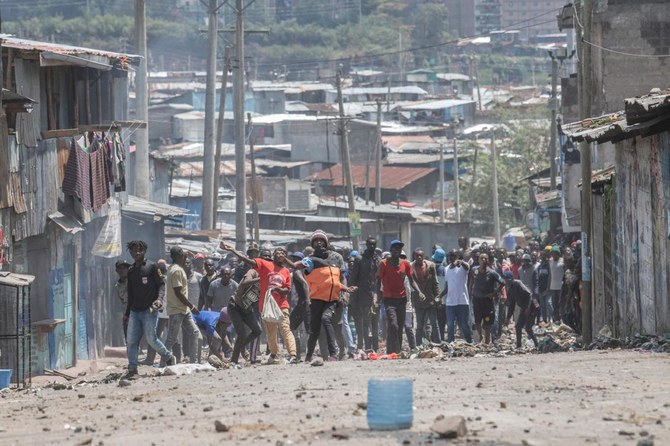
Police fire tear gas as fresh protests erupt in Kenya despite ban


Top UN court to hear Rohingya genocide case against Myanmar
THE HAGUE: Did Myanmar commit genocide against its Rohingya Muslim minority? That’s what judges at the International Court of Justice will weigh during three weeks of hearings starting Monday.
The Gambia brought the case accusing Myanmar of breaching the 1948 Genocide Convention during a crackdown in 2017.
Legal experts are watching closely as it could give clues for how the court will handle similar accusations against Israel over its military campaign in Gaza, a case brought to the ICJ by South Africa.
Hundreds of thousands of Rohingya Muslims fled violence by the Myanmar army and Buddhist militias, escaping to neighboring Bangladesh and bringing harrowing accounts of mass rape, arson and murder.
Today, 1.17 million Rohingya live crammed into dilapidated camps spread over 8,000 acres in Cox’s Bazar in Bangladesh.
From there, mother-of-two Janifa Begum told AFP: “I want to see whether the suffering we endured is reflected during the hearing.”
“We want justice and peace,” said the 37-year-old.
’Senseless killings’
The Gambia, a Muslim-majority country in West Africa, brought the case in 2019 to the ICJ, which rules in disputes between states.
Under the Genocide Convention, any country can file a case at the ICJ against any other it believes is in breach of the treaty.
In December 2019, lawyers for the African nation presented evidence of what they said were “senseless killings... acts of barbarity that continue to shock our collective conscience.”
In a landmark moment at the Peace Palace courthouse in The Hague, Nobel Peace laureate Aung San Suu Kyi appeared herself to defend her country.
She dismissed Banjul’s argument as a “misleading and incomplete factual picture” of what she said was an “internal armed conflict.”
The former democracy icon warned that the genocide case at the ICJ risked reigniting the crisis, which she said was a response to attacks by Rohingya militants.
Myanmar has always maintained the crackdown by its armed forces, known as the Tatmadaw, was justified to root out Rohingya insurgents after a series of attacks left a dozen security personnel dead.
‘Physical destruction’
The ICJ initially sided with The Gambia, which had asked judges for “provisional measures” to halt the violence while the case was being considered.
The court in 2020 said Myanmar must take “all measures within its power” to halt any acts prohibited in the 1948 UN Genocide Convention.
These acts included “killing members of the group” and “deliberately inflicting on the group conditions of life calculated to bring about its physical destruction in whole or in part.”
The United States officially declared that the violence amounted to genocide in 2022, three years after a UN team said Myanmar harbored “genocidal intent” toward the Rohingya.
The hearings, which wrap up on January 30, represent the heart of the case.
The court had already thrown out a 2022 Myanmar challenge to its jurisdiction, so judges believe they have the power to rule on the genocide issue.
A final decision could take months or even years and while the ICJ has no means of enforcing its decisions, a ruling in favor of The Gambia would heap more political pressure on Myanmar.
Suu Kyi will not be revisiting the Peace Palace. She has been detained since a 2021 coup, on charges rights groups say were politically motivated.
The ICJ is not the only court looking into possible genocide against the Rohingya.
The International Criminal Court, also based in The Hague, is investigating military chief Min Aung Hlaing for suspected crimes against humanity.
Another case is being heard in Argentina under the principle of universal jurisdiction, the idea that some crimes are so heinous they can be heard in any court.


